Why California for Public Health ?
California is a living public-health lab. More than 39 million residents are spread across megacities, coastal suburbs, agricultural valleys, mountain towns, and a long international border. That geography translates into hands-on learning: wildfire smoke and air-quality alerts, heat events, complex infectious-disease control, migrant and binational health, homelessness and housing, and large integrated delivery systems.
Table of Contents
Where you can learn while you study
- County & city health departments: disease surveillance, maternal/child health, chronic disease, harm reduction, preparedness.
- State programs: environmental health, epidemiology units, health equity initiatives, analytics and policy evaluation.
- Health systems & payors: population health analytics, quality improvement, implementation science, value-based care.
- Health-tech and data roles: product research, clinical informatics, outcomes measurement, dashboarding.
California-specific practice themes to lean into
- Climate & air quality: wildfire smoke, heat events, power shutoffs, risk communication.
- Infectious disease in context: Valley Fever (coccidioidomycosis) in the Central Valley/Central Coast; TB control; STI programs.
- Border/migrant health: language access, cross-jurisdiction data, culturally responsive models.
- Homelessness & housing: encampment outreach, behavioral health integration, harm reduction.
- Occupational & environmental: farmworker protections, ports/logistics, warehouse exposure assessments.
Bottom line: If you want applied public health with clear pathways into jobs, California is hard to beat. You can line up a practicum, collect real deliverables for your portfolio, and step into full-time roles without leaving the state.
Degree Pathways in California (and who each path fits)
Undergraduate (BA/BS in Public Health):
Good for entry-level roles (program coordinator, outreach, health educator) or as a launchpad to an MPH. Seek programs with capstones and community placements.

Master’s options (most readers’ target):
- MPH: Practice-oriented. Choose concentrations such as Epidemiology/Biostatistics, Health Policy & Management, Community Health, Environmental/Occupational Health, Global/Border Health, or Maternal & Child Health.
- MS (e.g., Biostatistics, Epidemiology): Methods-heavy. Better if you love coding, modeling, or plan to work in research analytics.
- MHA (often adjacent to SPH): Operations and leadership for health systems. Strong overlap with population health and quality.
Doctoral (DrPH vs PhD):
- DrPH: Leadership and applied systems work. Think program directors, executive public-health roles, cross-sector initiatives.
- PhD: Research and academia. Deep quantitative/qualitative training and grant-driven projects.
Online, hybrid, and accelerated formats:
California has multiple fully online or hybrid MPHs built for working professionals, plus selected accelerated options (≈11–18 months) depending on background and pacing. Always confirm time-to-degree, residency days (if any), and how practicum works for online students.
Quick fit guide
- Working full-time: Fully online/hybrid MPH with evening cohorts and practicum matching near your location.
- Data forward: MS Biostats or MPH Epi with R/Python/SQL, design of studies, and a health-system analytics practicum.
- Community/policy: MPH with community-based research, qualitative methods, and a county-department placement.
CEPH Accreditation (why, what to verify, and how to check in two minutes)
Why it matters: Employers and fellowships often prefer—or require—degrees from CEPH-accredited programs. Accreditation guarantees exposure to national core competencies: data analysis, leadership, evidence-based approaches, communication, and systems thinking.
What to verify before you apply
- Your degree and concentration appear in the CEPH Directory.
- The accreditation term is active (note next review date).
- The program clearly outlines the Applied Practice Experience (practicum) and Integrative Learning Experience (capstone).
Two-minute verification workflow
- Open the CEPH Directory.
- Filter State = California.
- Click your school/program → confirm your exact degree/concentration + dates.
Pro Tip: If your goal is a state or federal role in California (or programs like Cal-EIS), pairing CEPH accreditation with an in-state practicum gives you a clean hiring narrative.
Featured CEPH-Accredited Programs in California (curated highlights)
Use this to build your initial shortlist; always reconfirm details on the program page + CEPH Directory before submitting.
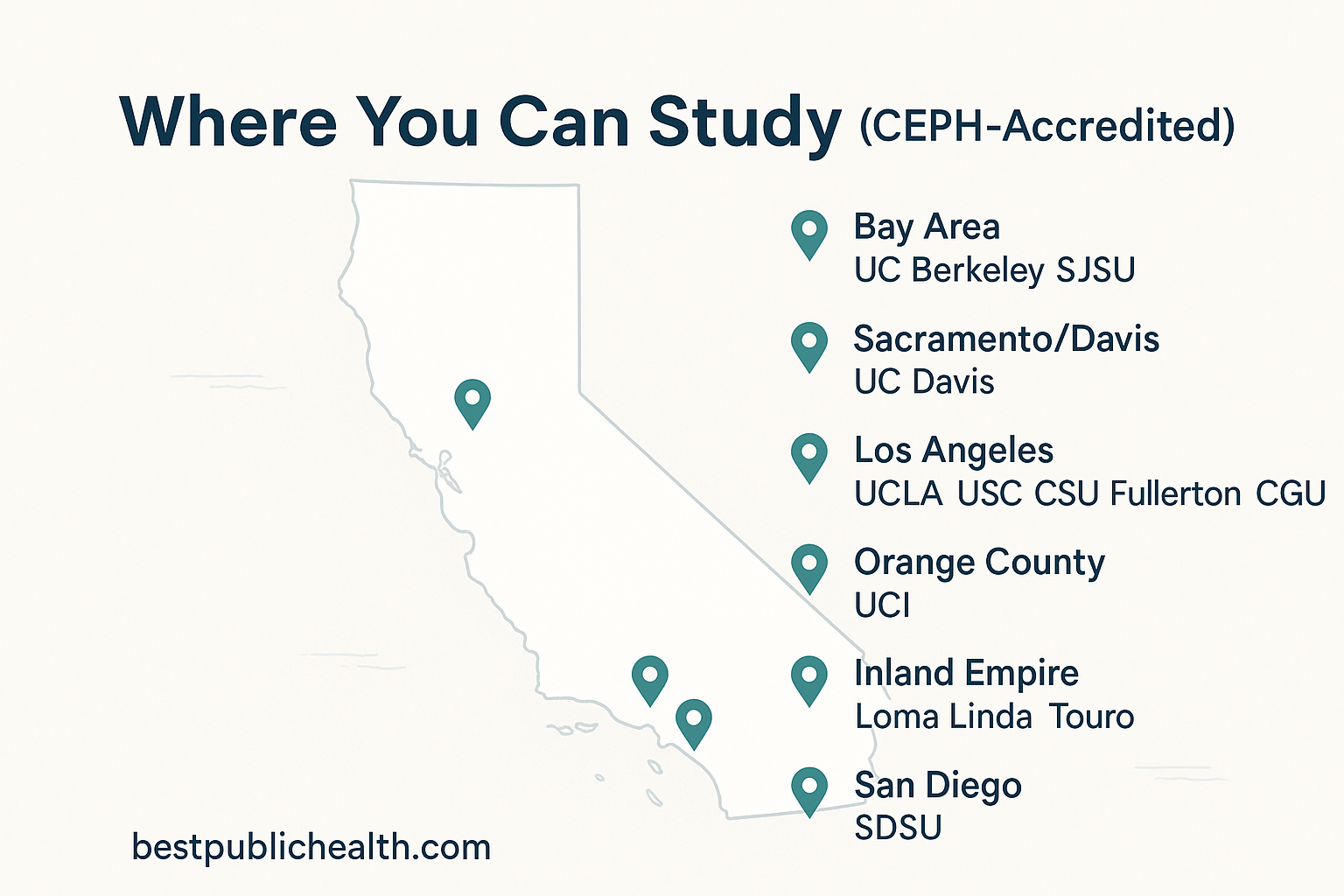
UC Berkeley — School of Public Health (Bay Area)
- Degrees: MPH (campus & online), DrPH, PhD.
- Good fit for: Breadth of concentrations, Bay Area health-tech/data opportunities, working professionals via Online MPH.
- Stand-out signals: Strong research networks; established practicum pipelines in the region.
UCLA — Fielding School of Public Health (Los Angeles)
- Degrees: MPH, MS, PhD; executive/working-pro options; joint degrees (e.g., MBA/MPH).
- Good fit for: Community health, policy, and LA County partnerships; large alumni network in SoCal.
- Stand-out signals: Deep bench of faculty and cross-department electives.
USC — Keck School of Medicine (Los Angeles)
- Degrees: MPH (on-campus & online).
- Good fit for: Flex formats with industry and health-system connections across LA; clear pathways for part-time students.
- Stand-out signals: Practicum sites spanning community orgs and large systems.
San Diego State University (SDSU) — School of Public Health
- Degrees: MPH, MS; joint PhD with UC San Diego (select areas).
- Good fit for: Border/Latinx health and binational collaborations; applied projects with local agencies.
- Stand-out signals: Strong community-engaged learning.
UC Davis — Master of Public Health (Sacramento/Davis)
- Degrees: In-person MPH with Epi/General tracks.
- Good fit for: Sacramento-area placements, state-level policy/epi exposure, practice-forward curriculum.
- Stand-out signals: Access to state agencies and legislative context.
UC Irvine — Program in Public Health (Orange County)
- Degrees: MPH, MS, PhD.
- Good fit for: Southern California placements and growing research strengths.
- Stand-out signals: Mix of practice-oriented and methods training.
Loma Linda University — School of Public Health (Inland Empire)
- Degrees: MPH (multiple concentrations), DrPH; online options.
- Good fit for: Service-oriented learners; online flexibility with fully remote study possible.
- Stand-out signals: Faith-based mission with community health emphasis.
San José State University (SJSU) — Dept. of Public Health & Recreation
- Degrees: MPH (Campus & Online, cohort model).
- Good fit for: Structured 2-year online cohort, strong community partnerships, often GRE-optional.
- Stand-out signals: Practice-heavy curriculum tailored to working students.
CSU Fullerton — Department of Public Health
- Degrees: MPH (Health Promotion; Environmental & Occupational Health; Epidemiology).
- Good fit for: CSU affordability and SoCal networks.
- Stand-out signals: Clear concentration choices and applied training.
Claremont Graduate University (CGU) — School of Community & Global Health
- Degrees: MPH (on-campus/online; select accelerated 12–18 month paths), DrPH; duals (MBA/MPH).
- Good fit for: Small-cohort experience with flexible pacing; policy/methods focus.
- Stand-out signals: Cross-school electives and leadership development.
Touro University California (Vallejo)
- Degrees: 100% Online MPH; MSPAS/MPH joint option.
- Good fit for: Learners needing no-residency online study while targeting California-based placements.
- Stand-out signals: Straightforward fully online structure.
Need the complete list? Use the CEPH Directory and filter by California; export results to track review dates and contacts.
How to Compare Programs (practical, not glossy)
Admissions (most will ask for):
- Bachelor’s degree + transcripts, Statement of Purpose, Resume/CV, 2–3 letters of recommendation.
- Quant prep: at least one statistics course (calc sometimes preferred for methods-heavy tracks).
- GRE: increasingly optional or not required; always verify per department/concentration.
Cost bands (budget the whole journey, not just per term):
- Public universities often use per-unit tuition + campus fees; privates list per-credit totals.
- Add cost of living: Bay Area/LA will run higher than Sacramento/Davis/OC.
- Ask for a full-program estimate (units × per-unit + mandatory fees) and confirm summer costs if you’ll enroll year-round.
Formats & pacing (your life still matters):
- Fully online vs hybrid vs in-person
- Cohort vs flexible enrollment (cohorts help with community; flexible helps with work)
- Evening/weekend availability
- Time-to-degree (accelerated 11–18 months vs standard ≈24 months)
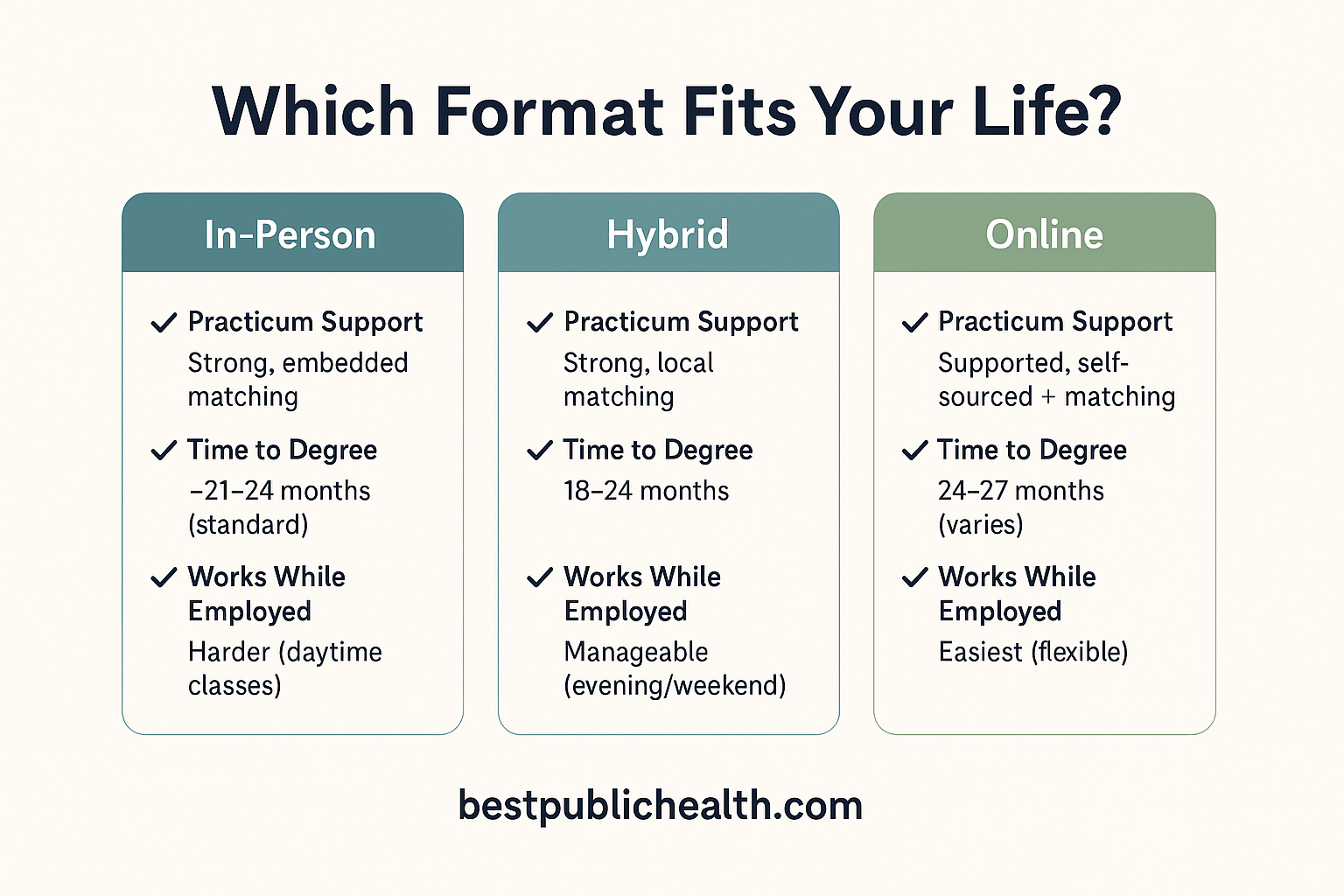
Practicum (where the real learning happens):
- Does the program match students to agencies or do you self-source?
- How many hours are required and can you complete them where you live/work?
- Are there California-specific sites (wildfire/air quality, Valley Fever, border health, homelessness, environmental/occupational)?
Your comparison table should include:
Delivery mode • Time to degree • Concentrations • Total estimated cost • GRE policy • Practicum support • Typical placements • Capstone format
Mini-Checklist (before you pay an app fee)
☐ CEPH status + next review date checked
☐ GRE policy confirmed for your track
☐ Stats prereq mapped (or plan to take it)
☐ Full-program cost estimated + living costs penciled in
☐ 2–3 practicum target sites identified in your metro
Funding & Scholarships (how to make this affordable)
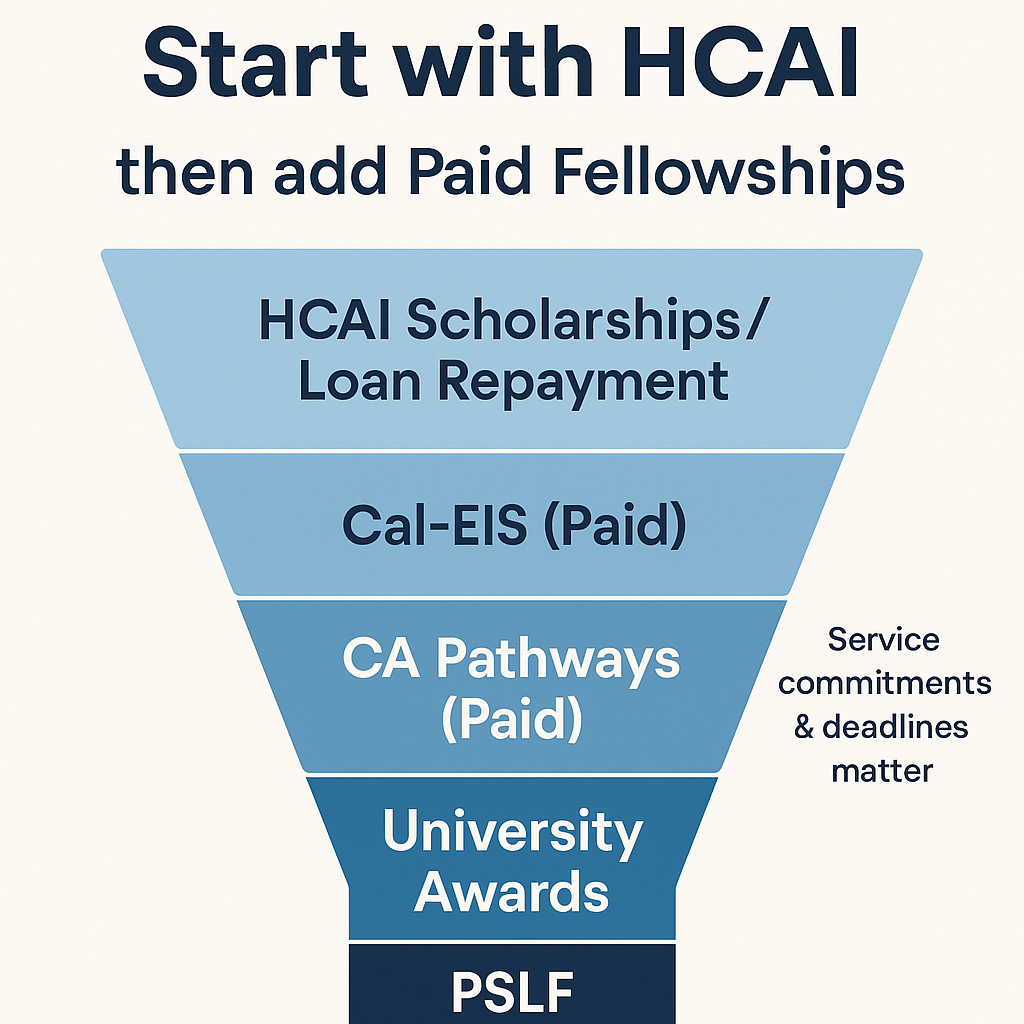
Start with California-specific options
- HCAI (Dept. of Health Care Access & Information): scholarships, grants, loan-repayment for service in underserved areas. Most awards have service commitments and strict deadlines—put them on your calendar.
- Cal-EIS (California Epidemiologic Investigation Service): paid, full-time, one-year applied epi fellowship with placements in CDPH or local health departments; excellent resume value.
- California Pathways into Public Health: paid 13-month placements in local agencies; strong conversion to staff roles.
Layer on the usual suspects
- University awards (departmental scholarships, Graduate/Teaching Assistantships).
- Federal support (when eligible): HRSA programs; Public Service Loan Forgiveness for qualifying public service employment after graduation.
- Local foundations & professional orgs (regional APHA affiliates, disease-specific societies).
Three-step funding game plan
- Price the program: total units × per-unit + mandatory fees + living.
- Submit HCAI + at least one paid fellowship application (Cal-EIS or Pathways) on a deadline tracker.
- Align your practicum with a county/state agency to build experience that helps you qualify for loan-repayment after graduation.
Pro Tip: If your budget is tight, combine a CSU or public-tuition option with a paid practicum/fellowship, then live in a lower-cost metro during study.
Career Outlook in California (what actually hires)
Who hires:
- Public sector: CDPH and county/city health departments across the state.
- Large systems: Kaiser, UC Health, major hospital networks, payors.
- Health-tech & analytics: Bay Area and LA firms focused on digital health, data platforms, and population analytics.
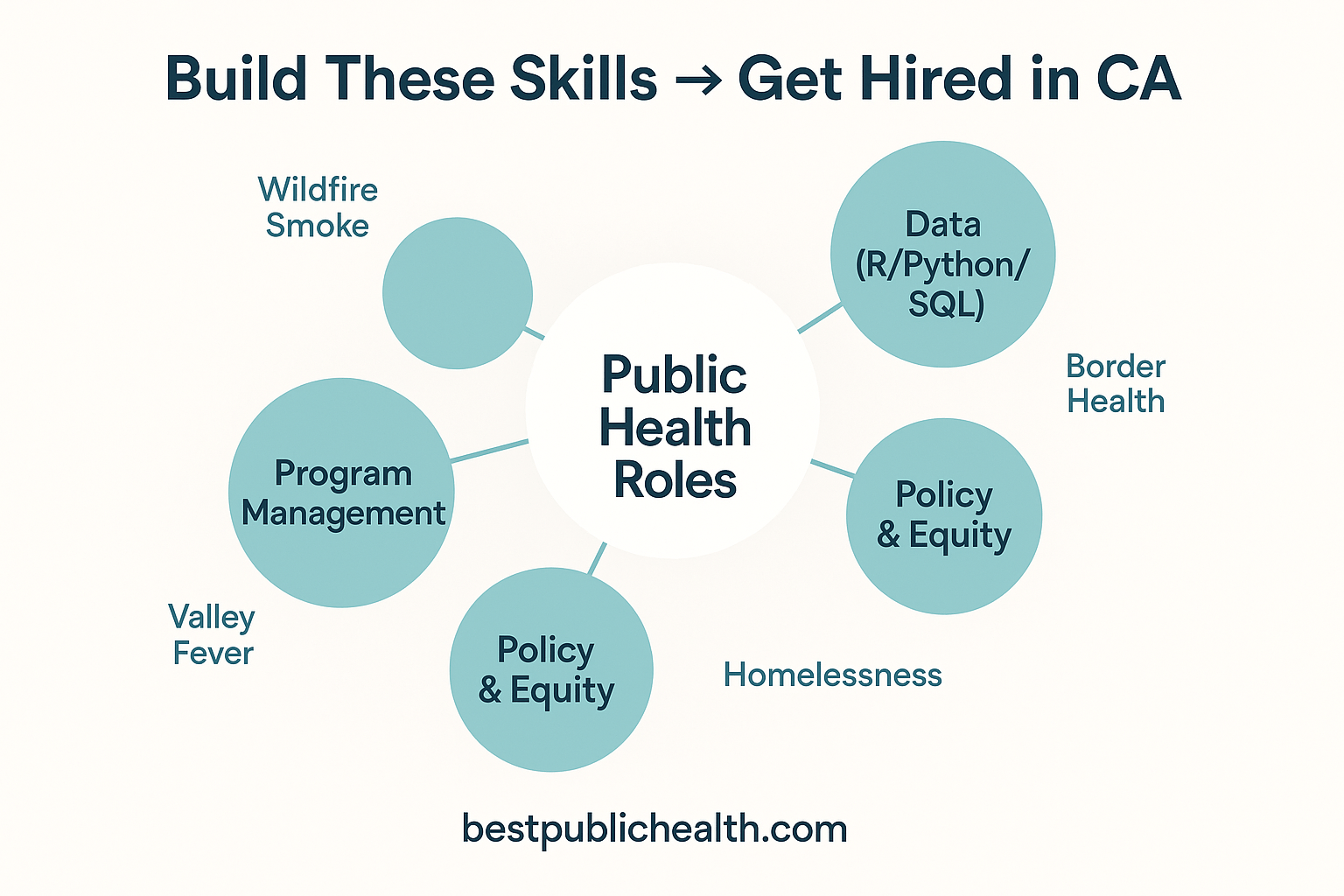
Roles with strong traction:
- Epidemiology & surveillance (respiratory disease, ID, environmental epi).
- Program management & evaluation (chronic disease, MCH, harm reduction).
- Environmental & occupational health (air quality, industrial hygiene, farmworker health).
- Data/analytics (R/Python/SQL, dashboarding, A/B or quasi-experimental evaluations).
- Policy & equity (community partnership, language access, cross-sector coalitions).
Skills that move your resume to the top:
- Coding: R, Python, SQL; reproducible workflows; version control.
- Evaluation & grants: logic models, budgeting, outcome frameworks.
- Risk communication: plain-language briefs, bilingual outreach, media coordination.
- Team delivery: stakeholder mapping, facilitation, “good meeting” habits.
Hiring signal: If you can show one California-relevant project (e.g., wildfire smoke exposure dashboard for a county) and one evaluation/grant deliverable, interviews come faster.
How to Choose: A Quick Decision Framework
Persona A — Working Professional
- Must-haves: online/hybrid, evening cohorts, remote-friendly practicum.
- Watch-outs: daytime practica that conflict with work; capstones that require business hours.
Persona B — Data-Led Analyst
- Must-haves: MS Biostats or MPH Epi with R/Python/SQL, design of studies, real datasets.
- Watch-outs: programs light on coding or with only spreadsheet-level analysis.
Persona C — Community/Policy Advocate
- Must-haves: county placements, qualitative methods, health equity coursework.
- Watch-outs: programs with limited community partnerships or narrow practicum choices.
Five “deal-breaker” questions
- Does the format fit your life for the next 18–24 months?
- Are the practicum partners aligned to the job you want after graduation?
- Can you afford the full cost (tuition + fees + living) without derailing your finances?
- Are CEPH status and GRE policy crystal clear for your concentration?
- Will electives build the exact skills your target employers ask for?
FAQs
How many CEPH-accredited options are in California?
Dozens across 20+ universities. Confirm on the CEPH Directory and check the review date.
Which schools often rank highly?
UC Berkeley and UCLA are frequently near the top. SDSU, UC Davis, USC, UCI, SJSU, CGU, Touro, and CSUs offer strong fits by specialty and format.
Is the GRE required?
Often no, but it varies by school and concentration. Always check the exact program page.
Can I work full-time during an MPH?
Yes, if you pick online/hybrid formats with evening courses and arrange a practicum that fits your schedule.
What California-specific focus areas can I pursue?
Wildfire smoke/air quality, Valley Fever, border/migrant health, homelessness/housing, environmental/occupational, and health-tech/data roles.
Is a practicum required?
Yes. CEPH programs include an Applied Practice Experience and a capstone. Hours and settings vary—confirm details with your program.
What about pay?
Compensation is generally higher than U.S. averages in major metros (SF Bay Area, Los Angeles). Check role-specific wage ranges when planning.
Are dual degrees available?
Yes—MBA/MPH, MSW/MPH, MD/MPH, and more. Timelines and admissions differ by campus.
Next Steps & Implementation Checklist
This week
- Shortlist 5–7 programs (fit = concentration + format + location).
- Verify CEPH status and GRE policy for your track.
- Rough-out a full-program cost (units × per-unit + fees + living).
This month
- Email 2–3 practicum sites in your metro to learn about timelines and onboarding.
- Build a funding calendar (HCAI + at least one paid fellowship: Cal-EIS or Pathways).
- Draft an SOP that connects your goals to California issues and each program’s practicum strengths.
Before you submit
- Confirm stats prereq (or register for it).
- Update your resume with impact bullets (verbs + metrics).
- Ask recommenders early and share your one-page goals sheet.
Internal Links
