A graduate certificate in public health is a for-credit, graduate-level program offered by a university (often fully online) that covers core public health skills without requiring you to commit to a full MPH right away. The smart way to use it is either to upskill fast (while working) or to “test-drive” public health and later apply the credits toward an MPH when the school allows it. (bulletin.gwu.edu)
Table of Contents
Fast facts (what matters in real decisions)
- Online options are common (some programs are explicitly 100% online). (University of Louisville)
- “No GRE” is often advertised for certificate admission (but always verify on the program page). (University of Louisville)
- Some certificates are “stackable” into an MPH (credits may apply toward an MPH at the same institution under specific rules like time limits and minimum grades). (bulletin.gwu.edu)
- Accreditation language matters: CEPH accredits schools of public health and public health programs (not “random certificates”), so you should describe certificates as being offered by a CEPH-accredited school/program when applicable. (Ceph)
- If you care about the CPH credential, schools/programs that are CEPH-accredited or CEPH-applicant determine which students are eligible to sit for the exam. (NBPHE)
Who this 2026 guide is for
- You want a U.S.-based, for-credit public health credential you can complete online while working.
- You’re deciding between a certificate and an MPH and you want a route that doesn’t waste credits if you continue later. (bulletin.gwu.edu)
- You want clear filters (online, no-GRE, cost signals, stackable-to-MPH) instead of generic “top 10” fluff.
What you’ll get on this page
- A U.S. program directory (online/hybrid, credits, typical duration, “No GRE” where published, and whether credits can apply to an MPH where the school states it). (bulletin.gwu.edu)
- A short decision framework: pick the certificate that matches your goal (career switch, clinical upskilling, MPH pathway).
- A FAQ written to answer the exact questions people ask Google/AI tools in 2026.
What counts as a “graduate” public health certificate in the U.S. (and what doesn’t)
A graduate certificate (the one you actually want)
A graduate certificate is a credit-based academic credential offered by a university, made up of graduate-level courses (the kind that appear on an official transcript and can sometimes be applied toward further graduate study). (Harvard Extension School)
In plain terms: if it has credit hours and it’s run through a university’s academic/graduate structure, it’s the real thing. If it’s just a “certificate of completion,” it’s usually not.
The non-credit certificate trap (what wastes your time)
Many “public health certificates” online are non-credit / continuing education programs. These can teach useful skills, but they generally cannot be used toward a credit degree (like an MPH). (Alvin College Home)
Brutal truth: if your goal is “this should help me progress into an MPH,” non-credit certificates are often dead ends.
How to tell the difference in 60 seconds (use this checklist)
On the program page, look for:
Green flags (credit-bearing graduate certificate):
- Explicit credit hours (e.g., “12 credits,” “18 credits”)
- Language like “graduate-level courses” or “academic credit” (Harvard Extension School)
- Hosted by a university/graduate school or academic department (not just “continuing education”)
Red flags (non-credit / completion certificate):
- Says noncredit, CEUs, or “certificate of completion” (Alvin College Home)
- No mention of credit hours anywhere
- Marketing focuses on “quick skill” with no academic structure
Why this matters for your MPH path
Some universities design graduate certificates specifically to let you take MPH-style coursework without committing to the full degree (and in some cases those credits can later count toward the MPH under stated rules). (College of Public Health)
Graduate Certificate vs MPH in the U.S. (2026): which one should you choose?
If your goal is speed + flexibility, a graduate certificate is the smarter move. If your goal is a full public health credential with practicum/capstone training, you want the MPH.
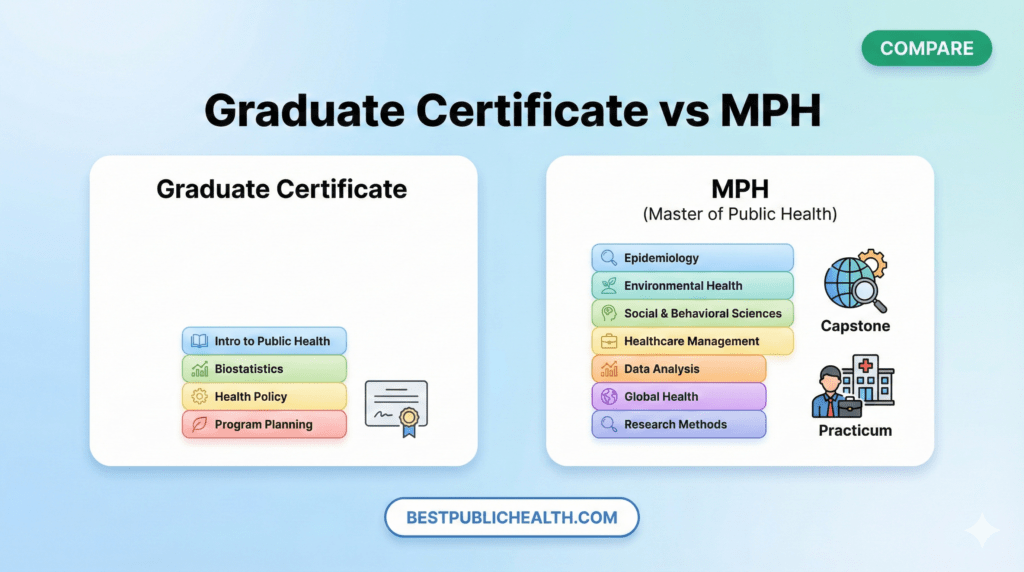
The simplest decision rule
- Choose a Graduate Certificate if you want a for-credit credential fast, you’re testing public health before committing, or you specifically want a stackable pathway into an MPH (only when the school clearly allows it). (Department of Public Health)
- Choose an MPH if you want the standard professional degree with a larger curriculum load and real applied training (practicum/capstone). (coloradosph.cuanschutz.edu)
What changes in real life (not marketing)
Workload & credits
- Graduate certificates are commonly ~12–18 credits (varies by school/program). (ech.charlotte.edu)
- Many MPH programs are 42+ credits. (sph.umich.edu)
Timeline
- Many MPH programs are built so students can finish in about two years (full-time), with part-time timelines varying by school. (sph.umich.edu)
Applied training
- MPH programs often require a practicum/capstone or internship-type experience (this is a major difference vs many certificates). (coloradosph.cuanschutz.edu)
Admissions friction
- Some graduate certificates explicitly say GRE is not required—but you must verify per program. (Department of Public Health)
The “stackable into MPH” question (don’t assume—verify)
Some universities clearly state that certificate coursework can be applied to an MPH after you’re admitted, sometimes with rules like minimum grades or other conditions. (Department of Public Health)
Before you enroll, check these 3 things on the official program pages:
- How many credits can transfer (some say “all,” some say “some”). (Zuckerman College of Public Health)
- Grade requirement (example: “B or better”). (Department of Public Health)
- Whether it’s only valid within the same university (most of the time, yes).
Accreditation reality check (USA)
When accreditation matters to you, remember CEPH accredits schools of public health and public health programs (not random “certificates” floating on the internet). So phrase it correctly: “certificate offered by a CEPH-accredited school/program,” when that’s true. (Ceph)
Admissions in 2026: No GRE, prerequisites, and what to check before you apply
Most U.S. online public health graduate certificate programs admit applicants with a bachelor’s degree and a minimum GPA threshold, and they typically evaluate you using a holistic review of transcripts + résumé + statement of purpose. The GRE is often not required, but you must verify it on the official program page because rules differ by school and sometimes by concentration. (College of Public Health)
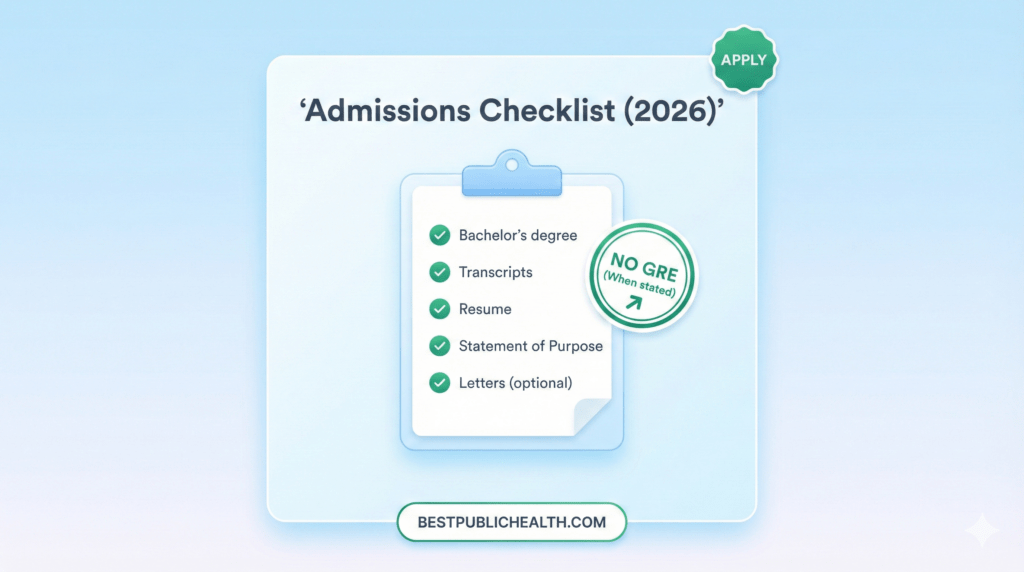
Common baseline requirements (what shows up again and again)
- Bachelor’s degree (U.S.-equivalent). Some schools explicitly state there’s no specific major required. (College of Public Health)
- Minimum GPA (varies; examples include thresholds like 2.5–2.75+ depending on the school). (College of Public Health)
- Transcripts (official). (College of Public Health)
- Résumé/CV is commonly required. (Michigan State University Public Health)
- Statement of purpose / goals statement is common. (Department of Public Health)
- Letters of recommendation are sometimes required (not universal). (Department of Public Health)
“No GRE” in 2026: common, but don’t assume
Several universities explicitly state GRE not required for their public health graduate certificate admissions (or specific certificate tracks). (Milken Institute School of Public Health)
What to do with this as a user:
- Treat “No GRE” as a filter in your program list, not a blanket promise.
- If a page doesn’t explicitly say it, assume it might still be required or conditionally waived.
International applicants (USA-based online programs)
If your prior degree is non-U.S., many programs require credential evaluation and English proficiency scores (TOEFL/IELTS). One example program guide spells out specific minimum TOEFL/IELTS requirements. (Milken Institute School of Public Health)
Application checklist
Before you apply to any 2026 program, confirm on the official page:
- Degree requirement (bachelor’s / U.S.-equivalent) (College of Public Health)
- Minimum GPA (Iowa Public Health)
- GRE requirement (yes/no/waiver) (Milken Institute School of Public Health)
- Required docs: resume, SOP, recommendations (Department of Public Health)
- International: TOEFL/IELTS + transcript rules (Milken Institute School of Public Health)
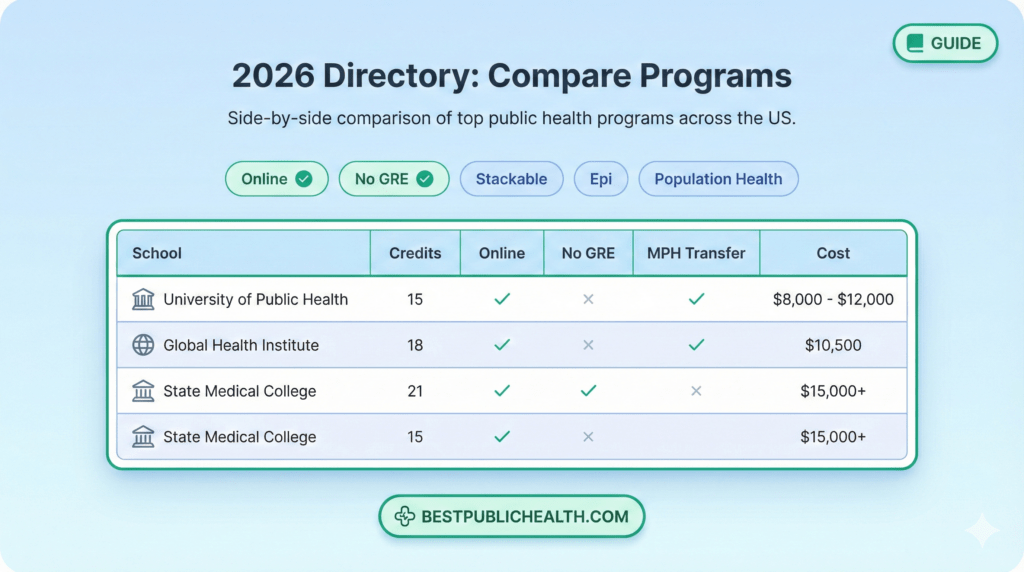
You’re right to call this out: without a curated, sourced programs list, this pillar is just another useless blog post. Here’s a 2026 USA shortlist you can publish as the “core directory” (then expand over time).
2026 U.S. Online Public Health Graduate Certificate Programs
For-credit programs you can compare by No-GRE admission, credits, and MPH credit transfer (when stated by the school)
| School (USA) | Program name | Delivery (as stated) | Credits (as stated) | No GRE (as stated) | Can count toward MPH (as stated) | Source |
|---|---|---|---|---|---|---|
| University of Louisville | Graduate Certificate in Public Health Training | 100% online | 12 | Yes | Not stated | (University of Louisville) |
| University of North Dakota | Public Health Certificate | 100% online or on-campus | Not stated | Yes | Not stated | (UND) |
| University of Missouri (MU) | Graduate Certificate in Public Health | 100% online | 12 | Not stated | Not stated | (Mizzou Online) |
| UW–Eau Claire | Graduate Certificate in Public Health | 100% online | 12 | Not stated | Yes (“fully transferrable into MPH”) | (UW-Eau Claire) |
| UMass Amherst | Graduate Certificate in Public Health | Fully online | 12 | Not stated | Not stated | (UMass) |
| Georgia State University | Graduate Certificate in Public Health | Online | 16 | Not stated | Not stated | (Georgia State Online) |
| Texas Tech Univ. Health Sciences Center | Graduate Certificate in Public Health | Online | 15 | Not stated | Yes (courses may be applied to MPH) | (Texas Tech Health Sciences) |
| University of Kansas Medical Center | Public Health certificate programs (MPH pathway) | Fully online | Not stated | Not stated | Yes (credit hours may be applied to MPH) | (University of Kansas Medical Center) |
| George Washington University | Public Health Graduate Certificate | Online or on-campus | 15 | Not stated | Yes (credits can be applied to MPH) | (George Washington University Bulletin) |
| University of New England (UNE) | Graduate Certificate in Public Health | 100% online | 18 | Yes (program guide) | “Path” to further graduate study (general) | (UNE Online) |
| University of North Texas Health Science Center | Graduate Certificate in Public Health | 100% online | 15 | Not stated | Yes (apply 15 credits to MPH with B or better, if admitted) | (UNT Health Fort Worth) |
| Florida International University (FIU) | Graduate Certificate in Public Health Foundations | Not stated | 18 | Not stated | Not stated | (Stempel College) |
| Idaho State University | Graduate Certificate in Public Health | Fully online | 18 | Not stated | Not stated | (Idaho State University) |
| University of Michigan–Flint | Graduate Certificate in Public Health | 100% online | 10 | Not stated | Not stated | (University of Michigan-Flint) |
| Oregon State University | Graduate Certificate in Public Health | Not stated (OSU Ecampus runs online) | Not stated | Not stated | Yes (credits may be applied/transferred to OSU MPH with approval/policy) | (Office of Graduate Education) |
| Des Moines University | Graduate Certificate in Public Health (Practice) | 100% online | 15 | Not stated | Yes (can be applied toward MPH) | (Des Moines University Academic Catalog) |
2026 U.S. Graduate Certificates Related to Public Health
Epidemiology, Population Health, Global Health, Informatics, and other focused tracks (online options included)
| School (USA) | Program name | Delivery | Credits | No GRE | Stack/Apply to MPH or other grad degree | Source |
|---|---|---|---|---|---|---|
| CUNY School of Public Health | Advanced Certificate in Public Health | Not stated | 15 | Not stated | Yes (may be applied to CUNY MPH) | (sph.cuny.edu) |
| Loyola University Chicago | Public Health Certificate | Not stated | 12 | Yes (for certificate) | Yes (credits may be applied to Loyola MPH) | (luc.edu) |
| University of Oklahoma | Population Health Graduate Certificate | 100% online | 12 | Not stated | Not stated | (OU Online) |
| University of Kentucky | Graduate Certificate in Population Health | Online | Not stated | Yes | Not stated | (online.uky.edu) |
| UIC (University of Illinois Chicago) | Public Health Informatics certificate | Not stated | Not stated | Not stated | Yes (academic credit may be applied toward MPH) | (publichealth.uic.edu) |
| UNC Online | Graduate Certificate in Global Health | Online | Not stated | Yes | Not stated | (online.unc.edu) |
| Creighton University | Global Health Promotion Graduate Certificate | Not stated | 15 | Not stated | Yes (credits can be applied to MPH) | (creighton.edu) |
| UMass Lowell | Online Graduate Certificate in Epidemiology | Online | Not stated | Yes | Not stated | (gps.uml.edu) |
| Benedictine University | Graduate Certificate in Epidemiology | Online | Not stated | Yes | Positioned as part of MPH electives | (Benedictine University) |
Cost, duration, and workload in 2026: how to compare programs without getting fooled
Quick answer (AEO)
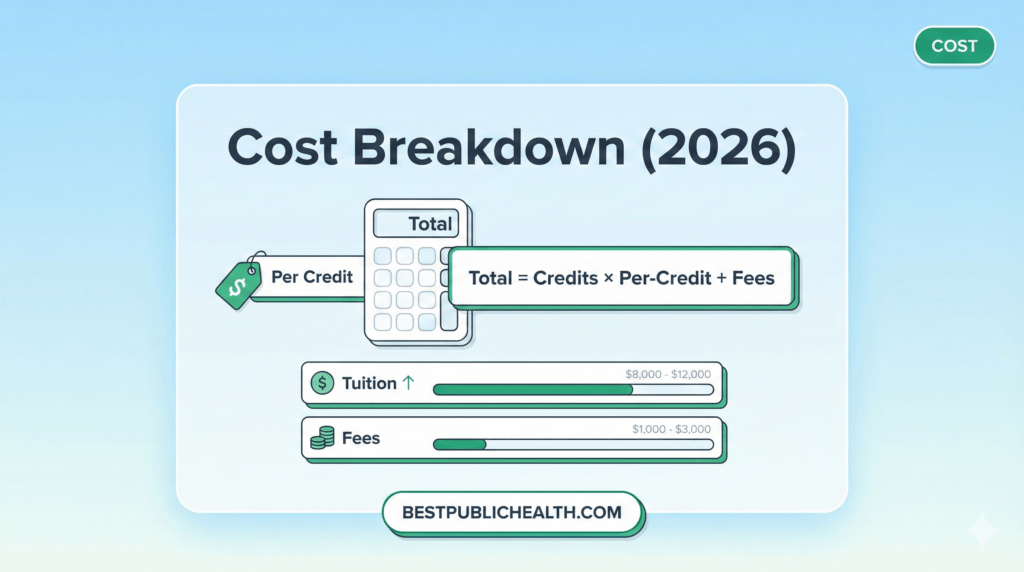
In the U.S., most online public health graduate certificates price tuition per credit hour, and the total cost is usually (credits × per-credit tuition) + required fees. The “real” total varies a lot by school, so you should compare programs using published per-credit tuition + published fees, not marketing phrases like “affordable.” (GW Student Accounts)
How tuition is usually charged (and what people miss)
Most common billing model: per credit hour. (GW Student Accounts)
What people forget to include: semester/term fees, technology fees, enrollment fees, and course-specific fees. (une.edu)
Your comparison rule (simple and correct):
- Confirm total credits (12, 15, 18, etc.)
- Confirm tuition per credit (published)
- Add required fees (published)
- Then compare totals
Real cost examples (published by universities)
These are not “estimates” from random blogs—these are school-published numbers.
Example 1 — University of New England (UNE)
- Tuition: $860 per credit hour (2025–2026 published) (une.edu)
- Also lists per-semester fees (technology + service fees) (une.edu)
What that means: an 18-credit certificate would be $15,480 in tuition (18 × 860), before semester fees/books.
Example 2 — George Washington University (GWSPH)
- Graduate certificate tuition: $1,555 per credit (FY26 table) (GW Student Accounts)
- Also lists an enrollment fee for graduate programs/certificates (GW Student Accounts)
What that means: a 15-credit certificate would be $23,325 in tuition (15 × 1,555), before fees.
Bottom line: even within “public health graduate certificates,” per-credit tuition can differ massively across U.S. schools. (une.edu)
Credits and duration (what “normal” looks like)
Many certificate programs are built around ~12–18 credits, often aligning with MPH core coursework (example: a 15-credit certificate made of core public health concept courses). (UNT Health Fort Worth)
Duration depends on pacing, not just credits:
- If you take 1 course at a time while working, you’ll finish slower but with less weekly pressure.
- If you take 2 courses at a time, you finish faster but the workload spikes.
(You’ll document the real durations in your directory row-by-row using the school’s own pages.)
Workload (honest framing)
Schools market these to working professionals and emphasize flexibility, which usually means the workload is manageable if you choose the right pacing (1 course vs 2). (UNT Health Fort Worth)
If your page doesn’t show credits + pacing examples, readers won’t trust it.
“Total cost range” statement (keep it defensible)
Based only on published examples above, tuition alone for a U.S. online public health graduate certificate commonly lands somewhere between:
- ~$10k (12 credits × $860/credit) and
- ~$28k (18 credits × $1,555/credit),
before fees/books. (une.edu)
Can a public health graduate certificate count toward an MPH?
Sometimes, yes — but only under the university’s written policy. In many U.S. schools, a for-credit public health graduate certificate is designed as an MPH “on-ramp,” meaning the coursework may count toward an MPH if you’re later admitted to the MPH and meet conditions like minimum grades, time limits, and transfer/approval rules. (UNT Health Fort Worth)
How “stackable into an MPH” usually works in the U.S.
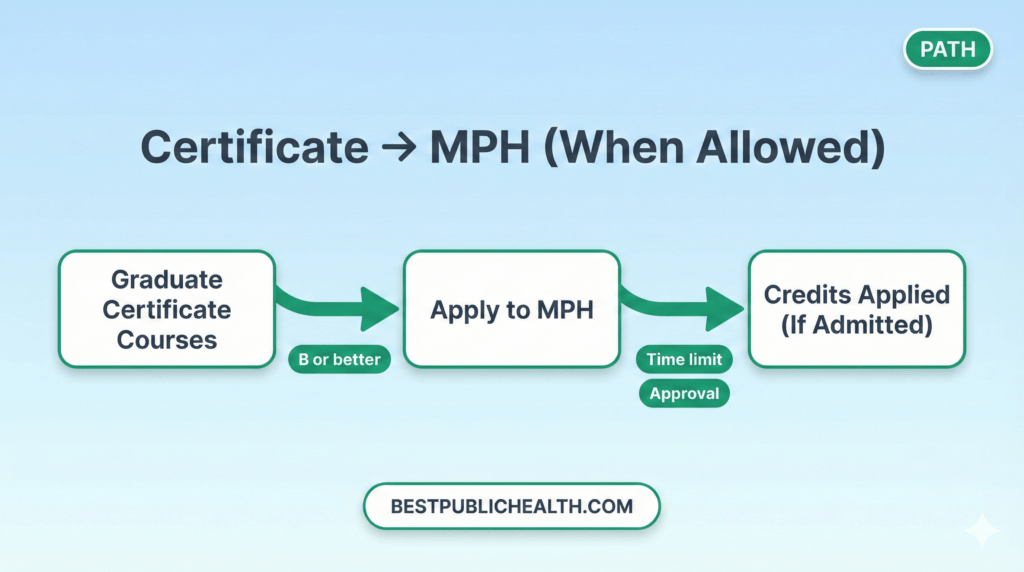
Most programs follow this pattern:
- You complete certificate courses as a non-degree/certificate student.
- You apply to the MPH (admission is not automatic). (Office of Graduate Education)
- If admitted, the school decides how many certificate credits can be applied to the MPH (sometimes all, sometimes some, sometimes none). (ecampus.oregonstate.edu)
What schools actually say
- All credits can apply (with conditions): UNT Health Science Center states that if certificate students earn B or better in each course and are admitted to the MPH, they may apply all 15 credits to the MPH. (UNT Health Fort Worth)
- Courses may be applied to the MPH: Texas Tech University HSC says its 15-credit certificate courses may be applied to its 45-credit MPH. (ttuhsc.edu)
- Credits can be applied toward an MPH: GW’s bulletin states the 15 credits completed for the certificate can be applied toward an MPH (and notes a completion time limit for the certificate). (bulletin.gwu.edu)
- With approval + transfer policy: Oregon State says certificate credits may be applied to the MPH with approval, are subject to transfer credit policy, and completing the certificate does not guarantee MPH admission. (Office of Graduate Education)
- General policy statement: UTHealth Houston notes certificate courses may be applied toward a degree program as transfer credits. (catalog.uth.edu)
- Admission is required (not guaranteed): UT Health San Antonio explicitly says certificate completers must apply to the MPH and admission is not automatic/guaranteed. (catalog.uthscsa.edu)
The 6 things you must verify before enrolling (so you don’t waste credits)
Check these on the official program/campus catalog page (or get it in writing from the program office):
- Are credits applicable to the MPH at all? (explicit “may/can be applied”) (ttuhsc.edu)
- How many credits? (some say all, others are vague) (UNT Health Fort Worth)
- Minimum grade requirement (example: “B or better”) (UNT Health Fort Worth)
- Approval/transfer policy (advisor approval, residency limits, transfer rules) (Office of Graduate Education)
- Time limits (certificate completion window; sometimes credits “age out”) (Milken Institute School of Public Health)
- Admission is not guaranteed even if you finish the certificate. (Office of Graduate Education)
Accreditation and trust signals in 2026 (what matters and what doesn’t)
What CEPH accreditation actually means
In U.S. public health education, CEPH is the main specialized accreditor. CEPH is recognized by the U.S. Department of Education and accredits schools of public health and public health programs (including programs outside schools of public health)—not “random standalone certificates.” (Ceph)
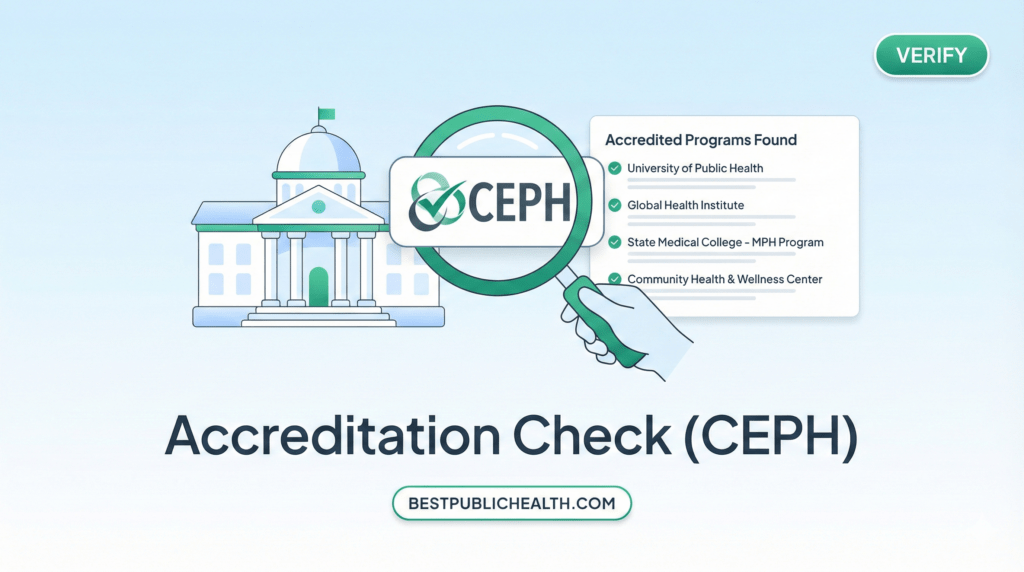
So the correct way to say it is:
- ✅ “This certificate is offered by a CEPH-accredited school/program.”
- ❌ “This certificate is CEPH-accredited” (usually misleading phrasing).
Why you should care (and when you shouldn’t)
You should care about CEPH if:
- You want maximum credibility for employers and future graduate pathways.
- You care about eligibility pathways tied to CEPH-accredited/applicant schools/programs (for example, some CPH exam eligibility routes depend on your school/program confirming you’re eligible). (NBPHE)
You shouldn’t obsess over CEPH if:
- Your goal is purely skill-building and your target jobs don’t care about formal public health credentials (rare in “public health” roles, more common in adjacent roles).
How to verify accreditation quickly (no guessing)
- Use CEPH’s search tool or the accredited schools/programs list to confirm the university’s public health school/program status. (Ceph)
- Match what you find there with what the program page claims (don’t trust banners or marketing copy alone).
- Record it in your directory as: “Offered by CEPH-accredited school/program: Yes/No” (and link the proof).
Other trust signals you should include in your directory (2026-proof)
- Clear credit hours + curriculum (if a page won’t state credits or courses, that’s a red flag).
- Transparent tuition and fees (avoid programs that hide real costs until after inquiry).
- Published admissions requirements (especially if they claim “No GRE”).
- A defined pathway statement if they advertise stacking/transfer to an MPH (the page should spell out conditions).
How to choose the right program in 2026 (a simple decision framework)
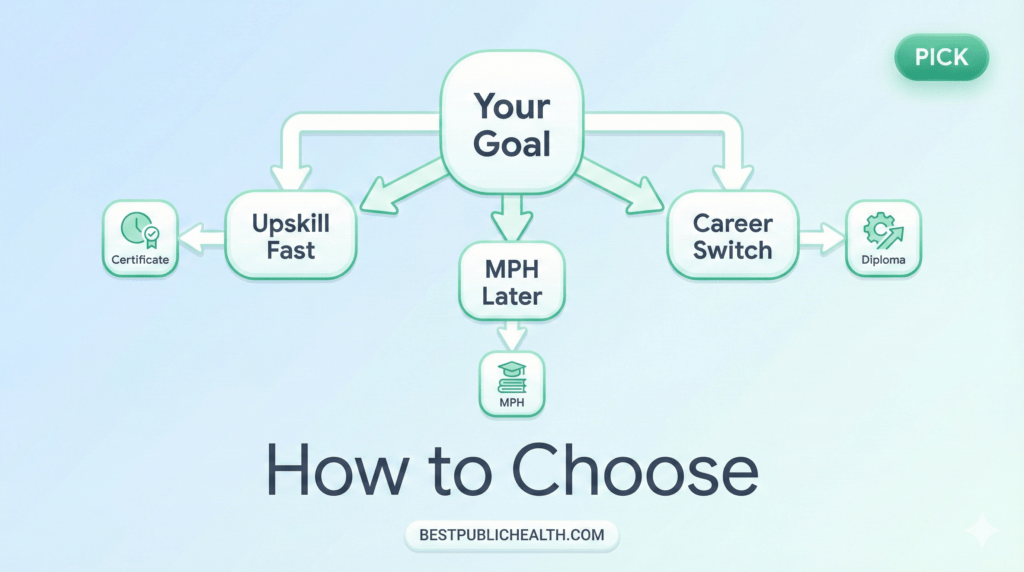
1) Start with your goal (don’t browse randomly)
Pick the program type that matches what you’re actually trying to do:
- “I want MPH later, but I’m not ready.” → prioritize certificates that explicitly say credits can be applied to an MPH and spell out the conditions. Example policies exist, but they vary a lot. (Office of Graduate Education)
- “I want a credential fast while working.” → prioritize programs that publish a clear pacing pattern and realistic finish time (many are built for working professionals and can be finished in ~1 year depending on pacing). (UNT Health Fort Worth)
- “I want credibility and fewer surprises.” → confirm the program is offered by a CEPH-accredited school/program (verify in CEPH’s database, not marketing banners). (Ceph)
2) Verify it’s a real graduate certificate (for-credit)
If the page doesn’t clearly state credit hours and the courses, you’re gambling. Legit programs are explicit (e.g., 15 credits built from core MPH courses). (UNT Health Fort Worth)
3) If “counts toward an MPH” matters, treat it like a contract
Do not assume “stackable” means anything.
What you want to see in writing:
- Credits may apply to the MPH (clear statement). (Office of Graduate Education)
- Conditions: grade thresholds (often B or better), GPA requirements, and a process to transfer/change into the degree. (UNT Health Fort Worth)
- Reality check: completing the certificate does not guarantee MPH admission (many schools state this explicitly). (Office of Graduate Education)
4) Compare time-to-finish based on pacing, not hype
A certificate can be “one year” on paper, but only if the course rotation supports it. Some programs even spell out a typical schedule (e.g., 2 courses fall, 2 spring, 1 summer). (UNT Health Fort Worth)
5) Use trustworthy program finders for discovery, then verify on the school page
For building/expanding your directory:
- Use ASPPH’s Academic Program Finder to discover programs. (programfinder.aspph.org)
- Use CEPH’s search/list to validate accreditation status. (Ceph)
Red flags (skip these programs unless you like wasting time)
- No clear credit hours, course list, or completion rules.
- Vague “may transfer” language with no conditions (grade, GPA, approval, time window). (George Washington University Bulletin)
- Claims that imply admission is automatic (many schools explicitly say it isn’t). (Office of Graduate Education)
- Accreditation claims that don’t match CEPH’s database. (Ceph)
Frequently asked questions (2026)
Is an online public health graduate certificate worth it?
It’s worth it if you need a for-credit credential quickly, want to upskill while working, or want a low-risk way to start MPH-level coursework before committing to a full degree. Programs openly market this as a flexible option for working professionals. (UNT Health Fort Worth)
Do I need the GRE?
Often, no—but it’s program-specific. Some universities explicitly state “No GRE required for admission.” (University of Louisville)
How many credits is a typical graduate certificate?
A lot of U.S. public health graduate certificates fall in the 12–18 credit range (examples exist at 12, 15, and 18 credits). (University of Louisville)
How long does it take to complete?
It depends on pacing and course rotation. Some schools set a hard limit—for example, completion within two years is stated for a public health graduate certificate at GW. (George Washington University Bulletin)
How much does it cost?
Costs vary widely because most schools charge per credit plus fees. Example: UNE lists $860 per credit for its certificate and shows a typical total cost for 18 credits, plus semester fees. (UNE Online)
GWSPH lists $1,555 per credit for graduate certificates (FY26) and also lists an enrollment fee. (GW Student Accounts)
Can the certificate credits count toward an MPH?
Sometimes. Some schools explicitly allow it if you’re later admitted to the MPH and meet conditions. For example, UNT Health Science Center states certificate students who earn B or better and are admitted to the MPH may apply all 15 credits toward the MPH. (UNT Health Fort Worth)
GW’s bulletin also states the 15 credits completed for the certificate can be applied toward an MPH. (George Washington University Bulletin)
Does finishing the certificate guarantee MPH admission?
No. Policies often make it clear that completing a certificate does not automatically admit you into the degree program; admission is a separate decision. (sph.uth.edu)
Does CEPH accredit graduate certificates?
CEPH is recognized to accredit schools of public health and public health programs outside schools of public health—so you should describe a certificate as being offered by a CEPH-accredited school/program (when true), rather than claiming the certificate itself is “CEPH-accredited.” (Ceph)
Can a graduate certificate help with the CPH credential?
It can be relevant depending on your situation. NBPHE notes that students in non-degree certificate programs should contact NBPHE staff for application instructions, and it references CEPH status in its eligibility guidance. (NBPHE)
What’s the biggest mistake people make when choosing a program?
Assuming “online public health certificate” always means for-credit graduate coursework and assuming “stackable to MPH” is automatic. Only trust what the university publishes (credits, transfer rules, grade requirements, time limits) and record those exact statements in your program table. (UNT Health Fort Worth)
Internal Links:
Accelerated 1-Year MPH Programs (2025 Guide): Accredited 12-Month MPH Options
Best Online MPH Programs 2025 (CEPH-Accredited)
