Introduction
Looking for CEPH-accredited MPH programs in Texas—including online MPH options you can complete from anywhere? This page gathers every accredited program in one place and makes it easy to scan delivery format, concentrations, typical timelines, GRE policy, and tuition bands. Use the quick filters below to shortlist best-fit programs, then save the page and set deadline alerts so you never miss priority dates. Each entry links to the official school page so you can verify details before you apply.
Table of Contents

Quick Filters (Jump straight to what fits you)
Narrow your list in seconds. These filters map directly to the table and mini-profiles further down the page.
- Delivery: Online • Hybrid • On-Campus
Choose Online if you need maximum flexibility; Hybrid for occasional campus intensives; On-Campus for full immersion and local practicum access. - City / Region: Houston • Dallas–Fort Worth • Austin • San Antonio • Other Texas cities
Useful if you’re targeting local practicum sites or a specific employer network (e.g., big hospital systems or local health departments). - Concentration: Epidemiology • Health Policy & Management • Global Health • Biostatistics • Environmental & Occupational Health • Community Health
Pick your intended career path first (e.g., epi analyst, policy associate), then match the concentration. - GRE Requirement: Required • Waived/Optional • Not Required
Many Texas programs offer waivers or no-GRE pathways. Filter here, then confirm on the school’s admissions page. - Time to Complete: Accelerated (≤18 months) • Standard (~2 years FT) • Part-Time (2.5–4 years)
Helpful for planning around work and family; some online tracks allow year-round starts. - Tuition Band (Estimated Program Total): <$20k • $20–40k • $40–60k • $60k+
We show conservative bands to help you compare apples to apples. Final cost depends on residency status, fees, and pace—always verify on the school site.

Tip: Start with Delivery + Concentration to get a tight shortlist. Then apply GRE and Tuition band to finalize 3–5 targets.
Accredited MPH Programs in Texas
How to use this section: Scan the table first, then jump to the mini-profiles. Every program below is CEPH-accredited (verify with the official CEPH directory before you apply). Sources are linked after each item.

Quick comparison (fast scan)
| Program / Provider | Delivery (high-level) | Notes you should care about | Verify |
|---|---|---|---|
| UTHealth Houston School of Public Health (multiple TX campuses) | On-campus, hybrid; some online tracks by campus | Longstanding TX flagship with hubs in Houston, Austin, Brownsville, Dallas, El Paso, San Antonio. | CEPH status (continuous since 1969). (sph.uth.edu) |
| Texas A&M University – School of Public Health | On-campus + online options in several concentrations | Large state school; broad employer network; online flexibility varies by track. | CEPH accreditation (since 2001). (public-health.tamu.edu) |
| UNT Health Science Center – School/College of Public Health (Fort Worth) | On-campus + online/hybrid mix | Recently re-accredited for the maximum 7-year term (to 2031). | Reaccreditation news + CEPH actions. (UNT Health Fort Worth) |
| Texas Tech University Health Sciences Center – Julia Jones Matthews School of Population & Public Health | Online + on-campus | Accredited through July 1, 2031; growing online footprint. | TTUHSC announcement + CEPH actions. (Daily Dose) |
| Baylor University – Public Health Program (Waco) | On-campus and fully online MPH | Smaller cohort feel; explicit “CEPH accredited through 2026.” | Baylor accreditation page. (publichealth.robbins.baylor.edu) |
| UTMB – School of Public & Population Health (Galveston) | On-campus + select online/hybrid | Initial CEPH accreditation to Dec 31, 2028 (newer school). | CEPH Fall 2023 actions. (ceph.org) |
| UT El Paso – MPH Program | On-campus; some online coursework | Re-accredited to Dec 31, 2025; current review cycle noted. | CEPH list + UTEP accreditation page. (ceph.org) |
Always confirm delivery format, GRE policy, deadlines, and tuition on the official program page. CEPH verifies accreditation, not your admissions fine print. You can search CEPH’s directory directly here. (ceph.org)

Mini-profiles (skimmable, source-verified)
UTHealth Houston School of Public Health (Houston + Austin + Brownsville + Dallas + El Paso + San Antonio)
At-a-glance: Multi-campus network; broad concentration choice; strong ties to TX health departments and medical centers.
Delivery: On-campus and hybrid options; some online availability varies by campus.
Why consider: Scale, practicum access, research depth.
Accreditation: Continuously CEPH-accredited since 1969 (confirm details on UTHealth/CEPH). (sph.uth.edu)
Texas A&M University – School of Public Health (College Station)
At-a-glance: Large state program; multiple concentrations; employer network across Texas.
Delivery: On-campus plus online MPH tracks in select areas.
Why consider: Big-school resources, online flexibility.
Accreditation: CEPH-accredited (since 2001; see school page / CEPH actions). (public-health.tamu.edu)
University of North Texas Health Science Center – College of Public Health (Fort Worth)
At-a-glance: Compact urban campus; practice-oriented; mix of on-campus/online.
Delivery: On-campus with online/hybrid availability by concentration.
Why consider: Recent max-term CEPH reaccreditation (signal of quality).
Accreditation: Reaccredited to 2031. (UNT Health Fort Worth)
Texas Tech University Health Sciences Center – Julia Jones Matthews School of Population & Public Health
At-a-glance: Expanding MPH footprint; online friendly.
Delivery: Online and on-campus options.
Why consider: Fresh 2031 accreditation horizon; growing West-TX network.
Accreditation: Accredited to July 1, 2031. (Daily Dose)
Baylor University – Public Health Program (Waco)
At-a-glance: Smaller cohorts; on-campus and fully online MPH.
Delivery: Full online pathway available.
Why consider: Tight student–faculty ratio; faith-based private university setting.
Accreditation: CEPH accredited through 2026. (publichealth.robbins.baylor.edu)
University of Texas Medical Branch – School of Public & Population Health (Galveston)
At-a-glance: Newer CEPH-accredited school; coastal health and medical complex ties.
Delivery: Primarily on-campus with some hybrid/online elements.
Why consider: Fresh CEPH accreditation to Dec 31, 2028; embedded in UTMB system.
Accreditation: Initial accreditation 2023–2028. (ceph.org)
University of Texas at El Paso – MPH Program
At-a-glance: Border-region strengths; community and environmental health emphasis.
Delivery: On-campus; some online coursework may be available.
Why consider: Regional practice focus; re-accreditation review underway.
Accreditation: Current CEPH term through Dec 31, 2025 (check for updates). (ceph.org)
Pro move: As you shortlist, save each program and set deadline alerts. Then schedule 30 minutes to verify accreditation on CEPH before you pay any application fees. (ceph.org)
How to Choose the Right Texas MPH (Fast Checklist)
Cut the guesswork. Run your shortlist through this filter and you won’t make dumb mistakes.
- Verify accreditation, then the next review date.
Open the CEPH directory entry for each program. If the end date is near (e.g., 2025), that’s fine—but confirm the program’s current review status on its site before you submit. (ceph.org) - Match concentration → first job you actually want.
Epi, Health Policy & Management, Global/Community Health, Biostats, Environmental/Occ Health. If you can’t name the first role (e.g., “Epi analyst at LHD”), you’re not ready to choose a concentration. - Lock delivery + schedule fit.
Be honest about constraints. Fully online = flexibility; hybrid = occasional campus time; on-campus = best for local practicum networking. If you work full-time, prioritize online/hybrid and check evening cohorts. - Understand GRE reality (don’t assume).
“No-GRE” can mean waived, optional, or not required. Policies change. Read the actual admissions page for your track and cohort and screenshot it for your records. (If GRE is optional and your GPA is weak, a decent score can help.) - Price it correctly (tuition band ≠ final bill).
Your cost depends on residency, fees, pace, and whether you bring transfer credit. Use the school’s cost calculator where available. If the site isn’t transparent, email the bursar and get numbers in writing. - Check practicum pipelines.
Look for named partners (local health departments, hospital systems, NGOs). If a school lists generic sites only, ask for recent placement examples before you commit. - Deadlines & rolling admits.
“Priority” often means scholarship priority. Put all key dates on a calendar, then submit two weeks before the earliest real deadline you care about. - Evidence of outcomes.
Scan program pages for recent grad roles and employer lists. No outcomes? Red flag. Small programs can still show where graduates land.
Next step: Pick 3–5 programs, save them, set alerts, and start your SOP + recommender outreach this week. Then verify accreditation and requirements one last time right before you submit. (ceph.org)
Online MPH Options in Texas
Prefer to study from home or around a work schedule? Many Texas MPH programs offer fully online or hybrid pathways. “Online” can still include occasional synchronous sessions, proctored exams, or short on-campus intensives—the fine print lives on each program’s admissions page.

Who an online MPH suits
- Working professionals who need evening/weekend coursework
- Students outside major metros who want CEPH accreditation without relocating
- Career changers building fundamentals before an epi/analytics or policy role
Trade-offs to consider
- Networking & practicum access: fully online tracks may require more initiative to secure local placements
- Course availability: some concentrations rotate online once per year—plan your start term
- Tech & proctoring fees: add to total cost; check the bursar’s schedule
- State authorization: if you’ll reside outside Texas, confirm your state is authorized for distance ed
How to verify an online option (do this before you shortlist)
- Open the program’s delivery description and check for “100% online,” “hybrid,” or “campus requirement.”
- Confirm by concentration—an online general MPH doesn’t guarantee an online Epi or Biostats track.
- Scan the plan of study for “campus intensive,” “residency,” or “skills lab.”
- Check practicum policy: Can you complete fieldwork at a site near you? Are remote placements allowed?
- Email admissions: “Is the {{Concentration}} track available fully online for the {{Term/Year}} cohort?”
Pro tip: If flexibility is your priority, filter this page to Online and Part-Time, then save 3–5 options. Use deadline alerts to time your application around work or family commitments.
GRE Requirements in Texas (What “No-GRE” really means)
GRE policies vary widely—and they change. Don’t rely on old lists or third-party summaries. Read the current policy on the official program page for your specific track and start term.
Four common policy labels
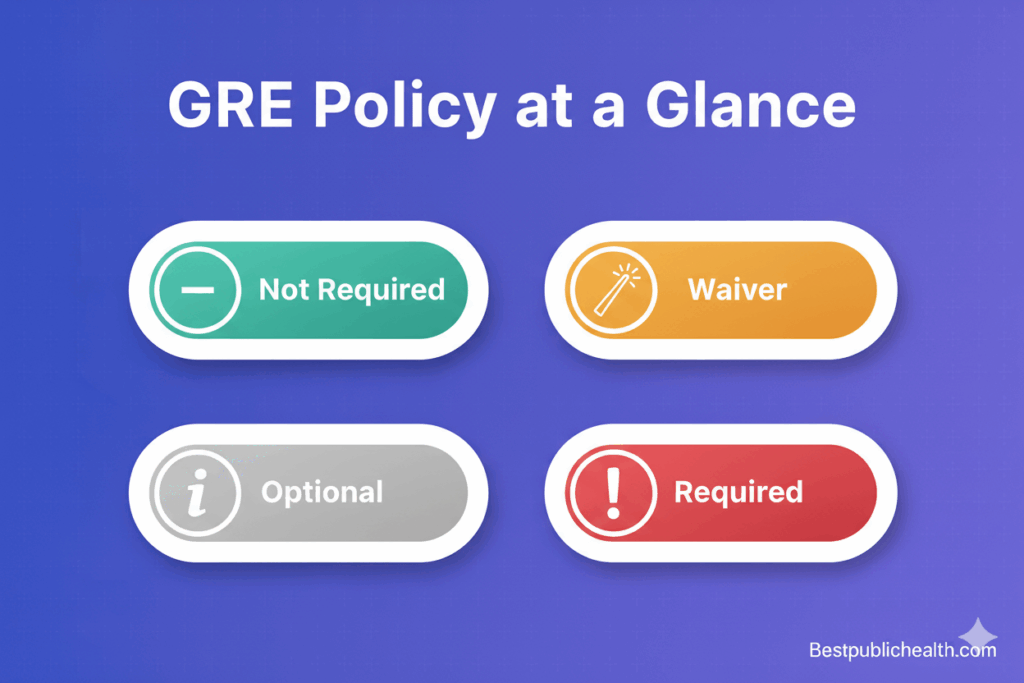
- Not required: GRE is not part of the application at all.
- Waived: You can skip GRE if you meet specific criteria (e.g., prior grad degree, GPA threshold, quant coursework, years of relevant experience).
- Optional: You may submit a score if it strengthens your profile (e.g., low GPA, limited quant).
- Required: You must submit a valid score by the posted deadline.
Typical waiver criteria (examples you’ll see)
- Completed graduate degree (MS, MD, PharmD, etc.)
- GPA above a threshold (e.g., 3.0–3.5) in the last 60 credits or in quant-heavy majors
- Quantitative prerequisites (calculus, stats, biostats) with strong grades
- Professional experience (often 3–5+ years) in a public-health-relevant role
How to check a program’s GRE policy (5-minute process)
- Open the Admissions page for your exact concentration and term.
- Look for the line that says Required / Optional / Not required / Waiver available.
- If “waiver,” read the exact conditions and whether they apply to your track.
- Confirm documentation needed (e.g., waiver form, transcripts, resume).
- If anything is unclear, email admissions: “For {{Concentration}}, Fall {{Year}}, is GRE {{required/optional/waived}}? What qualifies for a waiver?”
When sending a GRE score actually helps
- Your GPA is borderline or your transcript lacks recent quant coursework
- You’re aiming for epi/biostats where quant proficiency matters
- You want to offset non-traditional background concerns
Logistics to avoid last-minute pain
- Scores can take ~5–10 days to reach programs—build buffer time
- Some schools set priority deadlines for funding; submitting early increases options
- Keep a screenshot/PDF of the policy and the date accessed (policies update)
Next step: Filter by GRE policy (Not Required / Waived / Optional), save your shortlist, and set deadline alerts. Before you pay any application fee, re-check the program page to confirm nothing changed for your term.
Tuition & Funding (Read this before you budget)
Sticker prices are noisy. Your true MPH cost depends on four levers: residency status, fees, pace, and funding. Use bands on this page only to compare options; always confirm totals on the school site before you apply.
What drives cost (and how to control it)
- Residency rules: Public universities often charge far less for in-state students. Some schools offer non-resident tuition waivers for high-GPAs, veterans, or fully online cohorts. Ask admissions in writing whether your track qualifies.
- Mandatory fees: Proctoring, tech, student services, and “distance ed” fees can quietly add $1–3k+ over a degree. Find the bursar’s fee table and add it to your spreadsheet.
- Pace: Part-time = more terms = more per-term fees. If life allows, a 4–5 term plan often beats a 6–7 term plan on total cost.
- Course modality: Some schools price online credits differently (higher or lower). Verify by program, not just at the university level.
- Practicum costs: Travel, vaccinations, background checks—small line items that still hit your wallet. Ask the program coordinator what typical practicum out-of-pocket looks like.
Funding routes worth pursuing (realistic, first)
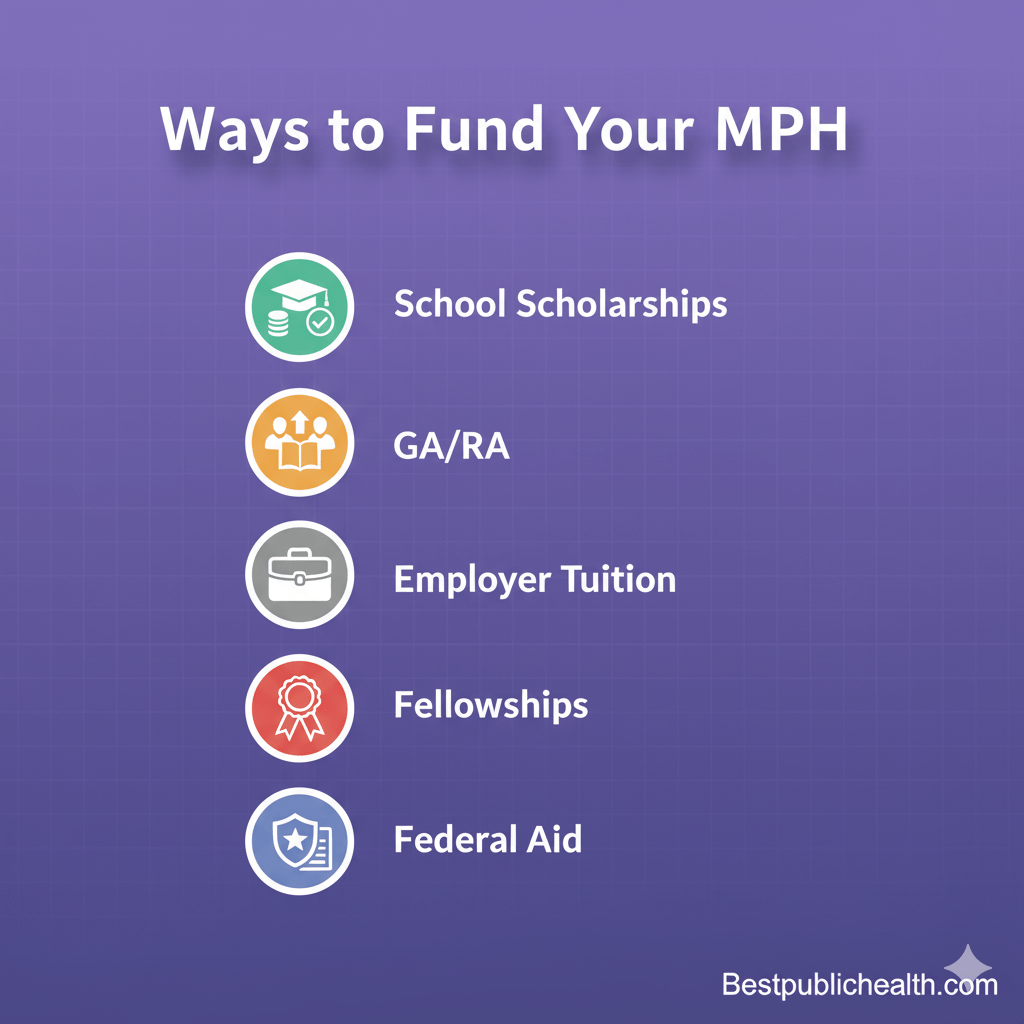
- School scholarships & tuition awards: Prioritize programs with automatic consideration at application. “Priority deadline” typically ties to these—submit early.
- Graduate Assistantships (GA/RA): Limited but valuable—tuition offsets plus stipends for teaching/research support. Ask about openings before you enroll.
- Employer tuition benefits: Hospitals, health departments, and NGOs sometimes reimburse $1–5k/year. Confirm the policy and any “work back” requirement.
- Public-health fellowships & small grants: Useful for second-year support or capstone/practicum costs.
- Federal aid (U.S. citizens/permanent residents): File FAFSA early for Stafford/Grad PLUS loans; compare interest and origination fees.
How to build a 15-minute cost model (do this in a sheet)
- List credits required × per-credit tuition (by track/modality).
- Add per-term fees × # of terms (based on your pace).
- Add one-time costs (application, matriculation, immunizations, background checks).
- Subtract confirmed scholarships/assistantships (not “maybe”).
- Add a 5–10% buffer for fee changes.
Result = Plan A. Duplicate for Plan B (second-choice program) and compare cost per credit and cost per expected outcome.
Next step → Open your shortlist’s tuition pages, fill the model, then head to our Scholarships & Fellowships hub to stack funding and set “Closing Soon” alerts.
Admissions Timeline (Plan backward from your deadline)
Deadlines vary by school, but most Texas MPH programs use priority windows for funding and final deadlines for seat availability. Work backward so you’re not scrambling.
Typical windows (high level, verify per program)
- Fall intake: Priority Jan–Mar • Final May–July
- Spring intake: Priority Sep–Oct • Final Nov–Dec
- Rolling programs review as files complete—earlier files = better odds for aid.
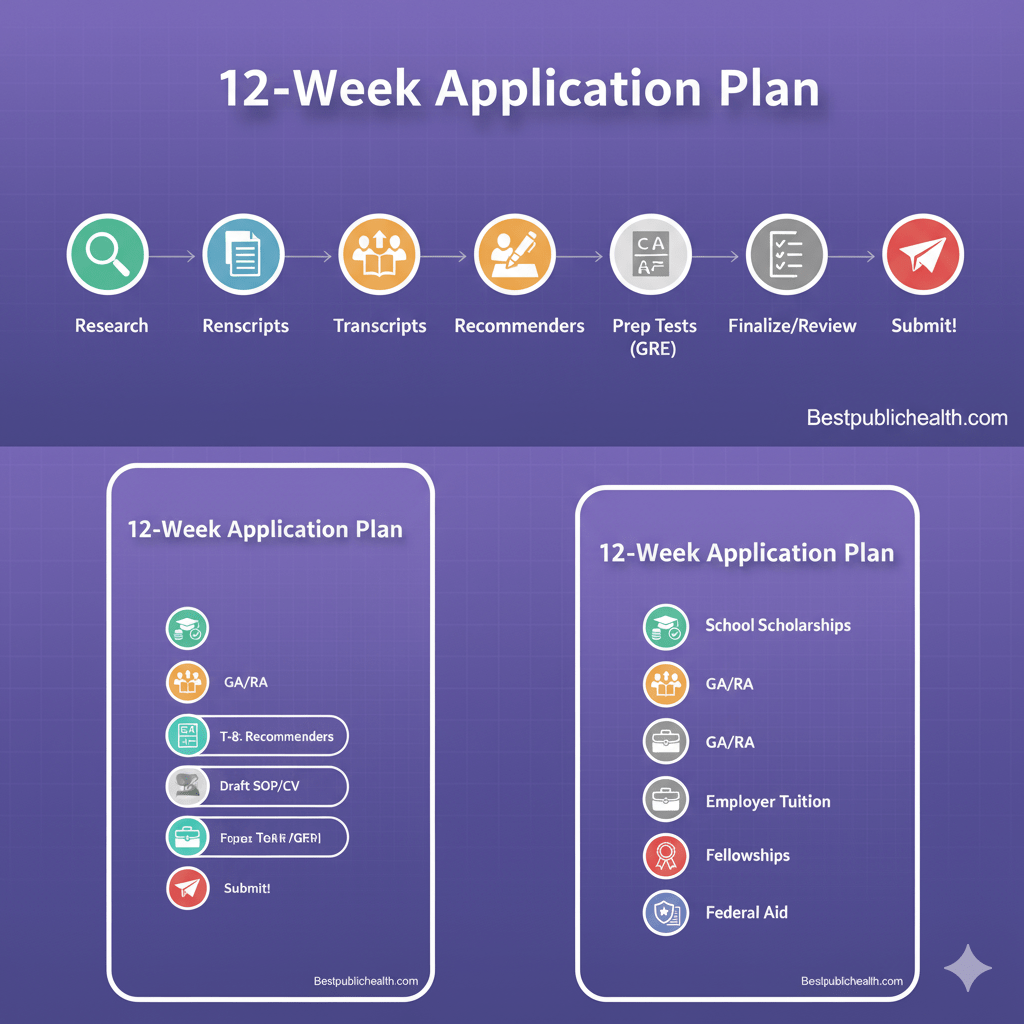
12-week backward plan (steal this)
(Assume a priority deadline 12 weeks from today; shift if you’re closer.)
- T-12 weeks — Shortlist & strategy
Lock 3–5 programs, pick concentration, decide GRE plan (Required / Optional / No-GRE). Create one master checklist. - T-11 weeks — Transcripts & credential eval (if intl.)
Order official transcripts. If international, start any required course-by-course evaluation immediately. - T-10 weeks — Recommenders
Ask 3 people who can speak to quant skills + public-health fit. Give them your resume + bullet points + the exact deadline. - T-9 weeks — Statement of Purpose
Draft → revise with a mentor → finalize a version you can lightly customize per school. Tie your stories to the concentration you chose. - T-8 weeks — Resume & gaps
Fix quant signals (list stats/epi tools, R/SPSS exposure, Excel skills). Add any recent volunteer or project work. - T-7 weeks — Tests (only if needed)
If GRE helps (or is required), schedule it now. Remember score delivery can take ~5–10 days. - T-6 weeks — Forms & uploads
Complete the online applications up to the payment step. Confirm program-specific questions (e.g., practicum interest). - T-5 weeks — Funding & GA/RA
Submit any scholarship forms and email about GA/RA openings for your start term. - T-4 weeks — Document proofing
Cross-check names, dates, and course lists. Convert all PDFs to clean, readable files under size limits. - T-3 weeks — Submit early
Hit submit/pay at least two weeks before priority. Early files are read sooner; recommenders get automated nudges. - T-2 weeks — Follow-ups
Verify all recommendations landed. If not, call and replace as needed. - T-0 — Deadline day
Confirm portals show “Complete.” Save screenshots of each confirmation.
After you submit
- Monitor email and applicant portals weekly.
- Prep for interviews or short written prompts (some programs use them).
- If you receive multiple offers, compare cost models + practicum placement strength + alumni outcomes, not just brand names.
Next step → Turn on Deadline Alerts for each program so you get nudged at T-6, T-3, and T-1 weeks. Then move to the FAQ section below to clear the last doubts before you apply.
FAQs
Are all programs on this page CEPH-accredited?
Yes—this page only lists programs with current CEPH accreditation. Still, you should open the official CEPH directory and confirm the program’s exact status and next review date before applying.
Which Texas MPH programs are fully online?
Several offer fully online or mostly-online tracks, but availability can vary by concentration and term. Check each program’s delivery details and plan of study; look for phrases like “100% online,” “hybrid,” or “campus intensive.”
Do Texas MPH programs require the GRE?
Policies differ: not required, optional, or waiver available (based on GPA, prior graduate degree, or experience). Read the admissions page for your specific concentration and start term—don’t rely on old lists.
How long does an MPH take in Texas?
Most full-time tracks target ~2 years; part-time plans typically run 2.5–4 years depending on course rotation and practicum timing. Accelerated paths exist but require heavier loads and careful planning.
What jobs do graduates typically land?
Common first roles include Epidemiology Analyst/Associate, Health Educator/Coordinator, Program Manager, Policy/Research Associate, and Infection Prevention roles—often in local/state health departments, hospital systems, universities, and NGOs.
Can out-of-state students pay in-state rates?
Sometimes—via non-resident waivers, fully online pricing, or specific scholarships. This is highly program-specific; verify with the bursar/admissions and get it in writing before you enroll.
Internal Links
Best Online MPH Programs 2025 (CEPH-Accredited)
Top Public Health Scholarships in 2025 (20+ Awards)
Best Public Health Programs in California (CEPH)
Accelerated 1-Year MPH Programs (2025 Guide)