
Introduction
This guide lists CEPH accredited MPH programs—online and on campus—plus how to verify status in the official directory.”
Table of Contents
Choosing the right Master of Public Health starts with one question: is the program CEPH accredited? This guide explains what CEPH accreditation is, why employers and fellowships care, and how to confirm a program’s status in minutes. You’ll also find practical shortcuts—like reputable online CEPH-accredited MPH programs, accelerated (1-year) options, and no-GRE pathways—to match your goals, budget, and timeline.
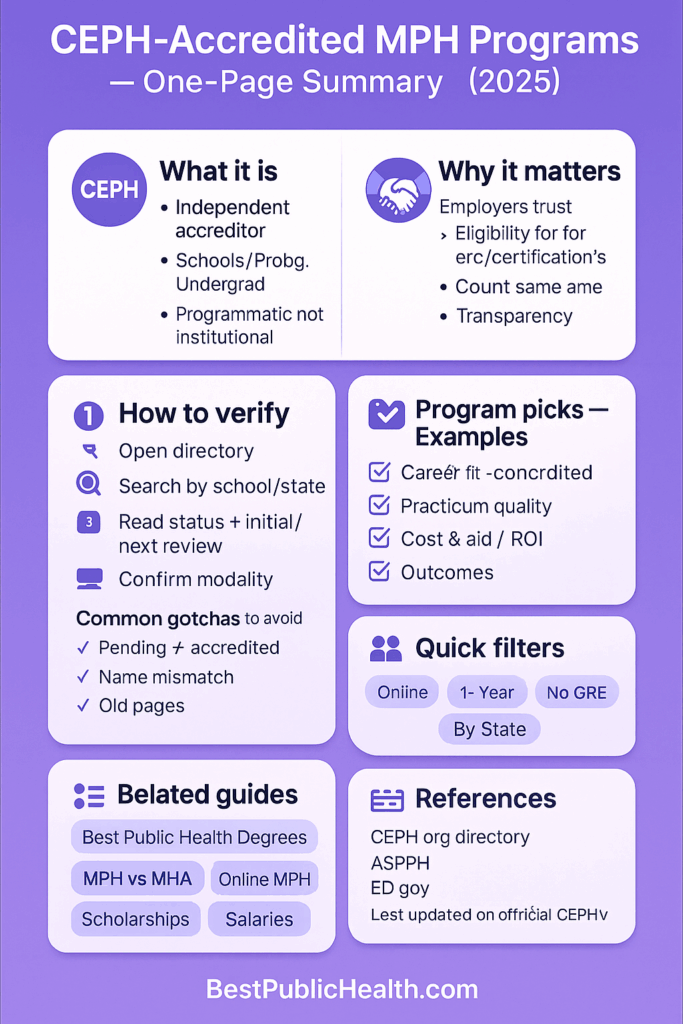
In plain terms, CEPH (the Council on Education for Public Health) is the independent body that reviews public-health education for quality. Graduating from a CEPH-accredited MPH program can open doors to competitive roles in health departments, hospitals, NGOs, and industry—and may be preferred for certifications and certain federal/state positions. Below, we’ll show you how to verify accreditation, what CEPH actually evaluates, and a checklist to choose confidently.
What Is CEPH Accreditation?
Think of CEPH—the Council on Education for Public Health—as a subject-matter inspector for public-health degrees. Regional accreditation checks the whole college or university. CEPH zooms in on public-health education specifically, asking: “Does this MPH actually teach what the workforce needs?”

Who can be CEPH-accredited
- Schools of Public Health (stand-alone schools with multiple departments)
- Public Health Programs (a department inside a larger college that offers the MPH/BS/BA)
- Undergraduate Public Health (selected BS/BA majors)
What CEPH looks at (quick snapshot)
- Clear foundational competencies + depth in your chosen concentration
- A real, supervised practice experience (your practicum/internship)
- Qualified faculty, student support, and fair, consistent assessment
- Ongoing quality improvement backed by data and outcomes
Why this matters: when a university lists “CEPH accredited MPH programs,” it signals the curriculum meets agreed-upon standards for training public-health professionals.
Pro tip: If a page says “accreditation pending,” always double-check the current status and dates on the official directory before you apply.
Why CEPH Accreditation Matters
A quick test: open a few MPH job posts or fellowship pages. You’ll often see a line that says “MPH from a CEPH-accredited program (preferred/required).” That one phrase saves you from guesswork about quality.
What it changes for you
- Screening signal for employers. Recruiters know what CEPH reviews cover. When your résumé lists a CEPH accredited MPH program, you skip the “is this legit?” step.
- Eligibility gates. Some fellowships, government roles, and professional credentials look for accredited training. Without it, you may be filtered out before an interview.
- Next-degree readiness. DrPH/PhD committees recognize CEPH standards. It helps them compare applicants from different schools on common ground.
- Online counts the same. If the program is CEPH-accredited, the delivery (online, hybrid, campus) doesn’t downgrade the credential.
- Public info you can verify. Status and review dates are posted publicly, so you can confirm a program’s standing before you apply.
Use CEPH as your first filter. Then compare the things that affect daily life—cost, schedule, practicum support, outcomes, and location.
Bottom line: Accreditation isn’t the only decision factor—but it’s a strong quality signal to weigh alongside cost, modality (online/on-campus), practicum support, and career outcomes.
CEPH vs Regional Accreditation (How They Fit Together)
Two different checks look at a university from two angles:
- Regional (institutional) accreditation reviews the entire institution—finance, governance, campus-wide academics.
- CEPH (programmatic) accreditation reviews public-health education specifically—competencies, practicum quality, faculty mix, assessment, and improvement.
Think of regional as the building inspection and CEPH as the specialist check on the MPH unit. The strongest scenario is both: a regionally accredited university that also offers CEPH-accredited MPH programs. If a school is only regionally accredited, the MPH may be fine, but you’re missing the extra, public-health-specific review that many employers and fellowships expect.
How CEPH Accreditation Works
Here’s the short version of how a program earns (and keeps) CEPH accreditation.
1) Eligibility + intent
A school or department signals that it plans to pursue CEPH accreditation and confirms it offers the right kind of public-health curriculum.
2) Self-study
Faculty and staff complete a detailed report on curriculum, competencies, practicum, assessment, outcomes, and resources. Think of it as “show your work.”
3) Site visit
A peer review team meets with leadership, faculty, students, alumni, and community partners. They compare what’s on paper with what happens in real life.
4) Decision
CEPH issues a decision with a status and a next review date. If there are issues, CEPH can require monitoring or follow-up.
5) Ongoing review
Accreditation isn’t “set and forget.” Programs report outcomes and address areas for improvement between reviews.
What this means for you
- A CEPH-accredited MPH program has cleared a specialty review beyond basic university accreditation.
- You can see the status and dates publicly (helpful when comparing offers).
- If a program says “applicant,” “in process,” or “pending,” that is not the same as accredited—verify the current status before you commit.
How to Verify a Program’s CEPH Status (Step-by-Step)

Use this quick check before you apply or pay a deposit.
Step 1 — Open the official CEPH directory
Search by school name, state, or program type. (Bookmark it; you’ll use it more than once.)
Step 2 — Find the exact unit that offers the MPH
Some universities have an accredited School of Public Health that covers multiple degrees. Others have an accredited Public Health Program inside a larger college. Match the listing to the unit on your offer letter.
Step 3 — Read the status and dates carefully
When you check the listing, look for three things:
- Accreditation status (e.g., accredited)
- Initial accreditation date and the next review date
- Any notes or monitoring requirements
Step 4 — Confirm the delivery you need
If you are applying to an online or hybrid MPH, make sure the accredited unit officially offers the program in that format.
Step 5 — Cross-check the catalog page
The university catalog should use the same unit name you saw in the CEPH directory.
If the wording looks vague—such as “accreditation pending” or only “regionally accredited”—ask admissions for a written confirmation before you enroll.
Common gotchas to avoid
- “Pending” does not equal accredited
- Unit name mismatch between catalog and directory
- Old marketing pages—trust the CEPH directory first
Pro tip: Take a screenshot or save the directory page to your application folder. It’s handy for fellowship and employer paperwork that asks whether your MPH is from a CEPH-accredited program.
What CEPH Looks For (Real-World View)

CEPH doesn’t just skim a syllabus. It asks, “Will this grad handle real public-health work on day one?” That means looking at the skills you’ll practice, the support you’ll get, and the results the program delivers.
Skills and curriculum. By graduation you should be able to work with data, design and evaluate interventions, manage projects, and communicate clearly with communities and stakeholders. Depth matters too—epidemiology feels different from health policy or environmental health, and your courses should show that.
Practice, not just theory. A supervised practicum with a written scope of work is standard. You should know who your preceptor is, what you’re delivering, and how your work will be judged. A capstone or integrative project ties everything together into something you can show an employer.
People and support. Look for accessible faculty, timely feedback, and help with writing and statistics. Good programs publish outcomes, listen to student feedback, and change what isn’t working.
Partnerships and equity. Strong ties to health departments, hospitals, NGOs, or community groups are a good sign. So is clear attention to inclusion and the needs of the populations being served.
A quick gut-check when you read a program page
- Can you see the competencies in plain language?
- Is the practicum structured with goals, supervision, and evaluation?
- Are job outcomes and next review dates public?
If the answers are “yes,” you’re likely looking at one of the CEPH accredited MPH programs built for real work—not just classroom credit.
How to Choose a CEPH-Accredited MPH (Practical Checklist)
Start simple: shortlist only CEPH-accredited options. Then choose for fit.
1) Career first, then concentration.
Picture your first role after graduation. Disease investigator? Program manager? Data analyst? Let that answer point you to Epi, HPM, Environmental Health, MCH, Global, or Health Promotion. Scan recent alumni on LinkedIn to confirm the path feels right.
2) Modality and pace.
Online, hybrid, or campus? Nights or weekends if you’ll keep working? Accelerated (~12 months) is intense; standard timelines (18–24 months) give more breathing room.
3) Practicum quality.
Ask who sources placements, how far in advance they’re arranged, and whether remote options exist. You want a named preceptor, a written plan, and deliverables that translate into bullets on your résumé.
4) Money and ROI.
Add up the total cost—tuition, fees, books, and lost work time if you quit your job. List likely roles and salaries in your area, then check how long it takes to break even. Don’t forget scholarships, assistantships, or employer tuition support.
5) Admissions profile and support.
Check the GRE policy (required, optional, waiver) and the typical GPA/work-experience range. Ask about writing labs, stats tutoring, and career coaching—these support systems matter.
6) Outcomes that are real, not vague.
Look for graduation rates, 6–12-month employment data, and example employers. If it isn’t published, ask for it.
Quick rule to decide between two offers
- Fit to role you want
- Practicum you can be proud of
- Outcomes and alumni network
- Cost and funding
- Schedule that won’t burn you out
Before you accept, talk to an advisor and a current student. Ten honest minutes can tell you more than any brochure.
Featured CEPH-Accredited MPH Programs (USA)
Below are concise spotlights you can use as “Top Picks.” Each lists who it fits, why it stands out, and a link target. Always verify status/dates on the official CEPH directory before publishing. ceph.org
1.Johns Hopkins Bloomberg School of Public Health (JHU):
Who it’s for: Professionals who want maximum choice and the option to study online/part-time or on campus.
Why it stands out: Extremely flexible format; huge elective catalog; capstone ties skills to a real problem; large global alumni network. Bloomberg School of Public Health+1
Good to know: CEPH accreditation renewed to June/July 2031 (CEPH directory lists 7/1/2031). Bloomberg School of Public Healthceph.org
2.UNC Gillings School of Global Public Health
Who it’s for: Students seeking a top public program with both on-campus and online pathways.
Why it stands out: Recent 7-year reaccreditation; online MPH options in Leadership and Nutrition with live sessions. Gillings School of Public Health+1
Good to know: CEPH term extends to July 2032 per UNC and the CEPH list. Gillings School of Public Healthceph.org
3.George Washington University (Milken Institute SPH)
Who it’s for: DC-area or remote learners wanting a well-known MPH@GW online option.
Why it stands out: School reaccredited in Aug 2024 through Dec 31, 2031; online MPH covered under the same CEPH umbrella. Milken Institute School of Public HealthGW-UMT
Good to know: Confirm your track/modality in the school’s accreditation note. GW-UMT
4.University of Florida (College of Public Health & Health Professions)
Who it’s for: Cost-conscious students who want a respected public option with online or campus study.
Why it stands out: Online MPH is 48 credits and fully online; college accredited through 2028. Public Health College+1
Good to know: Check concentration availability by format before applying. Public Health College
5.University of South Florida (College of Public Health)
Who it’s for: Learners seeking a large selection of online MPH concentrations with strong ed-tech support.
Why it stands out: Recognized leader in online MPH delivery; college reaccredited through July 1, 2026. USF Health+1
Good to know: Review practicum logistics for remote students in your concentration page. USF Health
6.UMass Amherst (School of Public Health & Health Sciences)
Who it’s for: Working adults who want a long-running Online MPH in Public Health Practice.
Why it stands out: Fully asynchronous online track with CEPH accreditation; school accredited through Dec 31, 2029. UMass Amherst+1
Good to know: Confirm credit totals and pacing for your chosen track. UMass Amherst
Online CEPH-Accredited MPH Programs (Quick Picks)
Below are reputable online MPH options from CEPH-accredited schools. Link each item to your neutral profile page, then to the program.
- JHU MPH (Part-Time/Online): Can be completed fully online, fully onsite, or hybrid; designed for working professionals. (CEPH to 2031) Bloomberg School of Public Healthceph.org
- UNC MPH@UNC: Live webcam classes + 24/7 coursework; concentrations include Leadership and Nutrition; online program under Gillings’ CEPH accreditation (to 2032). Gillings School of Public Health+1
- GWU MPH@GW: Online MPH covered by Milken’s CEPH accreditation (to 2031). GW-UMTceph.org
- University of Arizona Online MPH: Multiple online concentrations from MEZCOPH; college accredited through Dec 2027. University of Arizona OnlineZuckerman College of Public Health
- University of Florida Online MPH: 48-credit fully online option; college accredited through 2028. Public Health College+1
- University of South Florida Online MPH: Broad catalog of online degrees/certificates; college reaccredited through July 1, 2026. USF Health+1
- UMass Amherst Online MPH (Public Health Practice): Asynchronous online program; school accredited through Dec 31, 2029. UMass Amherst+1
1-Year / Accelerated CEPH-Accredited MPH Options (USA)
If you want to move fast, several CEPH-accredited schools offer intensive ~11–12-month MPH pathways. Always confirm the program’s current accreditation status and review dates on CEPH’s official directory before you apply. ceph.org
Examples (verify details and fit):
- Johns Hopkins Bloomberg (Full-Time MPH, ~11 months). Designed to be completed July–May with five eight-week terms; widely chosen by working clinicians and mid-career professionals. Bloomberg School of Public Health
- Columbia Mailman (Accelerated MPH, 1 year). One-year format covering the core Columbia MPH curriculum at a faster pace for experienced candidates. publichealth.columbia.edu
- Yale School of Public Health (Advanced Professional MPH, ~11 months). For applicants with advanced degrees or substantial experience; multiple tracks. catalog.yale.edu
- UC Berkeley (Interdisciplinary MPH, 11 months). A full-time accelerated option; the school explicitly describes the IMH as an 11-month program. UC Berkeley Public Healthbph-storage.s3.us-west-1.amazonaws.com
- Harvard T.H. Chan (MPH-45, 1 year full-time for eligible backgrounds). Several 45-credit tracks can be finished in one academic year; check track-specific eligibility. Harvard Chan School+1
Who thrives in accelerated MPH tracks
- Professionals with a clear target role and relevant experience (you’ll move quickly from day one).
- Applicants who can dedicate a full-time year (accelerated = compressed schedules, heavy course loads, and early practicum planning).
- Students who already have quantitative/clinical grounding and want to formalize public-health skills fast.
Before you commit
- Confirm modality (some are on-campus only; others allow limited online/hybrid).
- Map practicum timing—accelerated calendars can squeeze placement windows.
- Re-check CEPH status + next review date in the directory and keep a PDF for your records. ceph.org
CEPH-Accredited MPH Programs with No GRE (or GRE-Optional)
Many reputable programs have dropped the GRE or made it optional. This section highlights schools that publicly state “no GRE” (or “GRE optional”) for the MPH. Always read the fine print—dual degrees and certain tracks can differ—and verify accreditation in the CEPH directory. ceph.org
Clear “No GRE” or “Not Required” (MPH)
- UNC Gillings (MPH / MPH@UNC). School announced it dropped the GRE for MPH in 2020; current MPH@UNC page says GRE neither required nor typically recommended (and explicitly: “GRE scores are not required to apply”). Gillings School of Public Health+1UNC-MPH
- George Washington University (MPH@GW). Online MPH site states no GRE required; application pages repeat the same. GW-UMT+1
- University of Florida (MPH). Admissions page: “The MPH program does not require or consider GRE scores.” Public Health College
- UMass Amherst SPHHS. Testing info: “The GRE is not required for any degree and certificate programs in SPHHS or the MPH in Worcester program.” UMass Amherst
GRE-Optional (read program notes)
- Johns Hopkins Bloomberg (MPH). Program page lists standardized tests as optional; the joint MPH/MBA is different and may require GRE/GMAT unless you qualify for a waiver—read the small print. Bloomberg School of Public Health+1
Tips to evaluate “No-GRE” policies
- Look for bold statements on admissions pages, not just third-party lists.
- Check whether the policy applies to your track (e.g., online vs on-campus, joint degrees).
- If a page is unclear, email admissions for written confirmation and save it with your application notes.
Cost, Aid, Scholarships & ROI for CEPH-Accredited MPH
Make cost transparent and connect it to outcomes. Readers care less about sticker price and more about time to break even in their target role.
Typical salary anchors (BLS, May 2024)
- Medical & Health Services Managers (common for HPM grads): $117,960 median. Bureau of Labor Statistics
- Epidemiologists: $83,980 median. Bureau of Labor Statistics
- Medical Scientists (some research-oriented MPH paths): $100,590 median. Bureau of Labor Statistics
- Health Education Specialists: $63,000 median. Bureau of Labor Statistics
- Community Health Workers (entry/community roles): $51,030 median. Bureau of Labor Statistics
A simple break-even check (show this on the page)
- Total program cost (tuition + mandatory fees + books + any lost wages).
- Expected salary in your target role (use BLS, then adjust for your state/sector). Bureau of Labor Statistics
- Salary delta = Expected salary − your current salary.
- Payback period = Total program cost ÷ Salary delta.
If you plan to work in public service, factor in PSLF (loan forgiveness after 120 qualifying payments). Federal Student Aid+1
Funding options to list (with official references)
- Federal Direct Unsubsidized Loans (up to annual limits), plus Graduate PLUS for remaining need. Federal Student Aid+1
- PSLF eligibility for qualifying government/nonprofit work; point to the official PSLF help tool. Federal Student Aid
- School aid (scholarships/assistantships), employer tuition benefits, and state programs (link to each school’s aid page).
- Reminder: Federal loans generally offer income-driven repayment and other borrower protections; compare before using private loans. Federal Student Aid
What to publish for each program row (so readers can compare)
- Estimated total cost (not just per-credit tuition).
- Scholarships/assistantships available last cycle.
- Typical time to degree (e.g., 11–12 months accelerated vs 18–24 months standard).
- Early career outcomes (6–12-month employment rate; example employers).
- PSLF-friendly? (Share of grads in government/nonprofit roles, if known).
Career Outcomes & Roles After a CEPH-Accredited MPH
A CEPH accredited MPH program is a clear signal to employers that you’ve trained on core public-health skills. Your first role depends on your concentration, practicum, and the projects you can show.
Common roles by concentration (examples)
- Epidemiology: Disease investigator, surveillance analyst, research associate, biostat analyst.
- Health Policy & Management (HPM): Program manager, operations lead, quality improvement analyst, consultant.
- Health Promotion/Behavior: Health educator, program coordinator, community engagement lead.
- Environmental Health: Environmental health specialist, exposure/risk assessor, industrial hygiene associate.
- Maternal & Child Health (MCH): MCH program manager, perinatal health coordinator, family health analyst.
- Global Health: Program officer, monitoring & evaluation associate, humanitarian health coordinator.
Where graduates work
- City/county/state health departments, federal agencies
- Hospital systems, payers, community health centers
- NGOs and global health organizations
- Research institutes and universities
- Health tech, pharma/biotech, and consulting
Make your résumé “job-ready”
- Turn your practicum/capstone into 3–4 bullet points with outcomes (e.g., “designed dashboard used in weekly outbreak briefings”).
- Keep a small portfolio: one data viz, one protocol/logic model, one 1-page brief.
- Ask your preceptor for a skills-focused reference before you graduate.
- Join the alumni network and request two informational interviews per week for a month after graduation.
International & Non-U.S. Considerations
CEPH is a U.S. accreditor, but many employers and universities outside the U.S. recognize the standard—policies vary by country. If you plan to study from abroad or return home after graduation, use this quick checklist.
Recognition & credentials
- Confirm how your country views CEPH accreditation and whether an additional credential evaluation (e.g., WES/UK ENIC-style services) is needed for jobs or further study.
- For clinical or regulated roles, check if an MPH changes licensure status (often it complements—doesn’t replace—clinical licensing).
Studying online from overseas
- Check time zones and live-session requirements; ask if recordings are available.
- Verify practicum options in your country (remote/field placements, preceptor requirements, insurance).
- Confirm tech access (VPN restrictions, proctoring tools, library databases).
Visas & work plans
- If attending on campus in the U.S., review the university’s guidance on student visas and any post-study work options.
- Keep documentation of your CEPH-accredited program status; it helps with employer HR checks and future doctoral applications.
Bottom line
A CEPH accredited MPH program travels well academically, but employment and licensure rules are local. Verify early so your study plan, practicum, and first role align with where you want to work.
FAQs
Not always, but it helps. Many government roles, fellowships, and employers prefer grads from CEPH accredited MPH programs.
Yes. CEPH accredits the program, not the delivery format. Verify that your program/unit is accredited.
A School of Public Health is a whole school. A Public Health Program is a department within a larger college. Both can be CEPH-accredited.
On a set cycle (multi-year). Each listing shows a next review date. Always check the latest status.
No. Pending or “in process” is not the same as accredited. Enroll only when the official directory shows Accredited.
Some certifications, fellowships, or employers require or prefer CEPH. Check the rules for your target path.
It can. Committees recognize CEPH standards and competencies, which makes comparisons easier.
CEPH accredits programs/units that offer degrees. Some accredited units also run certificates, but confirm details on the program page.
Statuses and dates change. Re-check the official directory each time you shortlist or before you deposit.
Often yes for academic progression, but employment and licensure are local. Verify with your country’s rules.
Internal Links
Related MPH Guides
Use these linked guides to compare degree fit, accreditation, and costs before you apply.
