Updated April 2026. If you search for the best MPH programs, you will usually find the same weak formula: a long list of school names, vague praise, and very little help with the decision that actually matters. Which program is right for your goals, your budget, your schedule, and the kind of public health work you want to do after graduation?
Table of Contents
This guide is built to answer that question properly. The best MPH program is not automatically the most famous school or the most expensive option. The best program is the one that is CEPH-accredited, aligned with your intended career, realistic for your life, and strong enough to help you move into real public health work after graduation.
Best MPH Programs by Goal: Start Here
Use this quick map before reading any ranking. The best MPH program for a career changer is not always the best MPH program for a working professional, a research-focused applicant, or a student trying to reduce total cost.
| Your main goal | Start with this MPH path | Why it fits |
|---|---|---|
| Broad public health career | CEPH-accredited MPH with flexible concentrations | Gives you the widest applied public health base. |
| Work while studying | Online MPH programs | Lets you keep job momentum while completing graduate training. |
| Finish faster | One-year MPH programs | Best for students who can handle a compressed academic schedule. |
| Avoid standardized testing | No-GRE MPH programs | Useful when your application is stronger through work, grades, and recommendations. |
| Research or doctoral pathway | Compare MPH vs MSPH vs MHS | Helps you decide whether a research-heavy degree may fit better than a practice MPH. |
Which Actual MPH Programs Should You Shortlist First?
If you searched for the best MPH programs because you want real universities, start here. These are strong MPH programs to shortlist first based on fit, reputation, program depth, and the kinds of public health paths applicants usually care about. This is a better starting point than pretending one universal ranking works for everyone.
Important: treat this as a shortlist, not a final ranking. Before applying, verify CEPH accreditation, format, cost, practicum structure, and concentration fit for your goals.
| Best fit | Programs to shortlist first | Why start here |
|---|---|---|
| High-profile research and brand recognition | Johns Hopkins University, Harvard University, Columbia University | Strong national visibility, broad alumni reach, and deep public health recognition. |
| Leadership, policy, and public health systems | UNC Chapel Hill, Emory University, George Washington University | Good starting points for applicants interested in leadership, policy, systems work, and strong school-of-public-health environments. |
| Strong public-university MPH options | UC Berkeley, UCLA, University of Michigan | Useful if you want large public-school options with strong academics, breadth, and recognizable institutional names. |
| Large urban and applied MPH environments | Boston University, University of Illinois Chicago, University of Pittsburgh | Helpful for applicants who want broad city-based public health ecosystems and large applied-health settings. |
If your real priority is online flexibility, one-year speed, or test-optional admissions, use these more focused guides after you review the shortlist above:
- Best Online MPH Programs
- One-Year MPH Programs in the USA
- No-GRE MPH Programs
- CEPH-Accredited MPH Programs
Quick Answer: What Makes an MPH Program One of the Best?
The best MPH programs usually share the same core traits:
- They are CEPH-accredited or clearly documented through official accreditation channels.
- They offer concentrations that match real job paths, not just generic course lists.
- They are transparent about tuition, timelines, and practicum requirements.
- They fit your learning reality: online, hybrid, on-campus, part-time, or accelerated.
- They include applied training, not just theory.
- They help you build toward a credible career outcome.
If a program fails on those basics, it should not be on your shortlist, no matter how strong the university brand looks.
Questions This Guide Answers
- What makes an MPH program one of the best options in 2026?
- Does CEPH accreditation matter when choosing an MPH?
- Is an online MPH respected by employers?
- Are one-year MPH programs worth the intensity?
- How should you compare cost, format, practicum quality, and career fit?
Start With CEPH Accreditation
Before you compare rankings, location, or prestige, check accreditation. For U.S. MPH programs, CEPH is the non-negotiable first filter. If a school is not listed in the official CEPH directory, or if its status is unclear, that should stop you immediately until you verify it.
Why this matters:
- Many employers and fellowships prefer or expect a CEPH-accredited MPH.
- Accreditation confirms that the program covers core public health competencies.
- It gives you a more reliable baseline for comparing schools across cost, format, and outcomes.
If you want a full accreditation-first shortlist, start with our CEPH-accredited MPH programs guide.
How to Judge the Best MPH Program for You
The phrase best MPH programs sounds universal, but the right choice depends on what kind of work you want to do after graduation. An applicant aiming for epidemiology or analytics should not use the same decision logic as someone targeting policy leadership or community health program management.
Start by writing down two job titles you would genuinely be happy to pursue after graduation. Then judge each program against those roles.

| Career Goal | What to Prioritize | Common Good Fit |
|---|---|---|
| Epidemiology or surveillance | Quantitative training, data access, applied methods | MPH or MS with strong epi/biostats track |
| Policy, management, leadership | Health policy, systems thinking, management practicum | MPH with HPM focus or MHA comparison |
| Community or global health practice | Fieldwork, partnerships, implementation training | MPH with population-focused concentration |
| Career switch with flexibility needs | Online format, advising support, realistic pacing | Part-time or online MPH |
The 6 Factors You Should Compare Before Applying
1. Career Fit
Do not choose a program by name recognition first. Choose it by the work it prepares you to do. Look at the concentration, required methods training, practicum expectations, and the kinds of placements or projects students complete.
2. Format Fit
The right format is the one you can actually finish. Online programs can be strong, but only if they support practicum placement and your weekly schedule. Hybrid programs can be excellent for networking without full relocation. On-campus programs often provide stronger immersion, but they can be harder to justify financially if relocation costs are high.
3. Tuition and Total Cost
Never compare MPH programs by tuition alone. Add fees, software, books, travel, housing, and lost income if you need to reduce work hours. A famous school is not automatically the best investment if the total cost does not match the likely return.
4. Practicum Quality
A strong practicum can shape your first job. A weak practicum can leave you with a checkbox and no meaningful experience. Ask whether the school has partner sites, whether online students receive local placement support, and whether the capstone or applied project results in something you can show employers.
5. Admissions Accessibility
No-GRE policies matter, but they should not dominate your decision. A no-GRE program is only attractive if the curriculum, student support, and applied training still hold up. If you want admissions-flexible options, use our no-GRE MPH guide as a starting point, not the final answer.
6. Outcomes and Support
Not every school publishes clean placement data, but you should still look for evidence of career services, alumni access, employer-facing practicums, and transparent advising support. A polished admissions page is not the same as strong student outcomes.
Best MPH Paths by Student Type
Most applicants are not really choosing between random schools. They are choosing between pathways.
| If this sounds like you | Your best starting path | Recommended guide |
|---|---|---|
| You need flexibility while working | Online or part-time MPH | Best Online MPH Programs |
| You want the fastest route | Accelerated or one-year MPH | One-Year MPH Programs |
| You want accreditation certainty first | CEPH-first shortlist | CEPH-Accredited MPH Programs |
| You want easier admissions screening | No-GRE and test-flexible options | No-GRE MPH Programs |
| You are deciding between degrees, not just schools | Compare MPH with adjacent options first | MPH vs MHA and MPH vs MSPH vs MHS |
Online vs. On-Campus vs. One-Year: Which MPH Format Fits Best?
Many applicants search for the best MPH program when what they really need is the best MPH format for their life stage.

Online MPH
Online works well when flexibility matters and the program has real practicum support. The best online MPH programs still need clear faculty access, structured delivery, and credible field placement planning.
On-Campus MPH
On-campus programs often make the most sense for applicants who want close faculty access, daily cohort interaction, and location-specific practicum opportunities.
One-Year MPH
A one-year MPH can be smart if you already have a strong academic or professional base and can treat the program like a full-time job. It is usually a poor choice if you need a gentle pace, income stability, or time to explore the field. If that is your path, compare accelerated 1-year MPH programs with standard-timeline options before you commit.
How to Build a Smart MPH Shortlist
Instead of chasing rankings, score each program on the factors that actually affect your outcome.
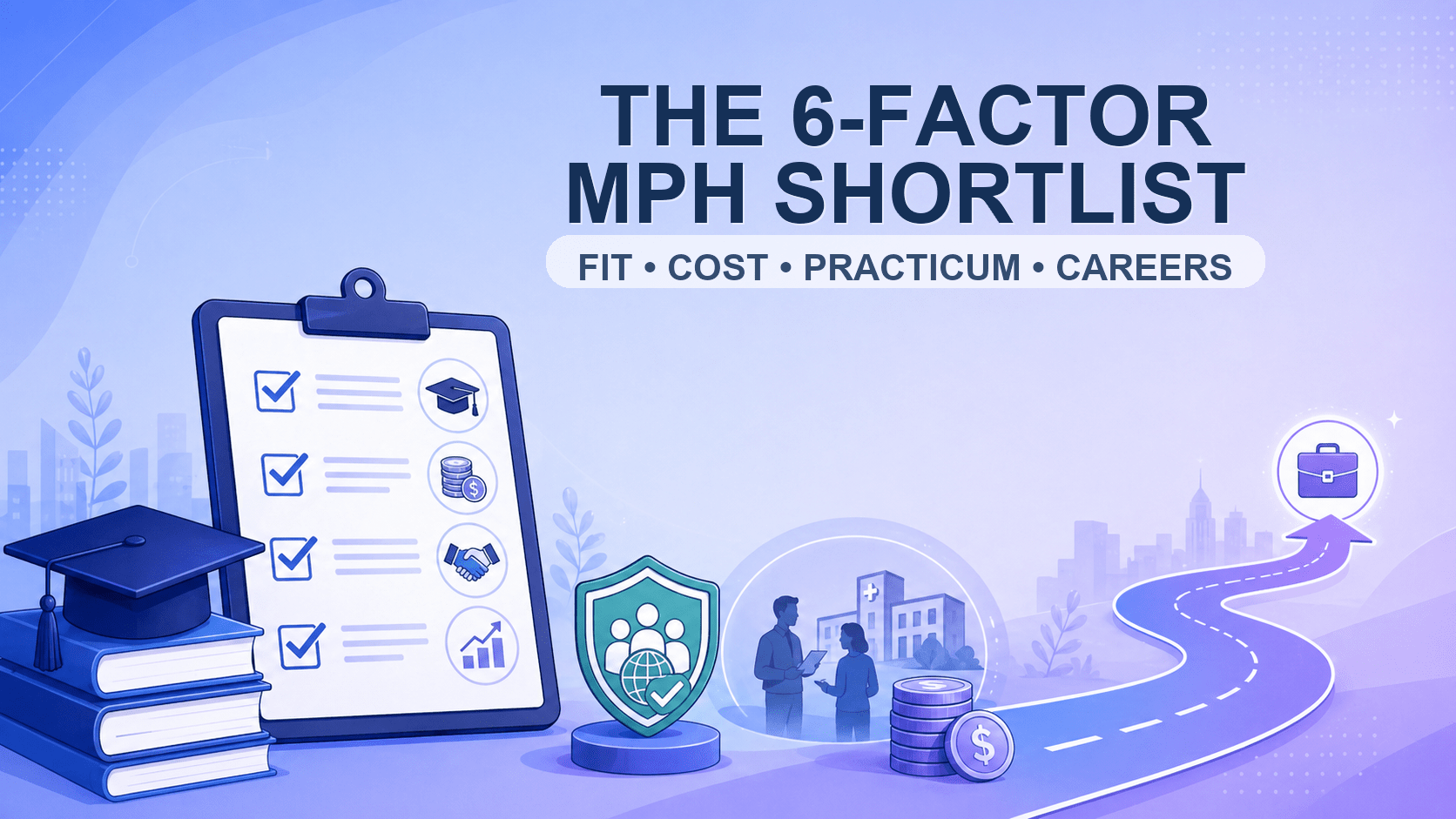
- Check CEPH accreditation.
- Match the concentration to your target job titles.
- Confirm the format fits your real schedule.
- Calculate the true cost, not just the headline tuition.
- Ask how practicum placement works for your location.
- Look for career support, not just marketing language.
If you do that honestly, your shortlist usually becomes much smaller and much better.
Common Mistakes Applicants Make
- Choosing by prestige alone: a famous brand does not automatically mean better fit.
- Ignoring practicum logistics: especially dangerous for online students.
- Overvaluing no-GRE labels: easier admissions is not the same as stronger education.
- Underestimating one-year intensity: faster is not automatically smarter.
- Looking at tuition without total cost: the real bill is almost always higher.
FAQs About the Best MPH Programs
Do employers care about CEPH accreditation?
Yes. For MPH programs in the United States, CEPH remains one of the most important baseline quality checks. It is not the only factor, but it should be your first one.
Is an online MPH respected?
Yes, if the program is accredited, well-structured, and supported by real practicum planning. The delivery mode matters less than the program quality and the outcomes it helps you build.
Are one-year MPH programs worth it?
They can be, but usually only for applicants who already have strong preparation and can handle an intense academic year without expecting much flexibility.
Should I choose a no-GRE MPH just because it sounds easier?
No. No-GRE should be treated as one admissions factor, not the main reason to choose a school.
What is the best way to compare MPH programs quickly?
Use a short scoring system based on accreditation, career fit, cost, format, practicum quality, and student support. That gives you a more reliable result than generic rankings.
Final Takeaway
The best MPH programs are not defined by hype. They are defined by fit, credibility, applied training, and whether they move you toward the work you actually want to do. Start with accreditation, compare programs through the lens of your target role, and do not let branding distract you from the details that shape outcomes.
If you want to continue building your shortlist, read these next:
