Accelerated 1-Year MPH Programs offer the same MPH credential on a 12-month timeline. This guide lists accredited one-year MPH options, admissions snapshots, costs, and practicum models so you can pick the right fast-track public health degree.
Table of Contents
Who This Guide Is For
If you’re determined to step into public health leadership fast, accelerated 1-year MPH programs—also called 12-month MPH or fast-track public health degrees—offer a compressed, career-ready path without compromising on core competencies. This guide distills everything you need to know about one-year MPH programs in a single place: what “12 months” actually means, who thrives in an accelerated format, and how to choose an accredited option that fits your goals, schedule, and budget.
Who benefits most?
- Clinicians and health professionals aiming to pivot into epidemiology, health policy, population health analytics, or program leadership—quickly.
- Career changers with strong time-management skills who value speed to impact and a defined plan for practicum/capstone work.
- Sponsored employees and mid-career candidates whose employers support upskilling on an aggressive timeline.
- Quant-ready learners comfortable with statistics, problem-solving, and collaborative projects under time pressure.
What to expect.
These programs are intensive—often equivalent to full-time study with limited room for part-time work. Practicums and capstones are embedded or scheduled in short, high-output blocks. The payoff: you re-enter the workforce sooner, with CEPH-aligned training and portfolio-ready deliverables.
What this guide covers.
A curated, accredited shortlist of ≤12-month MPH options (online, on-campus, and hybrid), admissions snapshots (GPA, prereqs, GRE policy), transparent cost ranges, practicum models, and a practical application timeline. Use it to compare fast-track programs side-by-side and decide whether an accelerated MPH is the smartest route for your next move in public health.
What Counts as a “1-Year MPH”? Definitions, Formats, and Caveats
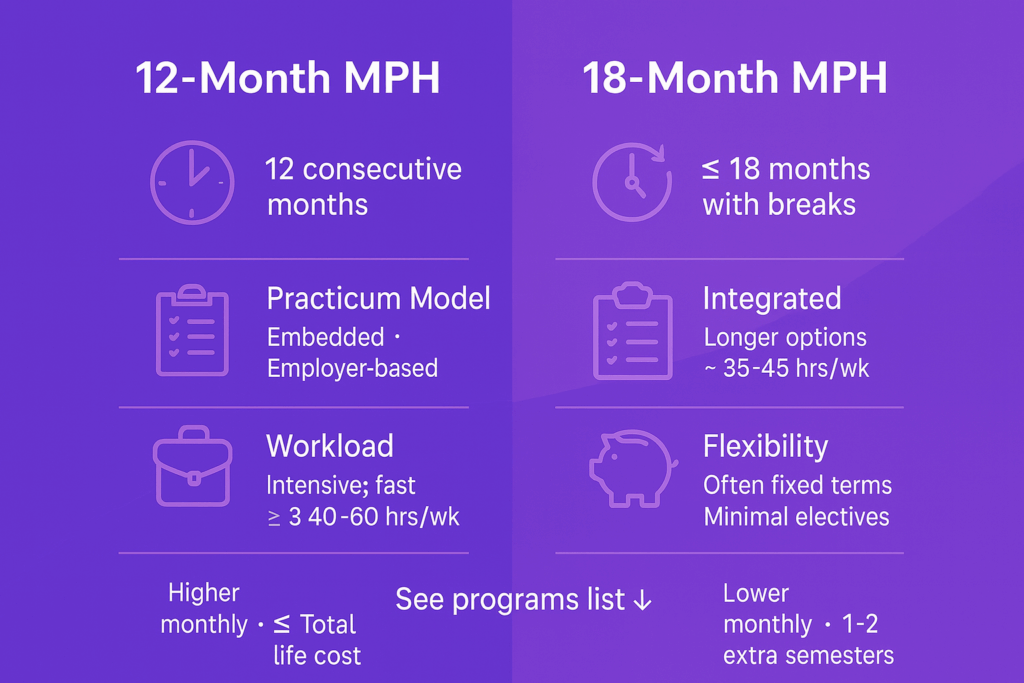
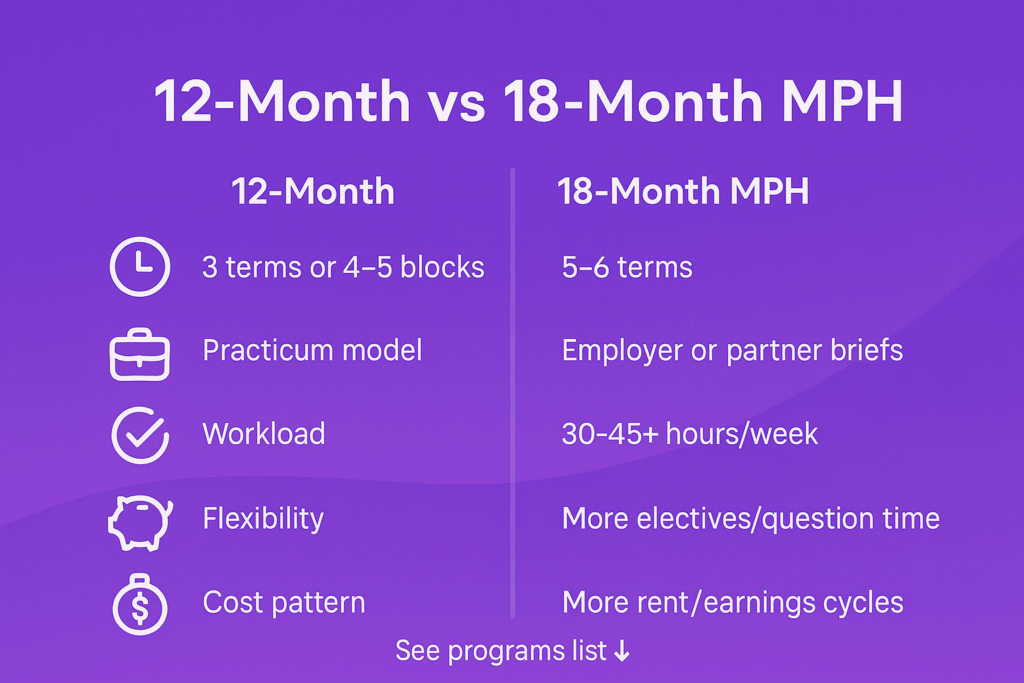
“1-year MPH,” “12-month MPH,” and “accelerated MPH” are shorthand for fast-track public health master’s programs that compress a traditional 42–48 credit curriculum into roughly 12 consecutive months. While the label sounds straightforward, schools structure the calendar in different ways—so it’s important to read the fine print.
The Core Definition (and Where Schools Differ)
- True 12 months vs. three terms:
Some programs run exactly 12 months (e.g., June–May). Others market a “one-year” experience but span three academic terms (Summer–Fall–Spring or Fall–Spring–Summer). Both can be completed in ~12 months, but term boundaries and holiday gaps vary. - Clock time vs. pace:
The contact hours and credits mirror a standard MPH; the pace is what changes. Expect heavier course loads, shorter modules (e.g., 7–8 weeks), and overlapping assignments. - Modality matters:
You’ll find on-campus, fully online, and hybrid/low-residency formats. Online can offer flexibility, but accelerated timelines still demand full-time bandwidth.
Practicum & Capstone in an Accelerated Timeline
- Embedded practicum:
Many fast-track programs integrate practicum hours alongside coursework to avoid extending the calendar. This requires early site selection and tight project scopes. - Intensive blocks:
Some schools batch applied practice experiences into short, high-output blocks (e.g., winter or summer intensives). - Employer-based projects:
If you’re already working in health, programs may allow workplace projects that meet competencies—confirm policies in advance. - No shortcuts on requirements:
CEPH-aligned competencies still apply. Legitimate accelerated programs do not waive core skills or practice experiences; they resequence them.
Specializations Offered (and Not Offered)
- Not every concentration is available on a 12-month track. Generalist, Epidemiology, Health Policy/Management, and Global/Community Health are common; high-lab or data-heavy specializations (e.g., advanced biostatistics) may be limited or longer. Always compare track availability before you apply.
Admissions Labels to Decode
- Accelerated, 1-Year, 12-Month, Express, Executive:
These terms are used interchangeably, but executive MPH options often target mid-career professionals and may include low-residency weekends or intensives. - GRE-optional ≠ math-optional:
Even where GRE is waived, you’ll need quant readiness (intro stats/epi). Some schools require a refresher or placement module.
Realistic Time Commitment
- Plan for 40–60+ hours/week across classes, projects, and practicum. Most students do not maintain standard full-time employment while succeeding in a true 12-month plan. If you need to work significant hours, a 16–18 month accelerated-standard program may fit better.
Accreditation Caveat (Non-Negotiable)
- For credibility with employers and eligibility for many public health roles, verify the program or school is CEPH-accredited. Accreditation ensures your accelerated MPH still covers foundational competencies and recognized practice standards.
Bottom line: A one-year MPH is the same degree delivered on a condensed calendar. You’re trading elective breadth and schedule flexibility for speed to impact—great for prepared, focused applicants who plan their practicum early and manage time like a pro.
How We Picked the Programs (No Hype, Just Checks)
You don’t need another vague “best of” list—you need to know how the names got on it. Here’s the simple, human process we used to build a trustworthy shortlist of accelerated, 12-month MPH options.
The non-negotiables
Before anything else, a program had to clear these basics:
- It’s a real MPH. Master of Public Health degree only—no MS/MHA/certificate stand-ins.
- It can be finished in ~12 consecutive months. Not “a year… plus an extra term for practicum.” We looked for calendars that show three back-to-back terms or a clearly marked 12-month plan.
- It’s CEPH-accredited. Accreditation keeps the curriculum aligned with public-health competencies employers recognize.
- It’s documented in writing. Curriculum map, credits, practicum/capstone, and admissions details are visible on official pages.
What we cut (and why)
We passed on programs that:
- Market “one-year” on the homepage but slip to 15–24 months once you read the fine print.
- Hide practicum details or imply it might extend beyond the stated timeline.
- List conflicting info across pages with no way to resolve it.
- Aren’t clearly CEPH-accredited.
The “prove it” pass
For each candidate, we did a sanity check you can replicate:
- Clock check: Do term dates and credit loads add up to ~12 months of continuous study?
- Practicum reality: Is practice work built into the schedule (embedded hours or intensive blocks), not tacked on later?
- Admissions clarity: Are GPA expectations, GRE policy, and any stats/epi prerequisites spelled out?
- Money on the page: Per-credit or total tuition listed, plus notable fees. When schools only post ranges, we note that.
How we prioritized (student-first)
We didn’t chase prestige; we chased usability:
- A credible 12-month path (no hidden extensions).
- Coherent course sequencing for a compressed calendar.
- Format fit (online, campus, or hybrid) and practical start terms.
- Plain-English costs you can plan around.
- Career alignment: practicum/capstone work you can show hiring managers.
A note on numbers and dates
Tuition changes. We cite what the school publishes and include the check date in our internal notes; you should still confirm before you apply. And a 12-month MPH is intense by design—expect sustained, full-time effort.
Bottom line: If a program appears in our guide, it’s there because the school provides clear, public, verifiable proof that you can complete a CEPH-accredited MPH in about a year—and the plan holds up when you read past the headline.
Reality Check: Will a 12-Month MPH Work for You?
An accelerated MPH is the same credential on a tighter clock. You’re trading breathing room for speed. Before you jump in, pressure-test the fit against your actual routine, not your best intentions.
The cadence—no gloss, just truth
- Everything overlaps. Core courses, practicum tasks, and capstone prep run in parallel. You won’t “finish one, then start the next.”
- Modules fly by. Many schools teach in 7–8-week blocks. Miss one week and you’re digging out.
- Teams cost time. Evening huddles, weekend edits, last-minute slide fixes—group work is real work.
Sample week (typical, not extreme):
Mon: Methods lecture → problem set draft
Tue: Team sync after class (45–60 min)
Wed: Epi lab + data cleaning for practicum
Thu: Policy seminar; capstone outline due 23:59
Fri: IRB email replies; faculty office hours
Sat: Literature review sprint (2–3 hrs)
Sun: Deck polish + plan next week
Who usually thrives
- Working clinicians/health staff used to shift pace and cross-disciplinary coordination.
- Quant-ready applicants who can handle basic stats and spreadsheets (or will brush up immediately).
- People with protected time—a year where school is the main job and family/employer are on board.
- Career switchers with a destination, e.g., “county epi analyst,” who can shape a practicum around that target.
When a longer track is the smarter call
Choose 16–18 months if you:
- Must work 20+ hours/week or have ongoing caregiving.
- Want elective depth, faculty-mentored research, or lab-heavy tracks.
- Need a gentler ramp back into math and coding.
- Value networking via multi-term internships and campus time.
Four prep moves that pay off
- Stats tune-up: Descriptive/inferential basics, study design, probability. A short boot camp or MOOC is enough to knock off rust.
- Pick one tools lane: Start in Excel/Sheets if you must, but sample R/Stata/SPSS/Python on a tiny public dataset (clean → summarize → simple chart).
- Calendar discipline: Block fixed study windows and team slots now. Treat them like clinic shifts—non-negotiable.
- Front-load the practicum: Identify a site and supervisor, narrow the scope, and list approvals (IRB, data use) before coursework peaks.
One-minute fit check (answer yes/no)
- I can treat school as a full-time job for 12 months.
- I’m comfortable with basic stats or will bridge this month.
- I know the role or domain I’m aiming for and can align a practicum.
- My work/family setup won’t pull me from key study blocks.
Bottom line: A 12-month MPH rewards planning, stamina, and a clear end goal. If you need more exploration time, want to earn while you study, or plan to dive deep into electives and research, stretching to 16–18 months delivers the same competencies with less turbulence—and often more networking mileage.
Admissions at a Glance (Accelerated 12-Month MPH)
Getting into a one-year MPH is less about prestige and more about readiness. Committees look for evidence that you can handle a compressed calendar without sacrificing quality. Use this section as a concise checklist.
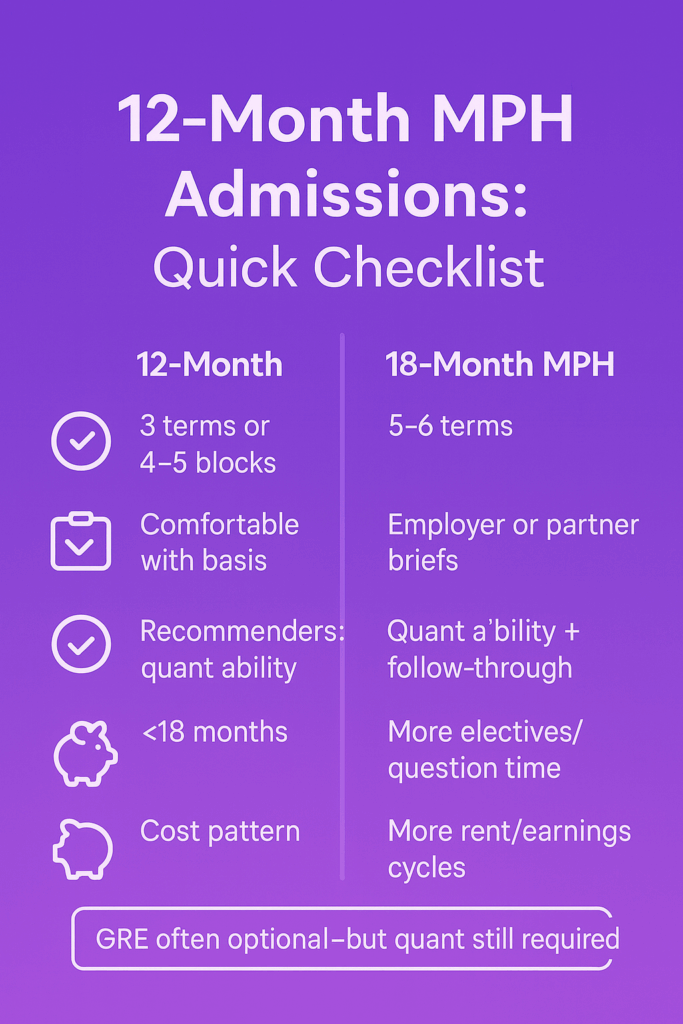
Core Requirements You’ll Almost Always See
- Bachelor’s degree from a recognized institution (any field; health/quant backgrounds help).
- GPA guidance: many programs state ≥3.0 minimum; competitive cohorts often skew higher.
- Prerequisites or proof of readiness: intro statistics and basic research methods/epi are common asks. If you lack them, some schools offer a short boot camp or placement module.
- Statement of purpose (SOP): clear target role (e.g., epi analyst, program manager), why 12 months, and how you’ll manage the pace.
- Resume/CV: highlight health experience, data skills, leadership/service, and any outcomes (dashboards, reports, protocols).
- Letters of recommendation (2–3): at least one academic (speaks to quant/analytic ability) and one professional (reliability under pressure).
- Transcripts: include any post-bacc or certificate work that demonstrates quant preparedness.
GRE Policy (and What Replaces It)
- Many accelerated MPH tracks are GRE-optional/waived.
- Waiver ≠ math waiver: committees still check quant readiness via transcripts (stats, calc, econ), work samples, or a short assessment/bridge.
What Strengthens a Fast-Track Application
- Evidence of time discipline: full-time clinical roles, project delivery under deadlines, or prior intensive study.
- Data comfort: coursework or experience with Excel/Sheets, plus exposure to R/Stata/SPSS/Python (even basic).
- Practicum concept: a short paragraph naming a theme/site type and feasible deliverables (e.g., “syndromic surveillance brief + dashboard prototype”).
- Impact snippets: bullets showing outcomes—“reduced turnaround by 18%,” “authored SOP adopted by X clinic,” “co-authored poster.”
International Applicant Notes
- English proficiency: TOEFL/IELTS/Duolingo per school policy; check subscore minimums.
- Credential evaluation: some schools require WES/ECE.
- Timeline realism: accelerated calendars compress visa, housing, and practicum onboarding—start earlier than you think.
Common Interview/Video Prompt Themes
- Why an accelerated MPH (not 18–24 months)?
- A time you delivered under pressure and what you’d change.
- How you’ll keep up with quantitative courses.
- Practicum idea and how it aligns with your career plan.
Fast Checklist (Before You Hit Submit)
- ✅ SOP names a target role + your plan to manage the pace
- ✅ Transcript shows stats (or you enroll in a pre-term refresher)
- ✅ Recommenders can attest to quant ability and follow-through
- ✅ Resume lists tangible outputs (reports, dashboards, protocols)
- ✅ Practicum concept is scoped and realistic for 12 months
Bottom line: Admit decisions hinge on fit for speed—clear goals, quant readiness, credible time management, and a practicum plan that can be delivered on a compressed clock.
Cost, Funding & ROI for a 12-Month MPH: Your Money Map
A true one-year MPH squeezes the same credits, practicum, and capstone into a single continuous cycle. Financially, that means fewer rent cycles and faster re-entry to a higher salary, but also larger monthly bills while you’re enrolled. Use this section to build a realistic plan—not just a wish list.
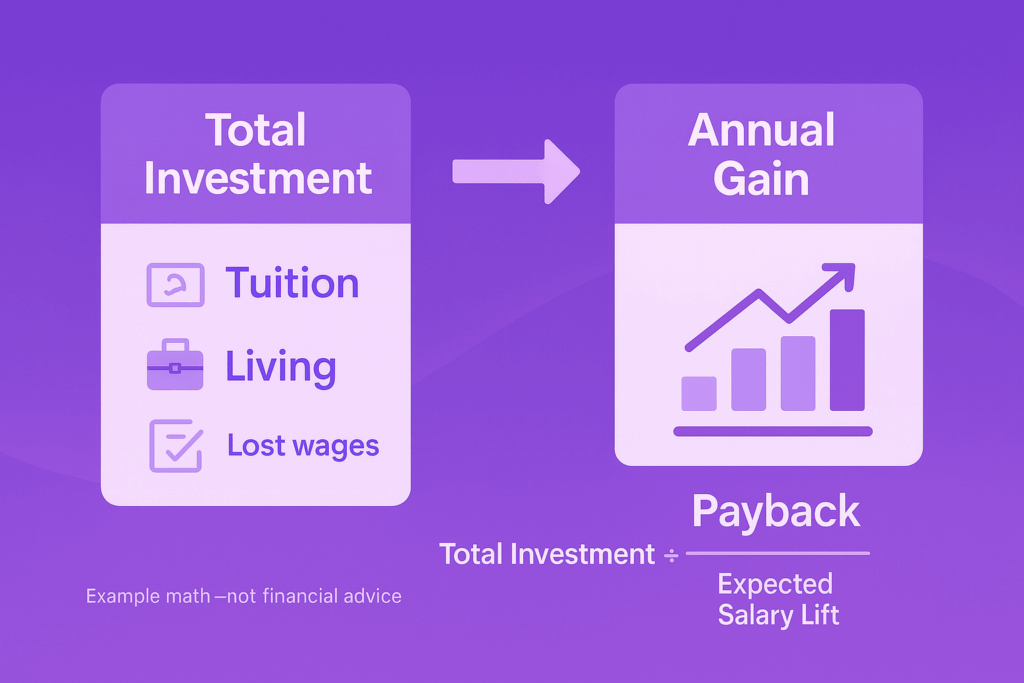
1) Build the budget you’ll actually live with
Think in totals and cash-flow (when money is due), not just sticker price.
Direct school costs
- Tuition (per credit or flat program rate)
- Mandatory fees (registration, tech, health services, graduation)
- Course extras (stat/epi texts; proctoring; software—sometimes campus licenses cover these)
Study-life costs
- Housing and utilities for 12 straight months
- Health insurance and copays
- Transport (commute to campus or practicum), data/Wi-Fi, printing
- One-off admin: background checks, immunizations, drug screens for placements
Often missed
- Bridge courses/bootcamps before term start
- Residency travel for hybrids (lodging + flights)
- Capstone printing/binding (if required)
- Late or change fees when plans shift
Cash-flow tip: Put every due date (tuition, fee tranches, rent) on a calendar. Align aid disbursements and set aside a small buffer so a delayed stipend doesn’t trigger a late fee.
2) Funding stack that fits a fast track
Because a one-year plan leaves little room for long RA/TA appointments, assemble support before day one.
- Institutional awards: Many schools offer merit/need packages decided at admission. Apply by priority deadlines.
- Employer sponsorship: Hospitals, health departments, and NGOs sometimes cover part of tuition if your role aligns with population health.
- Short projects & hourly research work: Not full assistantships—think scoped tasks tied to a faculty grant.
- External scholarships: Professional associations, local foundations, state public-health societies; smaller awards add up.
- Loans: Federal first (if eligible), then private. Borrow for direct costs + modest living—not for lifestyle creep.
How to phrase your ask (employer email skeleton):
“I’m beginning a 12-month CEPH-accredited MPH focused on [focus]. The practicum will deliver [output] directly relevant to our [unit]. I’m requesting tuition support of [amount/percentage] in exchange for [deliverable/retention period].”
3) Cash-burn math vs. total cost
Two truths can coexist:
- Monthly burn is higher in a one-year plan (more credits per term).
- Total life cost can be lower than a two-year plan (12 months of rent vs. 18–24, and you start earning sooner).
Create two columns in your sheet:
Column A: 12-Month Track
- Tuition + fees + extras
- 12 months living
- Lost wages while studying
- Minus scholarships/sponsorships
Column B: 18–24-Month Track
- Tuition + fees (often similar total, spread out)
- 18–24 months living
- More time to work part-time (reduce lost wages)
- Minus scholarships/sponsorships
Now compute payback:
Payback (years) = Total Investment ÷ Annual Salary Lift
If your post-MPH role reasonably adds $15–25k/year, many students see ~2.5–4.0 years to break even. The accelerated path often shortens real time-to-break-even because you return to full earnings sooner.
4) Two quick scenarios (illustrative, not offers)
A) Working clinician stepping into epi
- Investment (12 months): $54k total (tuition/fees $38k; living $14k; extras $2k) – $10k aid = $44k
- Prior salary $62k → post-MPH $82k ⇒ $20k lift
- Payback ≈ 2.2 years
B) Non-clinical career switcher
- Investment (12 months): $58k – $6k aid = $52k
- Prior salary $48k → post-MPH $66k ⇒ $18k lift
- Payback ≈ 2.9 years
- Note: Internship-to-offer pipelines and a strong practicum portfolio often shorten the search.
5) Dials you can turn to improve ROI
- Pick a role with clear bands. Epidemiology analyst, program manager, surveillance specialist, evaluation associate—roles with published pay ranges reduce guesswork.
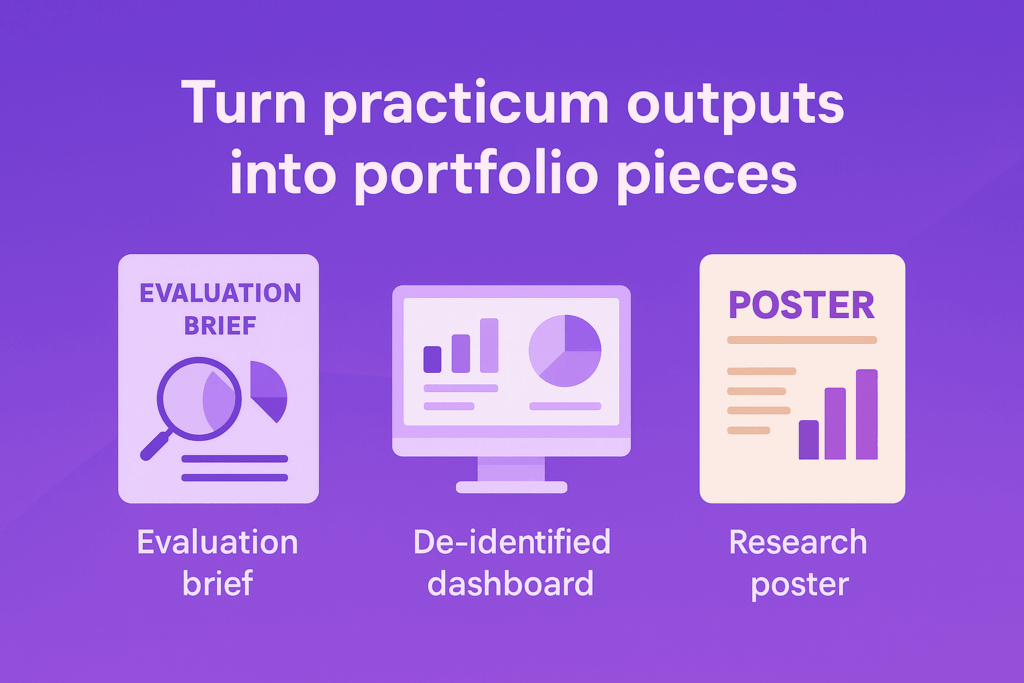
- Make your practicum hire-ready. Deliver a dashboard, a protocol, or an evaluation brief you can show (with de-identified data).
- Choose one analysis tool and get fluent. R, Stata, SPSS, or Python—practical competency moves résumés to the “interview” pile.
- Network where hiring happens. Local health departments, hospital quality teams, Medicaid analytics vendors, community NGOs.
6) Guardrails that prevent overrun
- Don’t bank on working 20+ hours/week. A true 12-month load rarely tolerates it without grades or health taking a hit.
- Lock housing early (sublets, roommate agreements) to avoid peak-season rent spikes.
- Confirm software/licenses (campus site licenses may save hundreds).
- Read the fine print on proctoring and course surcharges before registration.
7) International student notes (brief, practical)
- Budget for credential evaluation and English-testing fees if required.
- Confirm health-insurance rules and costs; campus plans can be cheaper than private options.
- Practicum onboarding (clearances, site approvals) can take weeks—starting the paperwork early avoids extra rent months.
8) A 6-step money plan you can finish tonight
- List every cost line; tag each with a due month.
- Add awards you already have; mark “probable” vs. “secured.”
- Create a term-by-term cash calendar (tuition drops, rent, travel).
- Decide the minimum loan to keep a one-month buffer.
- Draft two employer ask emails (tuition aid + flexible hours during residency weeks).
- Sketch your practicum output (what you’ll deliver) and how it feeds your résumé.
Bottom line: A one-year MPH concentrates both effort and expense, but it also shortens the path to new earnings. If you secure partial funding, keep living costs predictable, and turn the practicum into a portfolio piece, the financial case for the accelerated route can be stronger than a longer track—without sacrificing the credential or competencies employers expect.
Best Accredited 1-Year MPH Programs (2025 Shortlist)
Below are verified, CEPH-aligned options you can finish in ≈12 months. I’ve grouped them by format and included what stands out—timeline, practicum model, and notable admissions notes. Always confirm current details on the school site before you apply.

Online (fully online or low-residency)
George Washington University (MPH@GW) — 12-Month Online MPH
Intensive online track that mirrors the campus MPH; students average ~11.5 credits/quarter and are not permitted to work due to the pace. Starts multiple times per year; practicum is embedded. (GW-UMT)
Drexel University Dornsife — 12-Month Online MPH (Global Health or Urban Health)
A true one-year online MPH in defined concentrations. Drexel also offers an accelerated hybrid 12-month plan (first quarter online, remaining on campus). Expect a heavy weekly load; plan your schedule accordingly. (Drexel University)
Harvard T.H. Chan — MPH-45 (1-Year, Full-Time)
Harvard’s 45-credit MPH is designed as a one-year academic program for qualified applicants (multiple fields of study). It’s a campus-based year; a separate low-residency MPH-Epi exists but is part-time. (Harvard SPH Content)
Hawai‘i Pacific University — Accelerated Online MPH (≈12–16 months)
CEPH-accredited program with an accelerated calendar; full-time students may finish in ~12 months. Useful for applicants prioritizing an online format with frequent start windows. (HPU Catalog)
On-Campus (residential, intensive)
Johns Hopkins Bloomberg — Full-Time MPH (≈11 Months, July–May)
Among the most recognized accelerated MPH options: five 8-week terms to complete 80 quarter credits (≈53 semester). Practicum and capstone are integrated; multiple electives let you tailor depth despite the pace. (Johns Hopkins Public Health)
Dartmouth (The Dartmouth Institute) — Residential MPH (11 months)
Compact, hands-on curriculum with a structured practicum intensive. CEPH accreditation is listed on the site, which outlines three format options; the residential track runs 11 months.. (Dartmouth Health Sciences)
Emory Rollins — 12-Month MPH in Global Health (In-Person)
Three consecutive semesters (fall–spring–summer) totaling 12 months, including applied practice and an integrative learning experience; the 3rd term offers online flexibility for working pros. (Rollins School of Public Health)
Emory Rollins — 12-Month MPH in Health Care Management (In-Person)
Also a three-semester, 12-month plan focused on leadership and operations in health systems. Good fit for candidates with prior practical experience. (Rollins School of Public Health)
Boston University SPH — MPH (as fast as 1 year)
BU confirms you can complete the MPH in one year (though many students choose 16–24 months). If you pursue the fast track, map the practicum and module sequence early. (Boston University)
University of Miami — Accelerated MPH (1 Calendar Year, Summer–Summer)
An officially designated Accelerated MPH that follows the standard 42-credit curriculum on a summer-to-summer schedule. Miami notes a competitive GPA profile for this track. (Graduate Studies)
USC Keck — MPH (as few as 3 consecutive semesters, on-campus)
Designed as a two-year degree, but some concentrations can be finished in 3 back-to-back semesters. Verify your track and practicum timing to keep the plan within ~12 months. (Keck School of Medicine of USC)
Hybrid (mix of online & campus)
Drexel University Dornsife — 12-Month Hybrid MPH
Quarter 1 is online, followed by three on-campus quarters in Philadelphia. The program page details workload expectations and application deadlines for the accelerated cohort. (Drexel University)
Quick selection tips
- Match the format to your bandwidth. Fully online 12-month tracks (e.g., GW, Drexel) are no-work by design.
- Check concentration availability. Some schools limit which specializations run on the 12-month calendar (see Emory’s 12-month Global Health & HCM). (Rollins School of Public Health)
- Verify the calendar, not the marketing. Look for explicit statements like “11 months,” “summer–summer,” or “three consecutive semesters,” plus how the practicum fits the clock. (Johns Hopkins Public Health)
Curriculum & Workload: A Real Look Inside a 12-Month MPH
A true one-year MPH doesn’t trim the degree—it compresses it. You still hit the MPH foundations (epi, biostats, policy/management, social & behavioral, environmental health), but the order and pacing change so that courses, the practicum, and the capstone sit much closer together. Here’s how it typically unfolds when you’re actually living it.
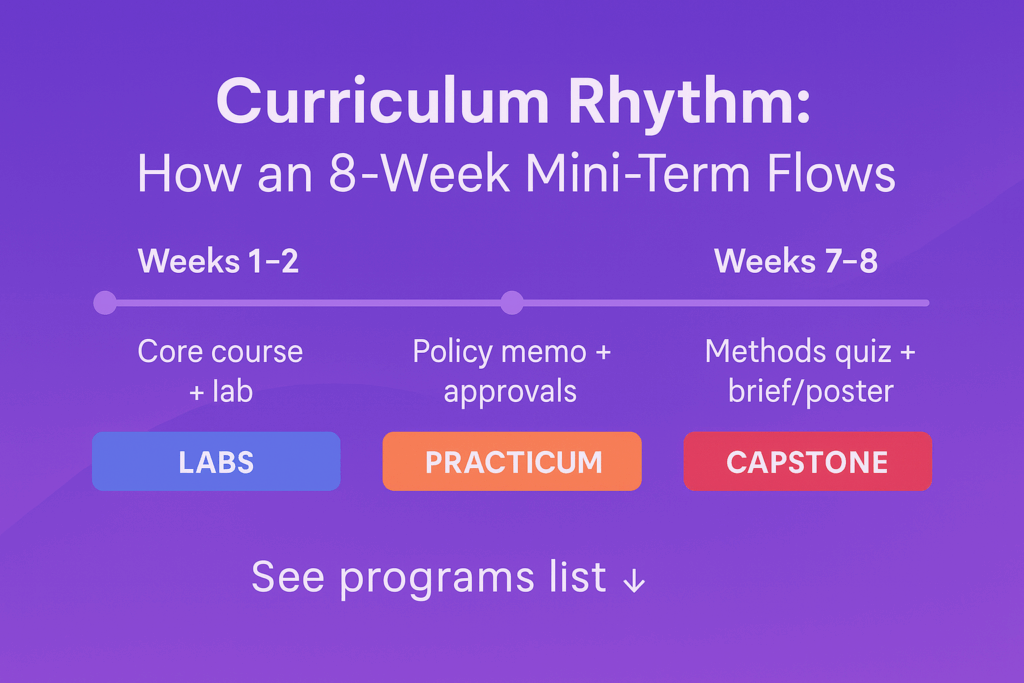
How the year is stitched together
Most schools use one of three blueprints:
- Three straight terms (Fall → Spring → Summer): Core methods arrive first, practicum launches early spring, and the capstone wraps by late summer.
- Five mini-blocks (~8 weeks each): Assessments reset every two months; you’ll juggle two courses plus a lab or practicum milestone per block.
- Quarter system (four terms): Smaller bundles per term, fewer breaks. Practicum often spans two quarters so you can collect data in one and present in the next.
Translation: there’s rarely a “quiet” month. Courses overlap with fieldwork by design.
What you actually study (and in what rhythm)
- Epidemiology: study designs, bias/confounding, surveillance basics; quick move into interpretation of tables and measures.
- Biostatistics: regression, model diagnostics, and hands-on analysis in R, Stata, SPSS, or Python. Expect weekly labs rather than a single midterm.
- Policy & management: financing, delivery systems, operations; frequent memos and short briefings rather than long essays.
- Social & behavioral sciences: determinants, program design, implementation and evaluation; group projects with real stakeholders are common.
- Environmental/occupational health: exposure pathways, risk assessment, and control strategies; some schools weave in climate and disaster readiness.
Electives still exist, but in a 12-month plan you’ll take fewer, more targeted ones—often aligned to the practicum and capstone.
Practicum and capstone—without adding extra months
Well-run accelerated programs embed practice hours in the calendar. Typical flow:
- Scope: weeks 2–4—pick a site or employer project, define a feasible question, list 2–3 deliverables (e.g., a surveillance brief, a dashboard, a short evaluation).
- Build: middle of the year—data cleaning, basic analysis, draft figures/tables.
- Ship: final term—submit a brief or poster and convert it into your capstone paper or presentation.
If you already work in health, employer-based projects often count—confirm the competencies and supervision requirements early.
Graded work you’ll see again and again
- Methods problem sets and labs (weekly or biweekly)
- Short policy memos and stakeholder briefs with concrete recommendations
- Team decks/posters in lieu of long essays
- Compressed quizzes/midterms; fewer high-stakes finals, more iterative grading
A realistic weekly footprint (most weeks)
- Classes/seminars: 8–12 hours
- Labs/tutorials: 3–6 hours
- Independent study & assignments: 15–25 hours
- Team meetings & shared docs: 4–8 hours
- Practicum tasks: 6–12 hours
Total: about 40–60+ hours, with obvious spikes near deliverable weeks.
One mini-term, mapped
- Weeks 1–2: Methods core + first lab; confirm practicum topic and data access.
- Weeks 3–4: Policy memo due; IRB or site paperwork in flight.
- Weeks 5–6: Team analysis → draft slides; practicum figures v1.
- Weeks 7–8: Methods quiz; submit poster or brief; revise capstone outline.
Where people stumble—and how to dodge it
- Methods pile-up: When epi and biostats peak together, split work into two shorter lab blocks in your calendar (e.g., Tue/Thu 90 minutes) instead of one weekend marathon.
- Team churn: Decide file names, versioning, and “hand-off by” times in the first meeting. Rotate a scribe so notes don’t vanish.
- Practicum drift: Write a one-page scope (question → dataset → 2–3 outputs → timeline). Share it with your supervisor before week 3.
- Tool sprawl: Pick one analysis environment for the term and stay there; switching between R, Stata, and Python burns hours.
Minimum toolkit that saves time
- Data: Excel/Sheets plus one stats tool (R/Stata/SPSS/Python)
- References: Zotero or Mendeley with a shared group library
- Project flow: a Kanban board (Trello/Notion) + calendar blocks you treat like clinic shifts
- Templates: a memo shell and a slide master you reuse across courses
Habits that keep the pace humane
- Ship early drafts (tables/figures first, prose second). Faculty can react to something concrete.
- Bundle outputs so practicum charts feed the capstone.
- Protect one off-day every week. A rested brain writes better code and cleaner memos.
- Ask for help fast—stats tutors and writing centers are there for exactly this calendar.
Bottom line: The 12-month MPH is the full curriculum on a tighter cadence. If you scope the practicum early, standardize your tools, and defend your weekly blocks, you’ll finish on time—and walk out with portfolio-ready briefs, posters, and dashboards that matter in job interviews.
Special Cases & FAQs (Fast Answers for a Fast Track)
Are 1-year MPH programs CEPH-accredited?
Many are, but not all. Treat CEPH accreditation as non-negotiable for employer recognition and licensure-adjacent roles. Verify the school or program on the CEPH directory before you apply.
Can you work full-time while in a 12-month MPH?
Realistically, no. A true accelerated plan runs ~40–60+ hours/week. Some schools explicitly discourage outside work for the one-year cohort. If income is essential, consider a 16–18-month route or secure employer sponsorship with reduced hours.
Do accelerated MPH programs waive the practicum?
They shouldn’t. CEPH-aligned programs embed or intensify applied practice rather than waive it. Expect shorter, tightly scoped projects (often employer-based) that still map to required competencies.
Are GRE scores required?
Increasingly optional. A waiver doesn’t waive math: committees still expect quant readiness through transcripts (stats/epi, calc/econ), short assessments, or a pre-term refresher.
What GPA do I need?
Published minimums commonly sit around 3.0; competitive accelerated cohorts often land higher. A lower GPA can be offset by strong recent quant coursework, clear SOP, and evidence you’ve handled fast-paced work.
Can international students pursue a 12-month MPH?
Yes—plan earlier. Compressed calendars tighten visa, housing, and practicum onboarding timelines. Confirm English-language requirements and any placement approvals well ahead of term 1. (For post-study work authorization, consult your institution’s international office—this is procedural, not academic, guidance.)
What if my background isn’t in health?
Plenty of students pivot in. Strengthen your file with an intro stats course, relevant volunteering or analytics projects, and a practicum concept tied to your target role (e.g., surveillance brief for a local health department).
How intense is the math/statistics—and how can I prep?
Expect epi + biostats with hands-on software. Refresh descriptive/inferential stats and study design; pick one tool (R, Stata, SPSS, or Python) and practice on a small public dataset. Aim for functional competence, not perfection.
Bottom line: A one-year MPH suits applicants who are quant-ready, time-disciplined, and destination-focused. If you need more flexibility or exploration, choose a slightly longer track—you’ll earn the same credential with more breathing room.
Internal Links
Related MPH Guides
Use these linked guides to compare degree fit, accreditation, and costs before you apply.
