Public health scholarships in the USA are not rare, but most students never find the ones that actually fit their profile. Tuition for an MPH can easily reach $40,000–$70,000 a year, so you need a clear plan to combine scholarships, assistantships, work, and only minimal loans.
Table of Contents
Public Health Scholarships in the USA (2025–2026): How to Fund Your MPH
An MPH in the USA is expensive, and it’s getting worse, not better.
Typical tuition for an MPH alone is roughly $20,000–$70,000 per year, depending on the university and format. (Collegedunia) At a top school like Johns Hopkins, the estimated 2025–2026 full-time MPH cost of attendance (tuition plus mandatory fees and basic living costs) can push close to $90,000 for an 11-month year. (Johns Hopkins Public Health) Harvard’s published graduate tuition rates for 2025–2026 are in the same general ballpark. (Harvard Chan School of Public Health)
From July 2026, the federal loan environment gets tighter. The “One Big Beautiful Bill Act” (P.L. 119-21) phases out Grad PLUS loans and introduces new caps for federal graduate loans, with most “non-professional” programs limited to about $20,500 per year and $100,000 lifetime. (Investopedia) That cap is lower than the full cost of a 2-year MPH at many schools, which means you can’t realistically plan to just borrow everything.
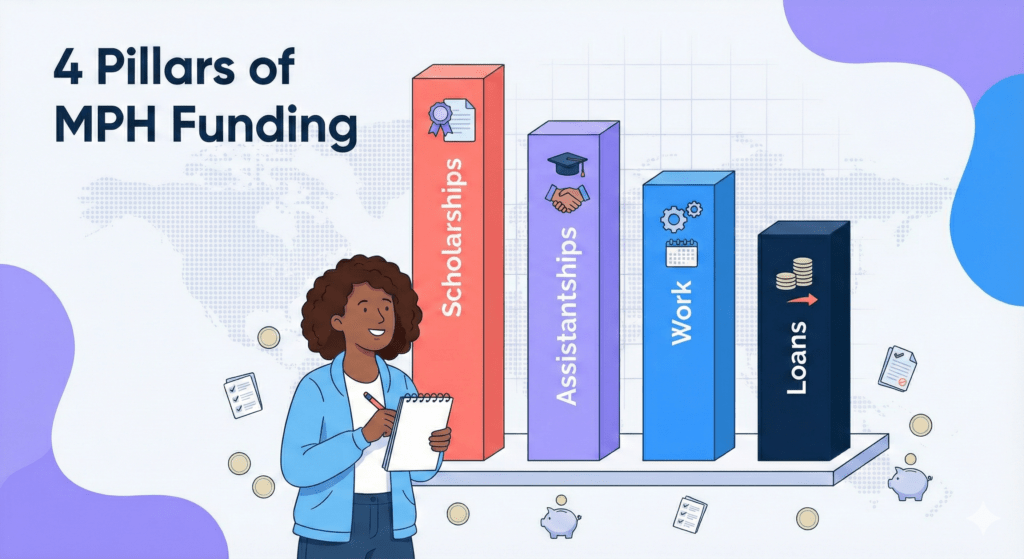
Because of that, funding an MPH in 2025–2026 is no longer about finding one magic scholarship. It’s about building a deliberate stack of school-based scholarships, external awards, work options, and only then loans to close the remaining gap.
Quick answer: How do you fund an MPH in the USA in 2025–2026?
The practical way to fund an MPH now is:
- Start with school-based scholarships and discounts.
Many US Schools of Public Health offer institutional scholarships, automatic discounts, or central scholarship pools for MPH students (e.g., Colorado School of Public Health’s central scholarship application, OHSU–PSU SPH graduate scholarships, Tufts’ automatic MPH discount). (coloradosph.cuanschutz.edu) - Add external public-health or development scholarships.
The Joint Japan/World Bank Graduate Scholarship Program (JJ/WBGSP) is one of the main fully funded options for eligible applicants from developing countries to study development-related master’s degrees, including some public-health-related programs. (World Bank) - Layer in assistantships, campus jobs, and employer support.
Many MPH programs offer teaching or research assistant roles, and some employers (hospitals, health departments, NGOs) provide partial sponsorship. - Use federal loans only as the last layer.
With Grad PLUS disappearing and total federal borrowing capped for most non-professional programs, loans can no longer be the main pillar; they’re the gap-filler. (Investopedia)
If you don’t start this stack before the main scholarship deadlines (usually December–February), most of the serious money will simply not be available to you.
What are the best public health scholarships in the USA for 2026?
For 2026 entry, there are a handful of scholarships and institutional deals that stand out:
- One fully funded route (for eligible applicants from developing countries).
- Several strong school-based scholarship systems with 2026 deadlines.
- Department-level awards that pay for high-cost components like global health fieldwork.
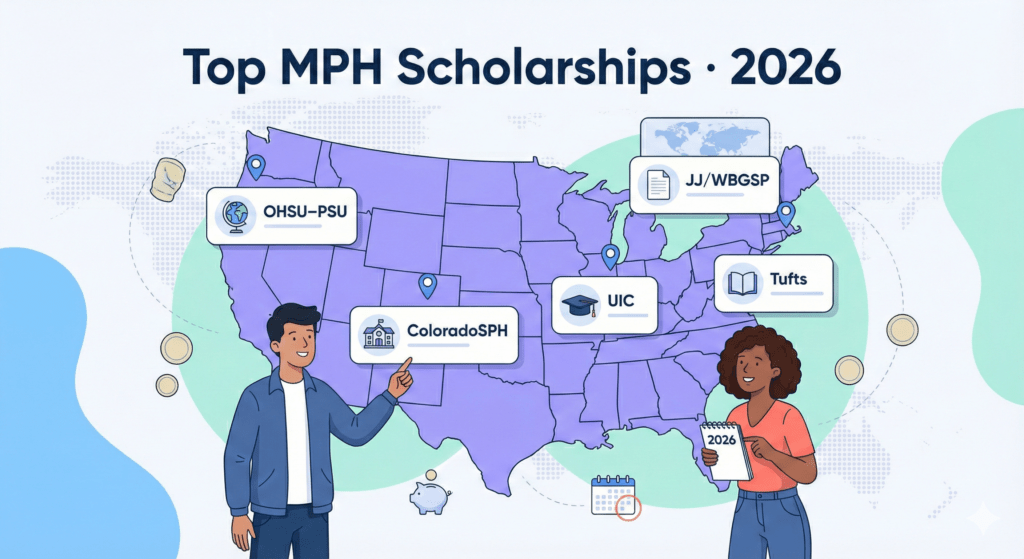
Joint Japan/World Bank Graduate Scholarship Program (JJ/WBGSP), 2026 Intake
The Joint Japan/World Bank Graduate Scholarship Program (JJ/WBGSP) is one of the very few truly fully funded master’s scholarship schemes that still cover study at selected universities in the US and elsewhere in development-related fields.
- What it funds
JJ/WBGSP covers tuition, a monthly living stipend, round-trip airfare, health insurance, and a travel allowance for mid-career professionals from eligible developing countries to pursue approved master’s programs. (World Bank) - 2026 application windows
For developing-country nationals, the World Bank has announced two application windows for the 2026 cycle:- Window 1: From January 15 to February 27, 2026 (for a subset of participating programs). (World Bank)
- Window 2: From March 30 to May 29, 2026 (for the remaining programs). (World Bank)
- Relevance to public health
JJ/WBGSP funds master’s programs in development-related fields at an approved list of universities worldwide. Public-health-related and health-policy programs are included among these participating programs at various institutions. (World Bank)
For any applicant from an eligible country who wants an MPH- or health-policy–oriented degree and meets the work-experience requirements, JJ/WBGSP is effectively the top fully funded option in the 2026 landscape.
Colorado School of Public Health – Central Scholarship Application (Deadline: 1 February 2026)
The Colorado School of Public Health uses a single central scholarship application for a block of MPH/MS scholarships.
- Central application structure
ColoradoSPH lists multiple scholarships (Capek Family Scholarship, COBank Public Health Rural Scholarship, and others) that all use the same CSPH central scholarship application. (coloradosph.cuanschutz.edu) - 2026 deadline
The official scholarship instructions state clearly that the deadline to submit the central scholarship application is February 1, 2026. (coloradosph.cuanschutz.edu) - Who it’s for
These awards are aimed at current and prospective ColoradoSPH students with financial need, with some funds targeting particular profiles such as Colorado residents or students from rural communities or with rural-health interests. (coloradosph.cuanschutz.edu)
Because a single form gives access to several internal scholarships, this is one of the more efficient 2026-dated scholarship pools for anyone planning to study at ColoradoSPH.
OHSU–PSU School of Public Health – Graduate Scholarships (Open December 2025; Close Around March 2026)
The OHSU–PSU School of Public Health in Portland administers a set of graduate scholarships for MPH and other public health students.
- Dean’s Scholarship (graduate)
The SPH Dean’s Scholarship provides US$10,000 for MPH students and US$15,000 for PhD students. (OHSU-PSU School of Public Health)- Eligibility focuses on SPH students (first-generation is prioritized), with a minimum GPA and credit load requirement. (OHSU-PSU School of Public Health)
- The scholarship open date is listed as December 2025, with deadlines typically falling in March 2026 for the 2025–2026 academic cycle (consistent with SPH scholarship pages that give March 2026 deadlines for similar funds). (OHSU-PSU School of Public Health)
- Other SPH scholarships
The same graduate-scholarship area also includes other named awards and SPH Dean’s Scholarship funds that support both master’s and doctoral public-health students, with open dates around late 2025 and deadlines around March 2026. (OHSU-PSU School of Public Health)
For students targeting OHSU–PSU SPH, these are realistic mid-four-figure to low-five-figure awards that can cut a noticeable chunk off total tuition if you apply between December and March.
Tufts University Master of Public Health – Automatic 25% Tuition Scholarship
Tufts has one of the simplest deals in the US MPH market.
- Automatic tuition discount
The Tufts University Master of Public Health program explicitly states that it offers a 25% tuition scholarship to all admitted students in the standalone MPH, whether they study online or on campus. (Tufts School of Medicine) - No separate application
This 25% scholarship is automatically awarded to incoming standalone MPH students regardless of financial need or academic merit and does not require any extra scholarship application. (Tufts School of Medicine) - Why it’s important
Instead of gambling on a competitive named scholarship, an admitted student can treat this as a guaranteed 25% discount on published MPH tuition, which materially changes the real per-credit price.
For anyone considering Tufts, this automatic scholarship is effectively part of the baseline financial package and should be treated as such in cost planning.
UIC School of Public Health – Global Health Scholarships (Fieldwork Support for MPH/MS Students)
At the University of Illinois Chicago (UIC) School of Public Health, several scholarships specifically support global health training and fieldwork for MPH/MS students.
- Parikh Scholarship and related awards
The Dr. Rajesh & Nayana Parikh Scholarship is open to graduate MPH or MS students at UIC SPH, with eligibility criteria including a minimum 3.0 GPA and enrollment in the School of Public Health; recipients are expected to use the funding for global health fieldwork or related experiential learning. (UIC School of Public Health) - Paul Brandt-Rauf Scholarship in Global Health
The UIC Global Health Program also administers the Paul Brandt-Rauf Scholarship in Global Health and other global-health scholarships, designed to support students engaged in international or underserved-population health work as part of their training. (UIC School of Public Health) - How it fits into MPH funding
These awards typically do not replace core tuition but cover the additional costs of global health practica and field placements (travel, living costs abroad, project expenses). For students pursuing an MPH with a strong global-health component, that can significantly reduce out-of-pocket costs for the most expensive experiential components of the degree.
For a 2026-entry applicant who is serious about global health and considering UIC SPH, these departmental scholarships are a key part of the funding picture alongside any general tuition discounts or external awards.
How many public health scholarships exist for MPH students?
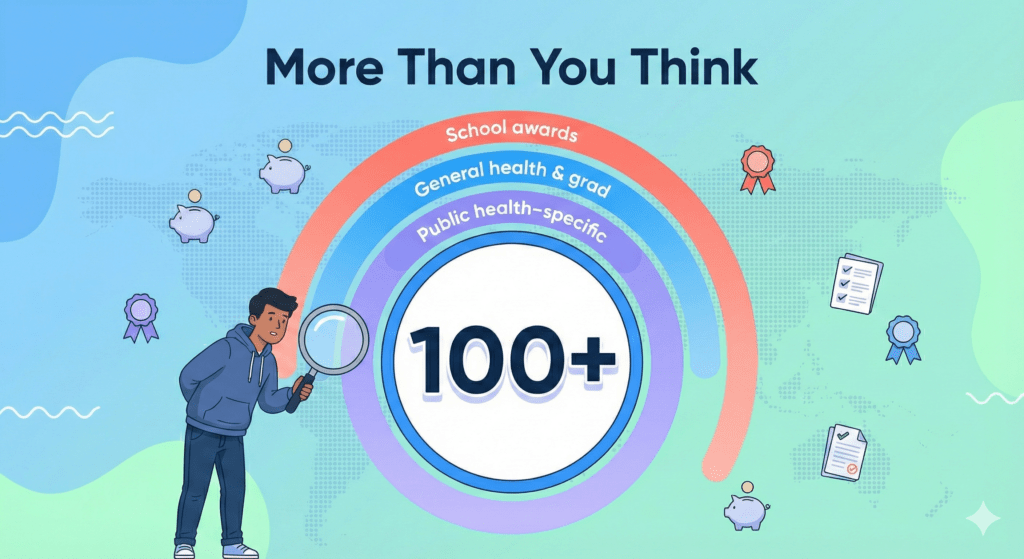
There isn’t a single master spreadsheet that tells you “there are exactly 213 MPH scholarships,” but you can get a realistic sense of scale by looking at the main scholarship ecosystems that actually matter.
First, there are the public-health–specific lists:
- MPHOnline publishes a curated list of 25 public health scholarships focused on students in public health and closely related areas. (MPH Online)
- PublicHealthDegrees.org has a fresh list of 25 public health scholarships for graduate students, updated in November 2025. (publichealthdegrees.org)
So just from niche public-health sites, you’re already at roughly 25–50 clearly labelled public health scholarships, not counting internal school awards.
Then you have the big scholarship platforms and directories:
- Bold.org’s public health category markets itself as having “Top 49 Public Health Scholarships” plus many other health-related awards you can filter by major. (Bold)
- MastersPortal’s scholarship search returns around 580 scholarships for public health at master’s level in the United States alone, and over 2,300 scholarships when you look at public health worldwide. (MastersPortal)
- Scholarships.com has a dedicated “Public Health Scholarships” page listing dozens of awards tied to “Public Health” as an academic major, plus many more under broader health and science categories. (Scholarships)
On top of that, every serious School of Public Health has its own internal funding:
- Colorado School of Public Health uses a central scholarship application feeding multiple MPH/MS awards with a 2026 deadline. (ASPPH)
- OHSU–PSU School of Public Health runs a portfolio of graduate scholarships including the Dean’s Scholarship and other named funds.
- UIC School of Public Health offers global-health–focused scholarships for MPH/MS students’ fieldwork. (Online MPH Degree)
- Tufts builds a 25% tuition scholarship directly into its standalone MPH pricing, which is effectively an automatic internal award.
Most other U.S. SPHs (Harvard, Johns Hopkins, UNC, Emory, etc.) also maintain multi-line scholarship and grant portfolios for their own students. (ASPPH)
If you zoom out and stop obsessing over the exact number, the picture is roughly:
- 25–50 scholarships that are clearly branded as public health scholarships on niche MPH/public-health sites. (MPH Online)
- Dozens more public-health and health-equity awards visible on platforms like Bold.org once you filter by major or category. (Bold)
- Hundreds of MPH-eligible scholarships in large databases (MastersPortal, Scholarships.com and similar), where “public health” appears as either the field of study or a qualifying major. (MastersPortal)
- Internal funding at almost every SPH, often split into 5–20 different pots per school (central merit funds, diversity scholarships, global-health awards, rural-health awards, alumni-named funds, etc.). (ASPPH)
The real problem is not that there are “no scholarships for public health.” The problem is that the information is fragmented across niche lists, big scholarship platforms, and individual school websites.
If you’re an MPH applicant, the practical takeaway is:
- Don’t waste time hunting for one magical list.
- Start with 1–2 curated public-health lists, layer in searches on large platforms (MastersPortal, Bold.org, Scholarships.com), then go school by school through the “scholarships” or “financing your degree” pages of your target MPH programs.
That’s how you actually surface a realistic set of 10–20 scholarships and internal awards you can apply for, instead of staring at “thousands of results” and doing nothing.
Types of Funding for an MPH in the USA (2025–2026)
When you strip away marketing language, there are only a handful of real ways people pay for an MPH in the USA. The smart move is to treat each one as a separate pillar and build a mix that fits your profile instead of fantasising about one perfect full-ride.
1. University-Based MPH Scholarships and Tuition Discounts
Almost every serious School of Public Health has some combination of:
- Merit scholarships (GPA/test scores/overall profile)
- Need-based grants
- Automatic tuition discounts
Examples:
- Tufts University MPH gives an automatic 25% tuition scholarship to all standalone MPH students, online or on campus – no extra application.
- Colorado School of Public Health runs a central scholarship application that feeds multiple MPH/MS awards with a single form, with its current cycle deadline set at 1 February 2026.
- OHSU–PSU School of Public Health offers graduate scholarships such as the Dean’s Scholarship (US$10,000 for MPH, US$15,000 for PhD) and other named awards, typically opening in December and closing around March each year.
This category is your first stop because:
- You only compete against people actually in your program or applicant pool.
- Some discounts (like Tufts’ 25%) are guaranteed if you’re admitted, unlike external lotteries.
2. External Public Health and Development Scholarships
These are scholarships not tied to a single university. They either target:
- Public health / health equity specifically, or
- Development-related master’s programs, including public-health-adjacent degrees.
Examples:
- The Joint Japan/World Bank Graduate Scholarship Program (JJ/WBGSP) funds mid-career professionals from eligible developing countries to do approved development-related master’s degrees, covering tuition, living stipend, airfare, and insurance, with two application windows in 2026.
- Niche lists like MPHOnline and PublicHealthDegrees.org surface 25+ named public health scholarships each, including awards for health equity, maternal and child health, and under-represented groups. (MPH Online)
These are highly competitive but powerful if you fit the criteria (citizenship, work experience, specific focus area). They make the most sense when:
- You come from an eligible country or under-represented group
- Your CV already shows real public-health or community work, not just a generic interest.
3. Government and Service-Linked Programs
Some funding is tied directly to public service obligations:
- Internationally, schemes like Fulbright or country-specific scholarships (e.g. for Pakistani students, HEC overseas scholarships) can fund public-health master’s in the USA if the MPH fits their priority fields. (MastersPortal)
- Programs like JJ/WBGSP explicitly require several years of professional experience and a commitment to return and work in a developing country after graduation.
These are great if:
- You’re fine with bonded service or return obligations.
- You’re already in the public or NGO sector and can frame your MPH as a direct investment in your country’s health system.
If you want maximum freedom to work anywhere after the MPH, read the fine print carefully.
4. Fellowships and Traineeships
Fellowships usually come in two flavours:
- Study fellowships – pay part or all of your tuition and sometimes a stipend while you are a student.
- Post-MPH fellowships – pay you to work in structured training roles (e.g. at CDC, health departments, NGOs) after you finish.
Examples:
- Several US-based fellowships in health policy, global health, or epidemiology fund MPH study plus practical placements, though the exact list changes by year and many are school-specific. (MastersPortal)
Fellowships are brutally competitive but can be worth it if:
- You have a lean CV but with very strong alignment to a specific area (e.g. firearm injury prevention, rural health, HIV, global health).
- You’re willing to accept structured work placements as part of the deal.
5. Assistantships, Work-Study, and Campus Jobs
This is the classic grad-school play: work for the university and let them subsidise your degree.
Typical options:
- Teaching Assistant (TA) – leading discussion sections, grading, sometimes lecturing.
- Research Assistant (RA) – working on a faculty member’s research project.
- Graduate Assistant (GA) – administrative or project work in a department or centre.
Many US universities offer tuition remission plus a stipend in exchange for 10–20 hours per week of work; details vary by school and department. (Bold)
For MPH students, these roles:
- Usually don’t cover everything, but can cut 5–20k per year off your real cost.
- Are easier to land if you come in with relevant skills (statistics, programming, prior teaching, or real field experience).
If you ignore assistantships and only chase scholarships, you’re leaving a big pillar of funding on the table.
6. Employer Sponsorship and Tuition Reimbursement
A lot of public-health professionals don’t pay alone – their employer helps.
Common scenarios:
- Hospitals, health systems, and larger NGOs that offer tuition reimbursement up to a set yearly cap if your degree is relevant to your role. (Scholarships)
- Government health departments that sponsor staff for part-time MPH programs in exchange for a service commitment.
This route is underrated because:
- It’s not advertised on scholarship sites; you have to check HR policies or ask directly.
- It often works best for part-time or online MPH where you can keep working while you study.
If you’re already employed in health, this can be a quiet but powerful funding stream that stacks with school scholarships.
7. Loans and Income-Driven Repayment (Gap-Filler Only)
You are not going to avoid loans completely in most cases, but after 2026 you are also not going to live off federal debt the way previous cohorts could.
Key points:
- The new US law phasing out Grad PLUS loans for graduate students and capping total federal borrowing for many programs at around $100,000 means you simply cannot plan to finance a full two-year MPH at a high-cost school purely with federal loans. (Scholarships)
- Federal loans still matter because they come with income-driven repayment and potential forgiveness options, especially for those who stay in public or non-profit jobs long term. (MastersPortal)
The realistic approach in 2025–2026:
- Treat loans as a gap-filler after scholarships, assistantships, work, and employer support are maxed out.
- Run the math on your expected post-MPH salary versus monthly loan payments under income-driven plans; if the numbers don’t line up, you’re overpaying for the degree.
Put bluntly: your MPH funding plan for 2025–2026 should not be “pray for one full-ride.” It should be:
- Squeeze maximum institutional discounts and internal scholarships out of your target schools.
- Add 1–3 serious shots at external or government/service-linked scholarships where you actually fit the criteria.
- Secure at least one assistantship or employer subsidy if you can.
- Only then, use federal loans to plug the remaining hole – and avoid private loans unless you’ve done cold, hard ROI math.
2026 public health scholarships in the USA: key options, amounts & deadlines
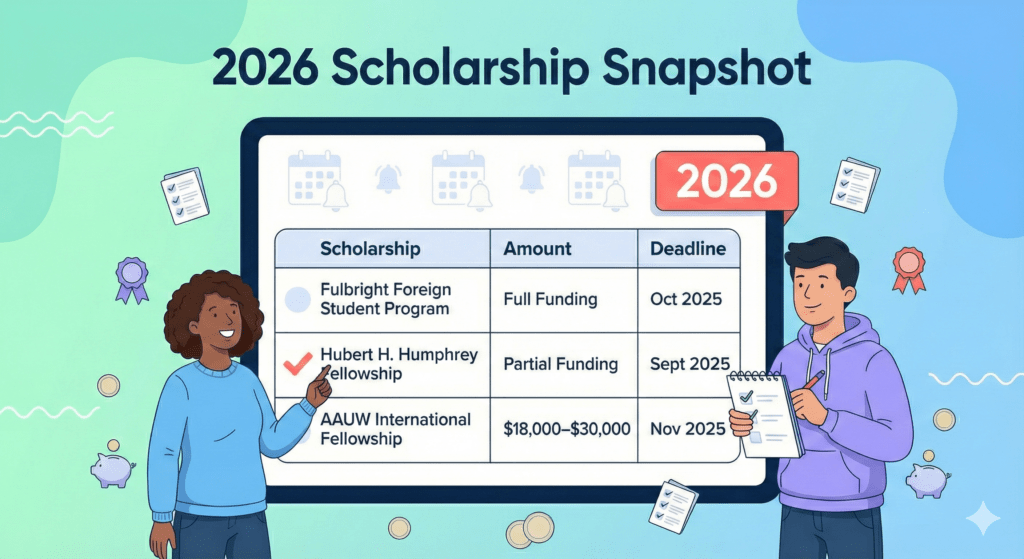
Here are concrete, dated scholarships you can still target for the 2026 intake. This is exactly the kind of thing a reader wants when they search “MPH scholarships 2026” – names, amounts, and deadlines in one place.
Snapshot table: 2025–2026 public health scholarships
| Scholarship / Provider | Type of funding | Who it’s for | Amount | 2025–2026 timing / deadlines* |
|---|---|---|---|---|
| Joint Japan / World Bank Graduate Scholarship Program (JJ/WBGSP) | Fully funded master’s (incl. tuition, stipend, airfare) | Citizens of eligible developing countries admitted to a participating master’s in a development field (incl. some MPH-style programs) | Tuition + living stipend + round-trip airfare + health insurance | Application Window #1: Jan 15–Feb 27, 2026; Window #2: Mar 30–May 29, 2026 (World Bank) |
| OHSU–PSU SPH – Provost Workforce Development Scholarship (Online MPH in Public Health Practice) | Automatic tuition scholarship | New online MPH in Public Health Practice students starting summer/fall 2026 | USD 12,000 total toward tuition and fees, disbursed in 2026–27 (or split over 2 years for the part-time track) (OHSU-PSU School of Public Health) | No separate scholarship form – automatically awarded once you’re admitted and enroll for 2026 |
| OHSU–PSU SPH – Named graduate scholarships (Dean’s, Celeste Davis, June Conway, Mitch Greenlick, O’Kelley-Bangsberg, etc.) | Competitive school-based scholarships | MPH/MS/PhD students at OHSU–PSU SPH (with priorities like first-gen, American Indian/Alaska Native, PhD epidemiology, etc.) | Roughly USD 1,000–10,000 depending on the scholarship (OHSU-PSU School of Public Health) | Most open Dec 2025 and close Mar 1 or Mar 15, 2026 for awards disbursed in fall 2026 |
| Colorado School of Public Health – Central Scholarship Application | One application for multiple internal scholarships | Prospective and continuing ColoradoSPH students with financial need | Varies by scholarship (Capek Family, COBank Rural, Leadership & Advocacy, etc.) | Central application deadline: Feb 1, 2026 for the 2026–27 year (coloradosph.cuanschutz.edu) |
| ColoradoSPH additional MPH scholarships (e.g., Chris Wiant, Hoffman, Judith Albino, etc.) | Targeted competitive awards | Current or incoming ColoradoSPH students (often MPH; some focus on epidemiology, communicable disease, etc.) | Typically USD 1,000–5,000+ per award (coloradosph.cuanschutz.edu) | Several have fixed dates, e.g. Aug 1 (Hoffman, Chris Wiant), or priority deadline Jan 1 / Feb 1 (Firearm Injury & Violence Prevention) |
| Tufts University MPH – automatic public health scholarships | Automatic tuition discount | All admitted standalone MPH students (online or on-campus) | 25% tuition scholarship for standalone MPH; 15% for B/MPH (equivalent to ~25% overall) (Tufts School of Medicine) | No separate scholarship form. For Fall 2026 MPH, final program deadline is Apr 15, 2026 (priority Jan 15, 2026) (Tufts School of Medicine) |
| UIC School of Public Health – Global Health Scholarships (Donna Farley, Passaro, Parikh, Paul Brandt-Rauf, MPH/MS Global Health Scholarship) | Travel / field-experience scholarships | MPH/MS/PhD/DrPH students at UIC with global health projects, often in low-/middle-income countries | Typically up to USD 1,000–1,500 per award, often 1–3 awards per term (UIC School of Public Health) | Application period for the 2025–2026 cycle is open now; awards are usually made for fall and spring terms – exact dates are set each year on the Global Health Scholarships page |
*Always check the official page again before applying – schools update dates every cycle.
1. Joint Japan / World Bank Graduate Scholarship Program (JJ/WBGSP)
If you’re from a low- or middle-income country and want a fully funded public-health-related master’s in the US, this is the heavyweight option.
The JJ/WBGSP funds mid-career professionals from eligible developing countries to study one of 44 participating master’s programs in development fields – including several public-health and health-policy programs in the US. The scholarship covers tuition, a monthly living stipend, round-trip airfare, health insurance, and a travel allowance. (World Bank)
For the 2026 intake:
- Application Window #1: 15 January – 27 February 2026
- Application Window #2: 30 March – 29 May 2026 (World Bank)
To even get the application link, you must first be admitted (unconditionally, except for funding) to one of the official JJ/WBGSP participating master’s programs, and be shortlisted by that university as a candidate. (World Bank)
For an MPH-focused reader, the realistic path is:
- Identify participating programs that are public-health or closely related.
- Apply early to those programs in late 2025.
- Once admitted, request to be considered for JJ/WBGSP and follow the instructions from the host university.
2. OHSU–PSU SPH: Provost Workforce Development Scholarship (Online MPH in Public Health Practice)
If you want an online MPH with a guaranteed discount, OHSU–PSU’s Provost Workforce Development Scholarship for the Online MPH in Public Health Practice is one of the clearest 2026-labelled deals.
Key facts: (OHSU-PSU School of Public Health)
- For new students starting in summer or fall 2026 in the online MPH in Public Health Practice (2-year or 12-month track).
- Scholarship amount: USD 12,000 total toward tuition and fees.
- If you choose the accelerated 12-month option, the full 12,000 is disbursed in the 2026–27 academic year.
- If you study part-time over two years, it’s typically USD 6,000 per year for two years.
- You don’t submit a separate scholarship application. All new students in the qualifying program automatically receive the award, as long as they’re enrolled in at least three credits per term.
Practically, your “deadline” is the program’s admission deadline for summer/fall 2026. Miss that, and you miss both the seat and the 12k discount.
3. OHSU–PSU SPH internal scholarships with 2026 deadlines
Beyond the Provost award, OHSU–PSU SPH lists several named scholarships targeted at MPH and PhD students, with clear December 2025 opening dates and 2026 deadlines. These are competitive, essay-based awards and are very relevant if you’re already in the school or admitted for 2026.
Examples (all MPH-relevant): (OHSU-PSU School of Public Health)
- Dean’s Scholarship
- Amount: USD 10,000 for MPH (USD 15,000 for PhD).
- Focus: first-generation graduate students, often from historically underserved or marginalized groups.
- Opens: December 2025.
- Deadline: 15 March 2026.
- Celeste Davis Memorial Fund
- Amount: USD 2,000.
- Focus: American Indian/Alaska Native graduate students in the SPH.
- Opens: December 2025.
- Deadline: 15 March 2026.
- June E. Conway Scholarship in Public Health
- Amount: USD 2,000.
- Focus: first-generation students in the SPH.
- Opens: December 2025.
- Deadline: 15 March 2026.
- Mitch Greenlick Public Health Scholarship
- Amount: USD 8,000.
- Focus: PhD students in public health, including MD/PhD.
- Opens: December 2025.
- Deadline: 1 March 2026.
- O’Kelley-Bangsberg Scholarship
- Amount: USD 2,500.
- Focus: first-generation SPH students with financial need.
- Opens: December 2025.
- Deadline: 15 March 2026.
All share a single online process via the SPH scholarship portal, with shared essay questions. If you’re writing this article, it’s worth stressing that a single strong personal statement can put you in the running for multiple awards at once.
4. Colorado School of Public Health: central application + extra MPH funding
ColoradoSPH is one of the few schools that publishes a single, clearly dated, central scholarship deadline for 2026.
For the 2026–27 academic year: (coloradosph.cuanschutz.edu)
- Central CSPH scholarship application deadline: 1 February 2026
- One application covers multiple internal awards, including:
- Capek Family Scholarship (Colorado residents)
- COBank Public Health Rural Scholarship (rural or rural-interest students)
- Leadership & Advocacy Scholarship
- Public Health Education Scholarship
- Hannah Spears Memorial Scholarship (MPH students)
- Hoffman Scholarships for MPH and MS students
On top of the central pool, a set of “Additional” scholarships have their own dates: (coloradosph.cuanschutz.edu)
- Chris Wiant Scholarship – application due Aug 1.
- Hoffman Communicable Disease Control / Epidemiology Scholarships – applications accepted June 1–Aug 1 each year.
- Hoffman Firearm Injury & Violence Prevention Scholarship – priority deadline Jan 1, final deadline Feb 1.
From an SEO/AEO angle, this is gold because you can anchor a clear answer like:
“Yes, you can still apply for MPH scholarships in early 2026 – for example, the Colorado School of Public Health’s central scholarship application is open to prospective and continuing students with a firm deadline of February 1, 2026.”
5. Tufts MPH: automatic 25% scholarship for Fall 2026
Tufts frames its MPH financial aid as a built-in discount rather than a classic “apply for a scholarship” process, but for most students the effect is the same: lower tuition without writing extra essays.
For the standalone Tufts MPH: (Tufts School of Medicine)
- All admitted standalone MPH students (online or on-campus) receive a 25% tuition scholarship automatically.
- B/MPH students get a 15% graduate-level discount, structured so the overall saving is about 25% once you factor in the undergraduate portion.
- No separate scholarship form. You just need to submit a complete MPH application through SOPHAS.
Ttimeline:
- Fall 2026 MPH deadlines:
- Priority: 15 January 2026
- Final: 15 April 2026
- Financial-aid priority filing date for Fall 2026: 27 February 2026 (for loans/work-study etc.). (Tufts School of Medicine)
Someone planning ahead, this is an easy example of a “guaranteed” MPH scholarship in the USA for 2026 – as long as they can get admitted.
6. UIC School of Public Health: global health scholarships for MPH fieldwork
UIC’s Global Health Scholarships aren’t full-tuition awards, but they matter for students who want to do fieldwork, especially abroad.
The Global Health Program offers several named scholarships – Donna Farley, Douglas Passaro, Rajesh & Nayana Parikh, Paul Brandt-Rauf, and an MPH/MS Global Health Scholarship – which help cover travel and project costs for MPH, MS, PhD, or DrPH students doing global-health–related applied practice experiences, theses, or dissertation work. Typical awards are up to USD 1,000–1,500, with one to three awards per term. (UIC School of Public Health)
For 2025–2026, the Global Health Scholarship application period is already open, and students apply through a common application that includes:
- A tailored personal statement
- A budget for travel / project costs
- Host-organization and faculty-supervisor letters
- Transcript and language information where relevant (UIC School of Public Health)
How to find more public health scholarships in the USA (without drowning)
If you just Google “MPH scholarships USA”, you’ll get thousands of results and zero clarity. The only sane way to do this is to use a small set of high-leverage sources and a system.
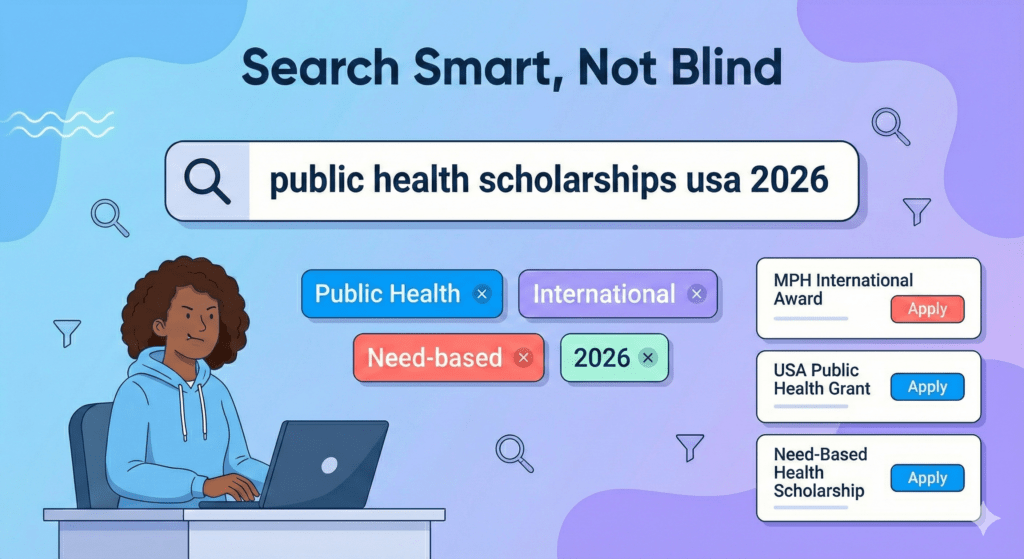
Here’s how to do it step by step.
1. Start with niche public health scholarship lists
Begin with sites that already curated the field for you:
- MPHOnline – 25 Public Health Scholarships
MPHOnline has a guide featuring 25 public health scholarships, aimed specifically at students in public health. It’s old as a page but still a useful starting map, with each scholarship linked out to the official site. (MPH Online) - PublicHealthDegrees.org – 25 Public Health Scholarships & Tips
This is more current: PublicHealthDegrees.org published a list of 25 public health scholarships for graduate students in November 2025, including award amounts and whether they target special interest groups like under-represented communities, global health, or health equity. (publichealthdegrees.org) - MPHProgramsList.com – 50+ Public Health Scholarships & Grants
This guide aggregates 50+ scholarships and grants for public health, listing the source, basic qualifications, amount, and a direct link to each scholarship’s own page. (MPH Programs List)
From these three alone, you can easily pull 30–60 realistic MPH-relevant scholarships without touching generic “healthcare” lists.
2. Use big scholarship platforms with filters (don’t scroll blindly)
Once you’ve squeezed the niche lists, move to the big aggregators – but use filters, otherwise you’ll drown.
- Bold.org – public health & healthcare categories
Bold.org has a dedicated “Public Health Scholarships” page with “Top 49 Public Health Scholarships” plus an underlying database of other awards you can filter by major, background, and interests. (Bold)- Start in Public Health → then check related categories like Healthcare, Nursing, Women, STEM, or regional categories that might still fund an MPH. (Bold)
- MastersPortal – scholarships for Public Health
MastersPortal lists hundreds of scholarships when you filter by Master’s + Public Health + United States, and around 2,300+ scholarships worldwide for master’s in public health. (MastersPortal)- Use filters: country = United States, field = Public Health, degree = Master’s.
- Save anything that clearly allows MPH or “health sciences / medicine & health” master’s. (MastersPortal)
- Scholarship lists tied to public health portals
MastersPublicHealth.com, PublicHealthCareerEDU.org and similar sites maintain state or program-level scholarship lists for public health degrees. (masterspublichealth.com)
The goal here isn’t to click everything. It’s to find 10–30 scholarships where your profile actually fits (citizenship, degree level, field, GPA, demographic).
3. Check each target school’s official “scholarships” or “financing your degree” page
This is where the real, often-better money hides.
Almost every accredited School of Public Health has:
- A “Scholarships & Financial Aid” page under Admissions or Current Students.
- Internal awards only visible on that site, not on Bold.org or generic directories.
Examples of what you find when you actually look:
- Colorado School of Public Health – a central scholarship application with a fixed February 1 deadline for 2026–27, plus additional MPH/epidemiology scholarships like Hoffman and Firearm Injury & Violence Prevention funds with their own date ranges. (MPH Online)
- OHSU–PSU School of Public Health – a graduate scholarship page listing the Dean’s Scholarship, Celeste Davis, June Conway, Mitch Greenlick, O’Kelley-Bangsberg and others, all with December open dates and March 2026 deadlines. (OHSU-PSU School of Public Health)
- UIC School of Public Health – a Global Health Scholarships page with multiple named awards (Farley, Passaro, Parikh, Paul Brandt-Rauf), each supporting MPH/MS/PhD global-health fieldwork. (UIC School of Public Health)
- Tufts University MPH – a tuition and scholarships page explaining the automatic 25% scholarship for standalone MPH students and the key Fall 2026 deadlines. (Tufts School of Medicine)
- ASPPH (Association of Schools and Programs of Public Health) – a “Financing Your Degree” hub that explains typical funding types (scholarships, assistantships, loans) and links out to member schools’ financial aid information. (ASPPH)
If you don’t click into these school-level pages, you’ll miss half the realistic funding you’re eligible for.
4. Filter opportunities based on your profile instead of chasing everything
Once you’ve built a long list from niche sites, big platforms, and school pages, you need to brutally filter:
- Citizenship / region
- Many scholarships are restricted to U.S. citizens/permanent residents or to particular states or service areas (e.g. foundation scholarships targeting specific hospitals or regions). (Midland Daily News)
- Degree level
- Cut anything that’s obviously undergrad only or strictly for MD, PharmD, or PhD unless they explicitly allow MPH/MPH-equivalent.
- Field and concentration
- Prioritise awards that explicitly mention public health, health policy, epidemiology, global health, health equity, community health.
- Demographic or professional criteria
- Under-represented groups, first-generation students, Indigenous students, rural origin, disability, specific religious or ethnic communities, etc. These often have better odds because the pool is narrower. (publichealthdegrees.org)
You’re aiming to end up with a shortlist of 10–20 scholarships where you are actually a strong fit. Everything else is noise.
5. Build a simple tracking table and align it with deadlines
Dump your shortlist into a basic table or spreadsheet:
| Scholarship | Type (external / school / project) | Amount | Deadline | Requires admission first? | Status |
|---|---|---|---|---|---|
| JJ/WBGSP | External, fully funded | Full | Feb 27 / May 29, 2026 | Yes | Not started |
| ColoradoSPH Central | School internal | Varies | Feb 1, 2026 | Yes (or applicant) | Drafting essays |
| Tufts MPH 25% | School automatic | 25% off tuition | Program app deadlines | No extra form | Submitted |
Why bother? Because scholarship ecosystems are deadline-driven:
- Bold.org and similar platforms constantly show live deadlines – you either hit them or you don’t. (Bold)
- School scholarships typically hit a December–March window for the coming academic year. (OHSU-PSU School of Public Health)
If you don’t put all the dates and statuses in one place, you will miss things, guaranteed.
6. Use general healthcare/medicine scholarship lists only as a bonus
There are broad healthcare and medicine scholarship lists with decent money:
- Bold.org’s Healthcare Scholarships page lists health-related awards and explains that public health students can use categories like Healthcare, Nursing, STEM, and Women to find extra scholarships. (Bold)
- MastersPortal lists hundreds of Medicine & Health and Health Sciences scholarships in the US that may accept MPH students, especially if they’re not ultra-specific about degree type. (MastersPortal)
Use these after you’ve exhausted public-health-specific and school-level options, not before. Otherwise you’ll waste time on half-relevant awards with low odds.
Sample 12-month funding plan for a 2026 MPH in the USA
Most people “plan” funding by panicking three months before the deadline. That’s how you end up with no scholarships and a ridiculous loan bill.
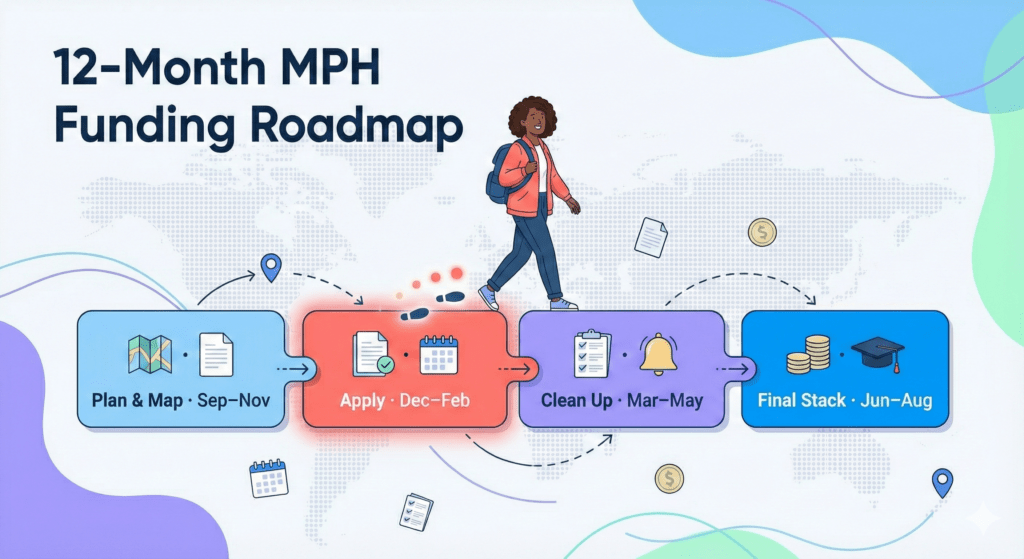
Here’s a sane 12-month plan you can follow if you want to start an MPH in Fall 2026 (or any 2026 start) and actually give yourself a shot at real money.
12–10 months before start (Sep–Nov 2025): map programs + scholarship windows
This is where most of the work is, and almost nobody does it properly.
Your goals in this phase:
- Decide on 5–8 target MPH programs in the USA.
- For each program, write down:
- Application deadlines
- Scholarship/priority deadlines (often earlier than the final deadline)
- Whether scholarships are automatic or require a separate form
- Start building a longlist of scholarships you could realistically apply for.
Typical patterns you’ll see:
- Many Schools of Public Health tie scholarship consideration to a December 1 priority deadline:
- University of Minnesota SPH: SOPHAS app submitted and verified by Dec 1 for first-round scholarships. (School of Public Health)
- Michigan SPH: priority scholarship deadline Dec 1, 2025 for 2026 entry. (U-M School of Public Health)
- UTHealth School of Public Health: Dec 1 is the priority deadline to be considered for new-student scholarships. (UTHealth)
- Dartmouth MPH/MS: Dec 1 “Priority Scholarship” deadline; Feb 1 “Final Guaranteed Scholarship” deadline. (Dartmouth Health Sciences)
- At the same time, big external schemes (e.g. Fulbright for Pakistan) open in early December and close around early March for the following academic year. (USEFP)
And ASPPH’s own guidance is blunt: many graduate scholarships close in October–December, often before the program’s final admissions deadline. (ASPPH)
So in this phase you:
- Shortlist programs.
- Note every Dec–Feb date attached to scholarships/admissions.
- Build a first draft of your scholarship spreadsheet with:
- Program-linked scholarships
- External schemes (JJ/WBGSP, Fulbright, public-health specific lists) (ASPPH)
If you skip this mapping step, you will miss things you can’t recover later.
9–7 months before start (Dec 2025–Feb 2026): hit priority scholarship deadlines
This is crunch time. For Fall 2026 entry, Dec 2025–Feb 2026 is where the real money sits.
What should be done here:
- Submit SOPHAS and program applications by scholarship deadlines.
- Many MPH programs use SOPHAS; the 2025–2026 SOPHAS cycle is already open, and programs set their own deadlines inside it. (ASPPH)
- JHU, Yale, Michigan, Minnesota, UC Davis, Dartmouth, and others all have Dec–Jan deadlines that are explicitly linked to scholarship consideration. (Johns Hopkins Public Health)
- Submit school scholarship applications that have separate forms.
- ColoradoSPH: central scholarship application due 1 Feb 2026. (School of Public Health)
- OHSU–PSU SPH: internally funded SPH scholarships (Dean’s, Celeste Davis, June Conway, Mitch Greenlick, etc.) open in Dec 2025 with deadlines in March 2026, but you should be writing those essays now, not the night before. (OHSU-PSU School of Public Health)
- Apply for external, country-level scholarships whose cycles match 2026 entry.
- Fulbright-type awards: open early December, deadline around early March. (USEFP)
- Other national schemes or foundation scholarships often follow similar winter cycles.
Practically: December–February is when you are writing statements, chasing referees, and submitting everything. If you wait until March to get serious, you’re already out for 2026 at many schools.
6–4 months before start (Mar–May 2026): clean-up + second-wave opportunities
At this point, the big early deadlines are gone, but there are still moves to make.
What you do now:
- Finish remaining school applications that still accept Fall 2026 MPH students:
- Some programs have final or “space available” deadlines in April–June (e.g. UC Davis June 1 space-available deadline; some online MPH programs have later cut-offs). (phhp.ufl.edu)
- Many schools, especially state schools, keep accepting applications into spring for domestic students. (8B – Student Loans for African Students)
- Target late-cycle scholarships and fellowships.
- Some endowed scholarships and small foundation awards have spring deadlines once admissions decisions are out; you’ll find these via school financial-aid pages and general scholarship platforms. (School of Public Health)
- Apply for assistantships and campus jobs.
- Many MPH programs (Michigan, Minnesota, Georgia State, Iowa, North Dakota, etc.) mention graduate assistantships and tuition waivers as part of funding; these are often awarded after admission, based on departmental needs. (U-M School of Public Health)
- Push external smaller scholarships.
- This is where you mop up smaller awards found through Bold.org, MastersPortal, Scholarships.com, etc., whose deadlines may fall anywhere between March and June for the upcoming fall. (Federal Student Aid)
You’re basically squeezing whatever’s left: small external awards, late school scholarships, and assistantships.
3–1 months before start (Jun–Aug 2026): lock in the actual funding stack
By early summer 2026, your goal is to stop fantasising and know exactly how you’re paying.
Lock in these pieces:
- Final scholarship outcomes.
- By June, most SPHs will have notified you about school-based scholarships tied to Dec–Feb deadlines. (School of Public Health)
- JJ/WBGSP second window (ending 29 May 2026) will be in review; if you’re a candidate, you should know your status within a few months of the deadline. (worldbank.org)
- Assistantships and work.
- Confirm any TA/RA/GA offers and their exact tuition remission + stipend amounts. (publichealth.gsu.edu)
- If you’re not getting an assistantship, this is when you decide whether to:
- downgrade to a lower-cost program,
- defer a year, or
- accept a higher loan load (with eyes open).
- Employer sponsorship or tuition reimbursement.
- If you’re working in a hospital, NGO, or government job, confirm in writing what they will pay for and what conditions apply.
- Loan planning (only after everything else).
- Use federal StudentAid resources to understand how much you can borrow and how income-driven repayment would look on your expected MPH-level salary.
- Decide on the minimum necessary borrowing; avoid private loans unless the ROI is crystal clear.
This is also when you brutally check: Does the funding stack and the school choice still make sense given the debt you’ll carry and the salary you’re likely to earn afterwards?
12-month funding plan in one view
If you want one simple picture, it looks like this:
- 12–10 months out:
Shortlist 5–8 MPH programs, map all Dec–Feb scholarship and priority deadlines, build your longlist of scholarships and fellowships. - 9–7 months out:
Submit SOPHAS and school applications by scholarship deadlines, apply for school scholarships that use separate forms, and hit big external schemes (Fulbright, etc.). - 6–4 months out:
Clean up remaining applications, chase smaller external awards, and aggressively hunt for assistantships and campus jobs. - 3–1 months out:
Accept or reject offers based on real money (scholarships + assistantships + employer support), then plug the remaining gap with the smallest possible loan amount.
This is what a grown-up funding strategy for a 2026 MPH looks like. Anything less structured is just rolling the dice and hoping you don’t end up with an MPH you can’t afford.
How competitive are MPH scholarships in the USA?
Short version: if you’re expecting a full-ride MPH scholarship in the USA, your odds are low. If you’re aiming for a stack of partial scholarships + assistantships + work, your odds are much better—if you actually play the game properly.
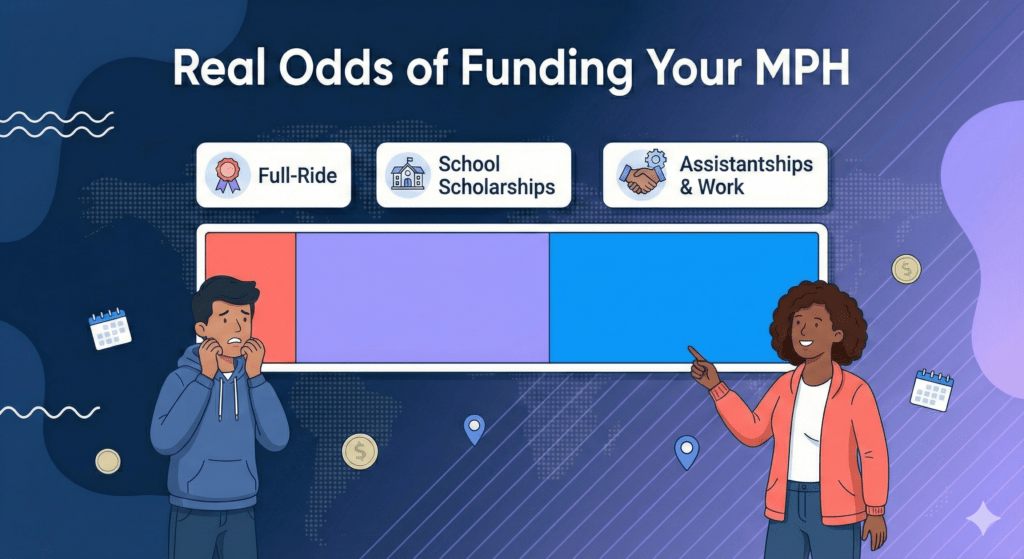
Let’s break this down brutally and realistically.
1. Fully funded MPH scholarships: very rare, very competitive
The “dream” options—things that cover tuition + living costs—are a tiny minority of all funding.
Examples:
- JJ/WBGSP: global, fully funded, mid-career professionals only, limited to World Bank–approved programs and nationals of specific developing countries. You’re competing against the best profiles from dozens of countries with years of experience.
- Similar fully funded fellowships or country-level schemes (e.g., Fulbright-style awards, elite school fellowships) operate in the same territory: small number of seats, international competition, strict criteria.
Realistically:
- You should treat these as lottery tickets you prepare seriously for, not something to emotionally depend on.
- If you land one, great. If not, your plan cannot collapse.
2. University scholarships: better odds, but still selective
At the school level you have two main types:
- Automatic discounts (e.g., Tufts’ 25% off standalone MPH, OHSU Provost’s 12,000 USD for online MPH).
- If you’re admitted and meet basic conditions (right program, credit load), you get them.
- The “competition” here is actually the program admission, not the scholarship.
- Competitive internal scholarships (Dean’s scholarships, named funds, diversity awards, global-health fieldwork grants, etc.).
- You’re competing against other accepted or current students in that one school, not the entire planet.
- For many of these, the number of awards is small (dozens or less), but the applicant pool is also much narrower than external mega-scholarships.
Real talk:
- Expect acceptance odds for good internal scholarships to be something like 10–30% if you’re a strong match (not 1–2% like flagship global schemes).
- If you apply to 5–6 serious internal awards across 2–3 schools, it is realistic to win 1–3 partial scholarships—enough to move the needle.
3. External public-health scholarships: crowded and noisy
Public-health-specific awards listed on niche sites plus platforms like Bold.org and MastersPortal look exciting, but:
- Many are small ($500–$2,000) and attract applicants from all over.
- Some are one-off or donor-dependent, not guaranteed to repeat.
- Criteria can be very narrow (e.g., specific region, identity, or micro-topic).
What this means for you:
- Treat external scholarships as top-up funding you apply to in batches.
- If you’re a strong fit for a given niche (e.g., first-gen, Indigenous, rural, disability, specific ethnic group), your odds go up; if you’re totally generic, your odds are mediocre at best.
Don’t waste time sending low-effort, copy-paste applications to 30 random external awards. You’re better off sending 5–10 well-targeted, high-effort applications where your profile clearly matches.
4. Assistantships and work: higher probability, unsexy but powerful
Most people ignore this because it doesn’t feel like “scholarship”, but financially it often matters more:
- A half-time TA/RA can easily equal several thousand dollars in tuition remission plus a stipend for the year.
- Odds of getting such roles are often higher than winning a big external award if:
- You have relevant skills (stats, coding, teaching, real field experience).
- You target programs where assistantships are common and ask early.
In practice:
- At mid-range schools, it’s not crazy for 10–30% of full-time grad students in certain departments to hold some kind of assistantship.
- Those roles don’t cover everything, but combined with a school scholarship and employer support they can take a massive bite out of your cost.
If you’re serious about funding, you should be sending emails to potential supervisors and program coordinators about TA/RA possibilities as soon as you apply—not passively waiting.
5. Who actually has good odds vs who’s dreaming?
You have relatively strong odds of decent funding if:
- You’re from an under-represented group, low-income background, or rural/underserved region, and you can clearly connect that to your public-health goals.
- You already have solid public-health or community work experience (not just “interest in helping people”).
- You apply early (by December/January) and hit all internal scholarship and priority deadlines.
- You are willing to combine:
- A school scholarship/discount,
- An assistantship or employer support, and
- A limited amount of loans.
You have low odds if:
- You apply late (after the scholarship deadlines) and rely on “final” admission deadlines.
- You do not fit any clearly defined priority group and your CV is weak or generic.
- You refuse to consider mid-tier or cheaper programs and only aim at ultra-expensive top brands without a realistic funding story.
- Your entire plan is: “I’ll just find some scholarships after I get in.”
6. What “success” looks like in funding an MPH
Success is not “100% free degree” for most people. It looks like:
- 10–50% of tuition covered by school-based scholarships or automatic discounts.
- An additional US$1,000–10,000 from internal or external awards (global-health, diversity, service, project-based).
- Some assistantship or part-time work that offsets living costs and maybe some tuition.
- A manageable loan component you can repay under income-driven plans without destroying your future.
If you walk into this expecting a full-ride miracle, you’ll either be disappointed or reckless. If you walk in expecting to build a serious, multi-pillar funding stack, your odds of ending up with affordable debt and a good MPH are actually decent.
The competition is real, but it’s not random: the people who start early, target the right scholarships, and actually align their profile with the funder’s priorities are the ones who keep winning.
Fair point, I skipped it. Let’s bolt on a clean FAQ section you can drop at the end of the article. I’ll bake the keyphrase in a couple of answers for Yoast as well.
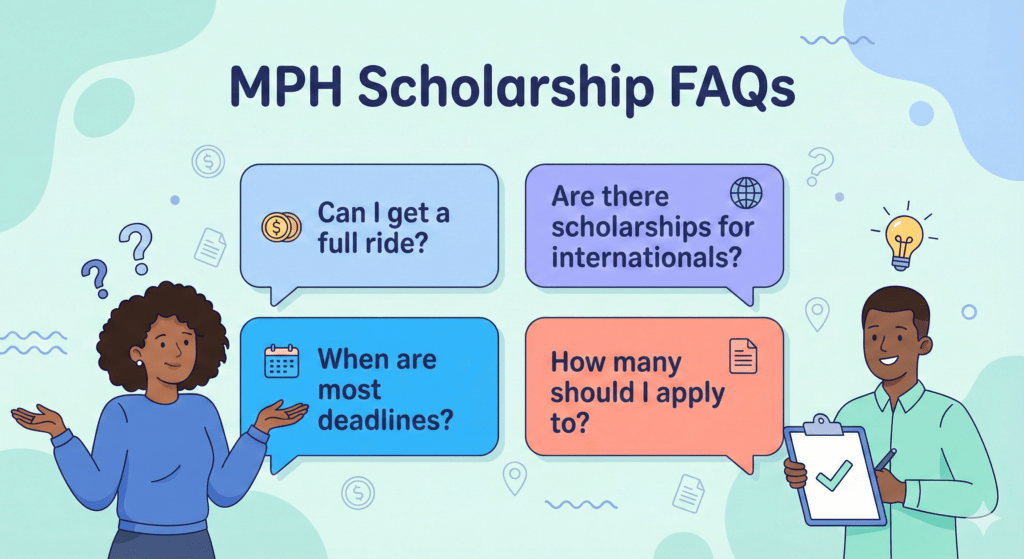
FAQs: Public Health Scholarships in the USA (2025–2026)
1. Can I really get a full-ride MPH scholarship in the USA?
Yes, but it’s rare. Fully funded options like the Joint Japan/World Bank Graduate Scholarship Program or certain government/fellowship schemes exist, but they target very specific profiles (developing-country nationals, strong work experience, clear development focus) and have brutal competition. For most people, the realistic goal is a stack of partial school scholarships, assistantships, employer support, and limited loans rather than a 100% free ride.
2. Are there public health scholarships in the USA for international students?
Yes. Many university-based scholarships are open to international MPH students, and some external schemes are designed specifically for students from low- and middle-income countries. Fully funded programs like JJ/WBGSP and country-level scholarships (e.g., Fulbright-style awards) are the big ones, but plenty of schools also offer merit or need-based aid that doesn’t restrict citizenship. You still need to check each scholarship’s eligibility rules line by line—never assume it’s open to all nationalities.
3. When are most MPH scholarship deadlines for Fall 2026?
The serious money is clustered in the December–March window before you start. Many Schools of Public Health tie scholarship consideration to December or January “priority deadlines” for applications, and internal scholarship forms usually close by February or early March. External national schemes often run December–March as well. If you’re waiting until April or May to think about funding, you’ve already missed most of the top options.
4. How many public health scholarships are there, roughly?
No one can give an exact number, but it’s easily hundreds when you combine everything: 25–50 clearly public-health-specific named scholarships on niche MPH sites, dozens more on big platforms like Bold.org, and internal awards at almost every serious School of Public Health. On top of that, there are general health/graduate scholarships that still accept MPH students. The problem isn’t that scholarships don’t exist—it’s that they’re fragmented across dozens of sites and school pages.
5. What’s the main focus keyphrase I should care about here?
From a search point of view, the main phrase you’re targeting is “public health scholarships in the USA” (or close variants like “public health scholarships USA”). That’s what students actually type when they want lists, deadlines, and concrete funding strategies. This article is structured so that the title, meta description, headings, and a few image alts all reinforce that phrase naturally.
6. Do I need perfect grades to win MPH scholarships?
No, but weak academics will absolutely hurt you. Many competitive awards want at least a 3.0–3.5 GPA equivalent, plus strong letters and a clear public-health story. That said, some school-based and need-focused scholarships are more interested in your trajectory and impact (work in underserved areas, lived experience, community projects) than a flawless transcript. If your grades are average, you need to compensate with a very strong narrative and evidence of real-world work.
7. What’s more realistic: external scholarships or school scholarships?
For most applicants, school scholarships and assistantships are more realistic. External scholarships attract a massive, mixed pool from many countries and disciplines; your odds per application are low. Internal awards limit the competition to people in your own program or school, and assistantships are often decided by departments based on skills and fit. You still apply hard to both, but your expected value is higher on the school side.
8. How should I decide how many scholarships to apply for?
Stop thinking in random numbers. Build a shortlist of 10–20 scholarships where you clearly meet the eligibility criteria (citizenship, degree, field, GPA, demographics, region). Then prioritise:
- Top 5–8 that pay the most or are the best fit → full effort, tailored essays.
- Next 5–10 smaller/medium awards → re-use and lightly adapt your main statement.
Spraying low-effort applications at 30+ random scholarships is a waste of time; deep work on a targeted set is how people actually win.
9. Can I work during my MPH and still manage the workload?
It depends on the program intensity, but many students do work—especially in part-time or online MPH tracks. A 10–20 hour/week assistantship or relevant part-time job is manageable for most, while a full-time job alongside a full-time MPH is usually a disaster. You need to be honest: if you’re doing an accelerated or quant-heavy program, treat work as a funding tool, not your main job.
10. What’s a “good” funding outcome for an MPH in the USA?
Realistically, a solid outcome looks like this:
- 25–50% of tuition covered through school scholarships/automatic discounts.
- An extra $1,000–$10,000 from internal/external awards for projects or living costs.
- Some assistantship or part-time work to offset expenses.
- A loan amount that you can service on an MPH-level salary using income-driven repayment without wrecking your life.
If you hit something in that range, you’ve done better than most. Anything beyond that (near-full funding) is a win, not an expectation.
Internal Links:
CEPH-Accredited MPH Programs (2025 Guide)
CEPH-Accredited MPH Programs in New York (2025)
Accelerated 1-Year MPH Programs (2025 Guide): Accredited 12-Month MPH Options
MPH vs MHA vs MBA (2025): Which Health Degree Is Best for You?
Related MPH Guides
Use these linked guides to compare degree fit, accreditation, and costs before you apply.
Continue Comparing MPH Options
After this guide, use these related resources to build a stronger MPH shortlist:
- Best MPH Programs – compare MPH options by career goal, format, accreditation, and cost.
- Best Online MPH Programs – compare flexible online MPH paths for working students.
- No-GRE MPH Programs – understand GRE optional, GRE waived, and GRE not required policies.
- MPH vs MSPH vs MHS – decide whether a practice, research, or specialized health science degree fits better.
