One year MPH programs in the USA are designed for people who want a fast, intensive route into public health leadership. In this 2025 guide, we break down how these accelerated MPH options work, who they’re really for, how much they cost, and which American universities offer serious 12-month tracks.
Table of Contents
Quick Answer: Are One-Year MPH Programs Worth It in 2025?
If you already have a solid health or quantitative background and you’re ready to treat school like a full-time job, a one-year MPH program in the USA can absolutely be worth it in 2025. You get the same MPH credential, finish in about 12 months, and return to the public health workforce faster.
If you’re changing careers, weak in statistics, or you need to work while studying, an accelerated one-year MPH is usually the wrong format. In that case, a traditional two-year MPH gives you more breathing room, more time to catch up academically, and better space for internships and networking.
Snapshot: What a One-Year MPH Actually Is
In the United States, a “one-year MPH” (often called an accelerated MPH or 12-month MPH) is not a lighter version of the degree. It’s the same degree, compressed into a much tighter schedule.
Most one-year MPH programs:
- Run for about 12 months of continuous study, often using summer + fall + spring with very short breaks.
- Cover the standard MPH core you see in two-year programs: epidemiology, biostatistics, health policy and management, environmental health, and social & behavioral sciences. These are the competencies expected in CEPH-accredited MPH degrees across the US.
- Add a practicum / applied practice experience plus some form of capstone or integrative project, even in the accelerated format.
The trade-off is intensity. Many one-year or 12-month MPH tracks openly tell students to expect a very heavy weekly load and to avoid full-time work while enrolled. Some schools describe the program as essentially a 60–80 hour per week commitment once you add classes, readings, group projects, and practicum work on top.
So when you see “one-year MPH” in the USA, think: same mountain, steeper climb — not an easier degree.
Who One-Year MPH Programs Are Best For (US Context)
In practice, US universities design accelerated one-year MPH programs for people who are already “inside” health or a related field. Typical profiles:
- Clinicians and advanced degree holders
Doctors, dentists, pharmacists, nurses with a bachelor’s or master’s, and other professionals who already understand clinical care or biomedical science. For them, the MPH is an extra layer of population-health, policy, or management training rather than a first exposure to health. - Mid-career public health or health-policy professionals
People working in health departments, hospitals, NGOs, consulting, or health insurance who need an MPH to move into leadership, policy, or management roles. They’re usually willing to step away from full-time work for one intense year to get the credential and move up. - Applicants already comfortable with numbers
A one-year MPH in the USA is much easier to survive if you’ve already done statistics, research methods, or data-heavy work. There is very little time in an accelerated schedule to “fix” weak math skills from scratch once classes start.
If you read those profiles and none of them sound like you, that’s your warning sign. Wanting to “finish faster” is not enough. Without the right background, the pace of a 12-month MPH can turn the whole experience into damage control instead of real learning.
Key Pros and Cons at a Glance
Real advantages of a one-year MPH (when you’re a good fit)
- Faster time to degree and earnings
You finish in roughly a year instead of two, which means you can return to work sooner and potentially increase your salary earlier in your career. Over time, that earlier bump can matter more than the extra year of study. - Same MPH credential in less time
In CEPH-accredited schools, an accelerated MPH still needs to meet the same foundational public health competencies as a standard MPH. On a CV or LinkedIn profile, employers usually see “MPH”, not “slower MPH” vs “faster MPH”. - Efficient for people who just need the public health layer
If you already have a clinical or technical degree, a one-year MPH can be a focused way to add population-health, policy, or management skills without stepping away from your main career for two full years.
Real downsides of a one-year MPH (and who should avoid it)
- Very limited room for work or family responsibilities
Because the course load is heavy and compressed, most one-year MPH programs in the US strongly discourage working alongside the degree. If you rely on a job to pay rent and bills, that’s a serious constraint. - Less time for exploration, networking, and extra projects
In a two-year MPH, you can try different electives, take on multiple internships, or build long-term research collaborations. In a one-year format, you’re often locked in from day one and simply don’t have spare time to experiment. - Tough for people new to public health or statistics
Career-changers who are just learning epidemiology, biostatistics, or the US health system usually do better with a slower timeline. With an accelerated MPH, there’s almost no space to catch up if you fall behind in the first semester.
Bottom line:
- If you’re experienced, focused, and financially ready to treat the program as a full-time job, a one-year MPH in 2025 can be a smart, high-leverage move.
- If you’re starting from zero, unsure about your direction, or depending on part-time work to survive, a traditional two-year MPH is usually the safer and more realistic option.
What Is a One-Year MPH Program? (Structure, Credits, Workload)
Most people hear “one-year MPH” and assume it’s a shortcut. It isn’t. In the US, a one-year or accelerated MPH is basically a standard MPH degree compressed into 12–15 months with almost no slack.
How a One-Year MPH Differs from a Traditional Two-Year MPH
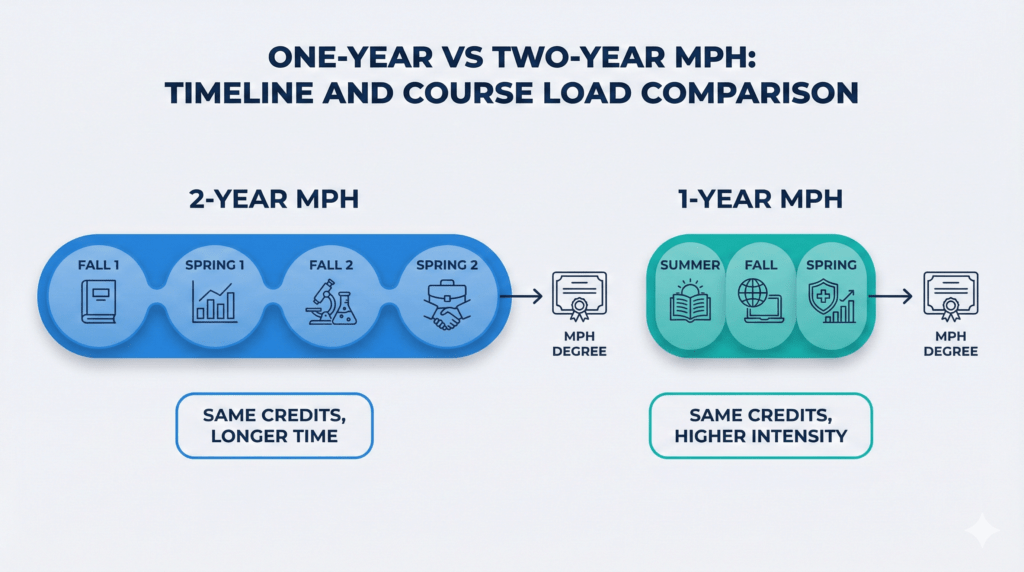
In a typical US school, an MPH is around 42–56 credits, spread over 4 traditional semesters (two academic years) with a summer in between. Many top schools let you stretch this over 18–24 months with lighter loads.
In a one-year or 12-month MPH, you’re doing almost the same number of credits, but:
- Packed into 3–4 consecutive terms (often summer + fall + spring, sometimes summer-heavy).
- With short or no long vacations.
- With practicum and capstone overlapped with coursework instead of spaced out.
Think of it this way:
- 2-year MPH = marathon pace.
- 1-year MPH = same distance, half the time, no pacing margin.
You don’t get “less MPH”. You get less time to absorb it.
Typical Curriculum Format in US One-Year MPH Programs
All serious one-year MPH programs in the USA still have to deliver the foundational public health core you see in standard MPH degrees:
- Epidemiology – study design, measures of association, outbreak investigation basics.
- Biostatistics – probability, regression, interpreting health data.
- Health Policy & Management – how US health systems and policies are structured and financed.
- Environmental & Occupational Health – exposures, risk assessment, regulation basics.
- Social & Behavioral Sciences – health behavior theories, social determinants, community interventions.
On top of this core, one-year MPH tracks usually stack:
- Concentration courses
– e.g., Global Health, Health Policy, Health Care Management, Epidemiology, Population Health, Urban Health, etc. - Applied Practice / Practicum
– supervised work in a health department, NGO, hospital, research unit, or similar. Even accelerated formats still require some form of applied experience or practicum. - Integrative Learning Experience / Capstone
– a final project, report, or presentation that ties your coursework to a real public health problem.
The difference from a 2-year plan isn’t what you study; it’s how stacked everything is. You’re doing core + concentration + practicum + capstone in what feels like one long, continuous sprint.
Time Commitment: How Intense Is It Really?
Here’s the part most marketing brochures downplay: the workload.
For a typical 2-year MPH, students often carry 9–12 credits per term. That’s already heavy if you’re working. In one-year MPH tracks, it’s common to see:
- 12–15+ credits per term, including summer.
- Multiple quantitative courses running in parallel (epi + biostats + methods).
- Practicum or capstone work layered on top of classes rather than separated in a quiet semester.
Realistically, that translates into:
- 50–80 hours per week of total effort (lectures, readings, assignments, group projects, practicum prep, capstone work).
- Very little slack for part-time jobs, family emergencies, or “I’ll catch up later”.
So when you’re thinking about a one-year MPH in the USA, you should assume:
- It will dominate your life for about 12 months.
- You will frequently feel overloaded if your background in stats, research, or health systems is weak.
- You are trading time (finishing sooner) for intensity (much harder year).
If that sounds acceptable, then the format fits you. If you’re already wondering how to “fit it around work”, that’s a sign you’re mismatched to the structure.
Summary: The Core Reality of One-Year MPH Structure
To keep it brutally simple:
- Same degree, same core competencies as a regular MPH.
- Roughly the same credits, just compressed into a year.
- Curriculum = core + concentration + practicum + capstone, with less breathing room.
- Workload = full-time job + extra, not “doable on the side”.
The structure is built for people who can give the program a full, focused year. If you treat it like a side project, it will crush you. If you treat it like your main job for 12 months, it can be a fast, efficient route into higher-level roles in US public health.
Types of One-Year MPH Programs in the USA (Online, On-Campus, Hybrid)
Not all “one-year MPH” programs look the same. In the US you’ll see three main formats:
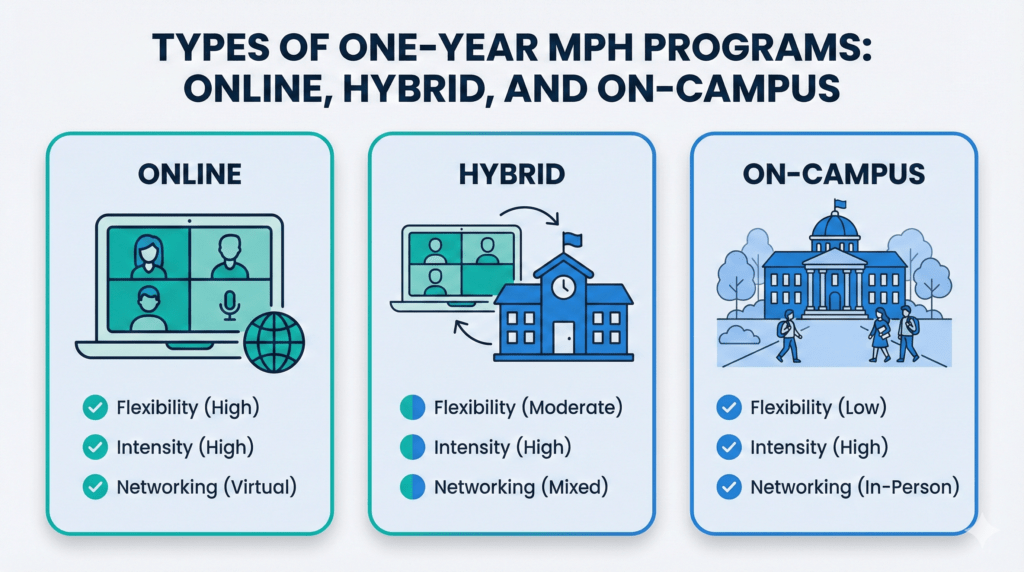
- Fully online one-year MPH programs
- Hybrid / mixed-format accelerated MPH programs
- Campus-based one-year MPH programs
The degree on your CV will still say MPH. But your day-to-day experience, networking, and lifestyle will be very different depending on which format you pick.
Fully Online One-Year MPH Programs
These are marketed as online but they are not part-time. The serious one-year options are full-time, high-intensity programs that just happen to deliver teaching through the internet.
Typical features of an online one-year MPH in the USA:
- Delivered 100% online (live + recorded sessions).
- Same curriculum as the school’s standard MPH – not a “lite” version.
- Heavy weekly credit load; terms run back-to-back.
- Very clear warnings that you should not work (or only minimally).
Concrete example:
- MPH@GW (George Washington University) – offers a 12-month online MPH track where students take about 11.5 credits per quarter. The school explicitly states that the one-year option uses the same curriculum as the regular online/on-campus MPH and that students are not permitted to work while enrolled because of the intensity. (GW-UMT)
- Drexel (online MPH plans of study) – the 12-month plan for its online MPH expects 60–80 hours of coursework per week and strongly recommends that students do not work during the program. (Drexel University)
Who this format suits:
- You’re in the US (or abroad) but can’t relocate.
- You can clear your schedule and treat the program like a full-time job.
- You’re disciplined enough to handle a brutal online workload without in-person structure.
If you’re hoping to “do an online one-year MPH in the evenings while working full-time”, these programs are the opposite of what you need.
Hybrid One-Year MPH Programs
Hybrid one-year MPH programs split learning between online and on-campus terms. You might do an online summer or first quarter, then move to campus for the remaining terms.
Examples of this “mixed” model:
- Drexel Dornsife 1-Year MPH – the school offers a one-year plan of study with options across on-campus and online majors. All versions of the 12-month plan come with the same warning: expect 60–80 hours per week and don’t plan to work. (Drexel University)
- Tufts University MPH – Tufts runs a flexible MPH with on-campus, online, and blended formats. For students who want speed, there is an accelerated one-year MPH option available in both on-campus and online formats, which effectively creates a hybrid reality for many students (online content + in-person elements, depending on chosen path). (Tufts Medicine)
What you normally get with hybrid one-year MPH programs:
- Some location flexibility (especially at the start).
- At least one term of in-person networking with faculty, classmates, and local organizations.
- The same insane pace as other accelerated options.
This format is a decent compromise if you want online convenience but still value face-to-face relationships, campus recruiting, and physical access to a US city.
Campus-Based Accelerated MPH Programs
Campus-based one-year programs are the “classic” accelerated MPH: you move to the city, live near campus, and your life revolves around the program for a year.
Key examples in the US:
- Columbia University Mailman School of Public Health – Accelerated MPH
- Intensive one-year program for highly motivated professionals.
- Curriculum is similar to the two-year Columbia MPH but completed at a faster, more demanding pace. (Mailman School of Public Health)
- Emory University Rollins – 12-Month MPH in Health Care Management
- Three-semester, 12-month MPH in Health Care Management.
- In-person, full-time; aimed at people who already have substantial public health/healthcare experience and want leadership roles in health care delivery. (sph.emory.edu)
- Emory Accelerated MPH for external graduate/professional students
- A two-semester accelerated MPH for students already enrolled in another US graduate/professional program (MD, JD, etc.).
- Students spend one academic year at Rollins to add an MPH on top of their primary degree. (Top Universities)
- Tufts University – One-Year Accelerated MPH
- Tufts openly markets an accelerated option where you can complete the MPH in one calendar year, starting in May and finishing the following June.
- Available both on-campus and online in select concentrations, so some students will experience this as fully on-campus. (Tufts Medicine)
What these campus-based options have in common:
- High-contact environment: You see faculty, peers, and guest speakers in person, which is a big deal for networking.
- Local practicum opportunities: Easier to plug into hospitals, health departments, and NGOs around the school.
- Zero illusion of “part-time”: The pace is openly intense; programs are designed on the assumption that you moved there just for this year.
If your goal is to build a US network, get face-time with well-known public health faculty, and access local practicum sites, campus-based accelerated MPH programs usually beat fully-online ones — as long as you can afford to relocate and survive a year of tunnel vision.
Bottom line for this section:
- Online one-year MPH (USA) = no relocation, but still full-time intensity.
- Hybrid one-year MPH = some flexibility plus limited in-person networking.
- On-campus one-year MPH = maximum immersion and networking, but highest disruption to your life.
Your choice isn’t just “Where can I finish fastest?” It’s how you want to live for that year and how much you care about in-person US networks vs pure convenience.
Admissions Requirements for One-Year MPH Programs (US Universities)
Don’t romanticize this part. Accelerated and one-year MPH tracks are more selective on average than regular MPH programs. Schools want people who can survive a 60–80-hour academic week without falling apart.
Below is how admissions typically works for US one-year / accelerated MPH programs.
Minimum Academic Background
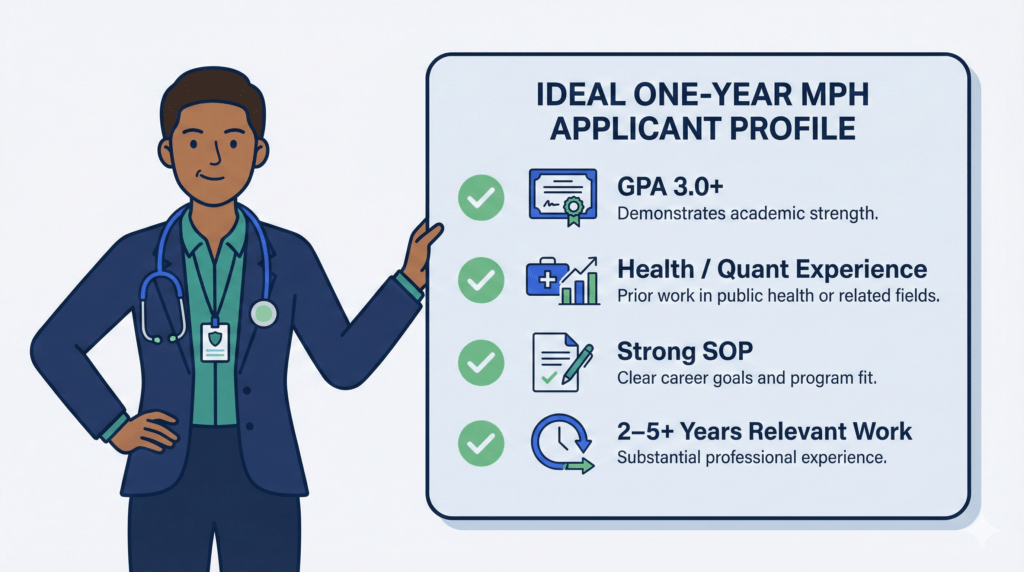
At the bare minimum, you need:
- A regionally accredited bachelor’s degree (US or recognized foreign equivalent). (CORP-MPH2 (MPH Prog))
- A solid academic record, often with:
- Minimum GPA around 3.0 for general MPH, and
- Higher GPA (3.25+ or “strong academic performance”) for accelerated or one-year tracks. (publichealthdegrees.org)
For some accelerated programs, “minimum bachelor’s degree” is not enough:
- Certain fast-track options only admit applicants who already hold a master’s or doctorate (e.g., MD, DO, PhD, JD, DNP, etc.) and want to add a public health credential on top. (MPH Online)
Bluntly: if your undergrad GPA is weak and you have no advanced degree, the one-year options are the wrong battlefield. Go for a standard 2-year MPH where you have room to rebuild your academic profile.
Professional Experience and Target Applicant Profiles
This is where one-year MPH programs draw the line between “good fit” and “please don’t apply”.
Many accelerated MPH tracks in the US are explicitly built for:
- Clinicians and advanced professionals
Columbia Mailman’s Accelerated MPH, for example, is a one-year track “for advanced professionals” and requires at least two years of substantial health-care–related work experience at the time of application. (Mailman School of Public Health) - Experienced public health / health-sector workers
Other accelerated options (like the University of Florida’s accelerated MPH) state that the program is intended for working professionals with ample experience in a public-health-related field, often limited to people who already hold the highest degree in their field. (MPH Online) - Mid-career applicants with measurable impact
Sites summarizing accelerated MPH admissions repeatedly mention:- Required or strongly preferred 3–5+ years of relevant work experience, and
- A stronger than average academic record. (publichealthdegrees.org)
If your CV shows zero health-related work, and your plan is “I’ll figure out public health once I get in,” you’re not who these programs are designed for. They’re built for people already in the system, not for people still deciding if they even like the field.
Standard Requirements: GPA, Tests, Documents
Across US universities, the actual admissions checklist looks similar, whether the MPH is one-year or two-year. The difference is how competitive each item must be for the accelerated track.
Expect to submit:
- Academic transcripts
From all post-secondary institutions. Programs use these to check:- Overall GPA
- Performance in quantitative courses (math, stats, research methods, economics). (CORP-MPH2 (MPH Prog))
- Letters of recommendation
Typically 2–3 letters from:- Faculty who can talk about your academic ability, and/or
- Supervisors who can prove your public health / health-sector performance.
- Statement of purpose / personal statement
This is where most people blow it. For accelerated MPH, they’re looking for:- Clear, specific career goals in public health (not “I want to help people”).
- A logical connection between your past work and your proposed concentration.
- Evidence that you understand how intense a one-year MPH is and why you can handle it.
- CV or résumé
Needs to show:- Health or adjacent work experience (clinics, NGOs, government, research, health tech, etc.).
- Leadership, responsibility, and ideally some exposure to data or program management. (CORP-MPH2 (MPH Prog))
- GRE (often optional or not required)
- GW’s online MPH (including the 12-month option) states that GRE scores are not required; you may submit them if they strengthen your application. (GW-UMT)
- Many US MPH programs have moved to no-GRE or GRE-optional admissions, especially post-COVID. (publichealthdegrees.org)
Reality: in 2025, for most one-year MPH tracks, GRE is not your main problem. Weak GPA, weak experience, and a vague SOP are.
Extra Considerations for International Students (One-Year MPH in the USA)
If you’re applying from outside the US, you have the same baseline requirements plus extra constraints.
Most US schools will expect:
- English proficiency test
Common benchmarks:- IELTS around 6.5+ or
- TOEFL iBT ~80–100+ (varies by school and program). (upGrad)
Some will also accept Duolingo English Test scores. Always check each program’s graduate admissions page.
- Equivalent academic background
Your bachelor’s degree must be recognized as equivalent to a US 4-year degree. If not, you’ll spend time and money on credential evaluation (WES, ECE, etc.). - Funding reality
One-year MPH = no real time to earn money in the US while studying:- Programs like GW and Drexel clearly say that students in the 12-month track should not work due to 60–80 hours/week workload. (GW-UMT)
- As an international student on an F-1 visa, your legal work options are already limited. Combine that with an accelerated load and you’re basically committing to fully funded or self-funded survival for a year.
- Visa and start dates
Many accelerated MPH options start in summer, not fall (e.g., Drexel’s 12-month online MPH in Global/Urban Health, Tufts’ accelerated track that starts in summer). (Tufts Medicine)
That affects:- When you need your I-20,
- How much time you have to arrange housing, and
- When you must have proof of funds ready.
If you’re an international applicant with limited savings, little health-related work, and weak stats background, a one-year US MPH is likely to be financially and academically brutal. In that case, a longer program with more scholarship options and a lighter per-term load is usually a better move.
Takeaway for this section:
- One-year MPH programs in the USA expect stronger academics + stronger experience than most regular tracks.
- Typical package: bachelor’s (often plus advanced degree), relevant health work, 3.0–3.25+ GPA, serious SOP, good references, and proof you understand what “accelerated” really means.
- International students face the same bar, plus language tests, visa constraints, and the reality that they probably cannot work their way through a 12-month MPH.
If you tell the truth on paper and your profile still looks thin, that’s your signal to:
- Build 1–2 years of solid health-sector experience,
- Patch your quantitative skills,
- Then decide whether the one-year MPH or a more flexible timeline makes more sense.
Pros and Cons of Choosing a One-Year MPH (vs 2-Year MPH)
You’re not choosing between “MPH” and “better MPH”. You’re choosing between pace and trade-offs.
A one-year MPH in the US is not some magical hack; it’s the same 42–45+ credit degree compressed into 12–15 months. (Milken Institute School of Public Health)
Here’s the real gain–and–pain breakdown, based on what actual schools and data say.
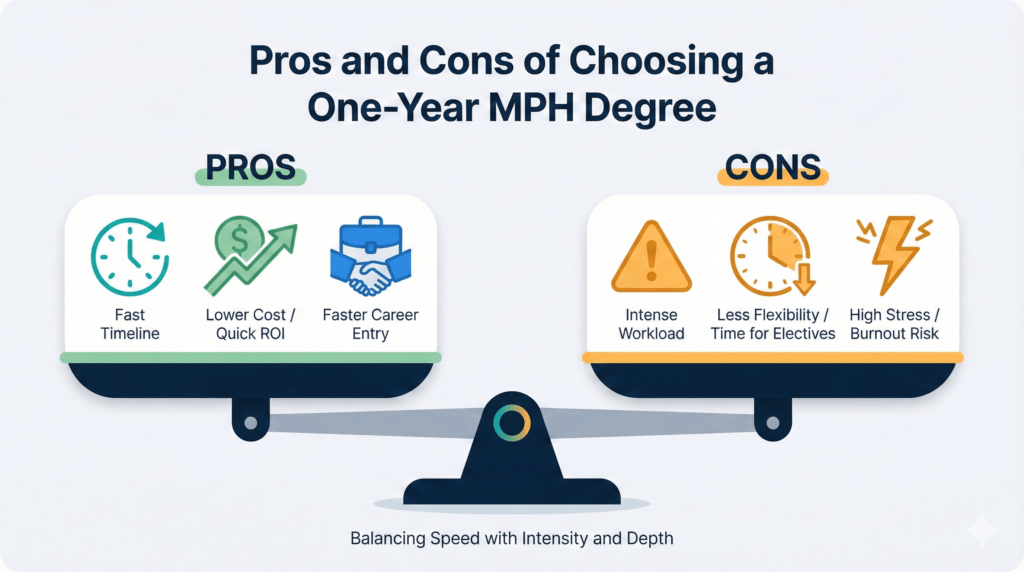
Advantages of the Fast-Track Route
1. You get the same MPH in less time
CEPH-accredited programs don’t create a “mini MPH” just because it’s accelerated. GW’s MPH@GW, for example, uses the same 45-credit curriculum for the 12-month track as for its standard online/on-campus MPH; Drexel’s 12-month plan is just a compressed version of their regular MPH. (GW-UMT)
On a CV or LinkedIn, it’s still MPH from X University. Employers don’t see a giant asterisk saying “done slower” vs “done faster”.
2. Faster time back into the workforce (and earlier salary bump)
Most traditional MPH programs run about 2 years, while one-year / accelerated options finish in roughly 12–15 months. (Research.com)
That means:
- You lose one year less income compared to stepping out for a full 2-year program.
- You can hit post-MPH roles earlier, so your higher salary starts compounding sooner.
If you’re already mid-career—clinician, analyst, program officer—the time saved matters more than yet another year of classes.
3. Intense, focused year instead of a dragged-out degree
Accelerated degrees are designed as compressed, high-focus training. Research.com openly describes accelerated public health degrees as having heavier weekly workload over roughly 12–15 months, while traditional programs spread the same material over two years for a more manageable pace. (Research.com)
That’s a pro if you:
- Prefer sprints to marathons.
- Want to get in, train hard, and get out — not sit around campus for years.
4. Good fit for already-qualified professionals
Schools like Columbia Mailman explicitly design their Accelerated MPH as a one-year program “for highly motivated professionals”, with the same core curriculum as the two-year MPH but completed at a “faster, more demanding pace.” (Mailman School of Public Health)
Similarly, Drexel’s online 12-month plan is pitched at students who can handle 60–80 hours/week and are advised not to work alongside study. (Drexel University)
If you already have:
- A clinical or quantitative background, and
- Clear, realistic public health career goals,
then a one-year MPH converts your existing base into a higher-level credential quickly and efficiently.
Disadvantages and Risk Factors
1. Brutal workload and almost zero room for work
This isn’t “evening school”. This is “your life for a year”.
- Drexel’s 12-month MPH plan literally tells students to expect 60–80 hours of coursework each week and recommends not working at all during the program. (Drexel University)
- GW’s 12-month MPH option requires around 11.5 credits per quarter and states that students are not permitted to work while enrolled because of the demanding load. (GW-UMT)
If your plan is “full-time job + one-year MPH”, forget it. The programs themselves are telling you it’s unrealistic.
2. Less time for internships, side projects, and exploration
Traditional two-year MPH programs give you:
- Multiple semesters to try different electives,
- Space to do one or more internships,
- Time to build longer research projects or quality improvement work.
Compressing into a one-year track usually means:
- Little or no eligibility for internships or research assistantships in the 12-month plan (Drexel explicitly excludes 12-month students from these). (Drexel University)
- Your practicum and capstone get stacked on top of a heavy course load rather than sitting in a quieter semester.
If you’re a career-changer who needs exposure to different roles before deciding where to land, this time pressure is a problem.
3. Higher burnout risk, especially for weak quantitative backgrounds
One-year programs throw you into:
- Epidemiology
- Biostatistics
- Methods
- Policy / management
all at high speed. Overviews of 1-year MPH programs explicitly describe them as intensive, condensed formats that demand 60–80 hours of study weekly. (Research.com)
If you struggle with stats or haven’t touched math in years, you’re signing up to fix that in the most unforgiving environment possible. Many students can survive it, but survival is not the same as learning well.
4. Networking can be shallower if you’re not intentional
In a two-year MPH, you naturally accumulate:
- Multiple cohorts of classmates,
- Several rounds of group projects,
- More time to attend seminars, conferences, and student groups.
In a one-year MPH:
- You’re busy from day one.
- You have less time to experiment with side projects or student leadership.
You can still build a strong network, especially at schools like GW or Columbia with big alumni networks, but you have to be ruthless and deliberate about it. (edX)
Who Should Not Pick a One-Year MPH
Based on how these programs are actually structured, a one-year MPH is usually a bad idea if:
- You’re a total career-changer with zero health or data background and no idea which public health niche you want.
- You need to work a significant number of hours just to pay rent and bills. The schools themselves say “don’t work” for the 12-month track. (GW-UMT)
- You have a weak academic record and need time to rebuild your GPA, retake stats, or show a new trajectory.
- You want extended research, dual degrees, or long multi-year projects; those fit far better in a 2-year structure.
For those profiles, the traditional 2-year MPH is not “slower = worse”. It’s slower = survivable + more options.
Bottom line for this section:
- A one-year MPH is a high-pressure, high-reward option: great if you’re prepared and focused, awful if you’re using it as a shortcut.
- The main trade: time saved versus intensity and flexibility lost.
- If you can comfortably clear a year of your life and already bring serious health/quant experience, the fast-track can make sense.
- If you can’t, you’re better off with a standard two-year MPH and more space to actually build the career you want.
How to Choose the Right One-Year MPH Program in the USA
If you pick the wrong one-year MPH, you don’t just waste money — you waste your only year. So stop thinking “Which school is famous?” and start asking “Which program fits my goal, profile, and reality?”
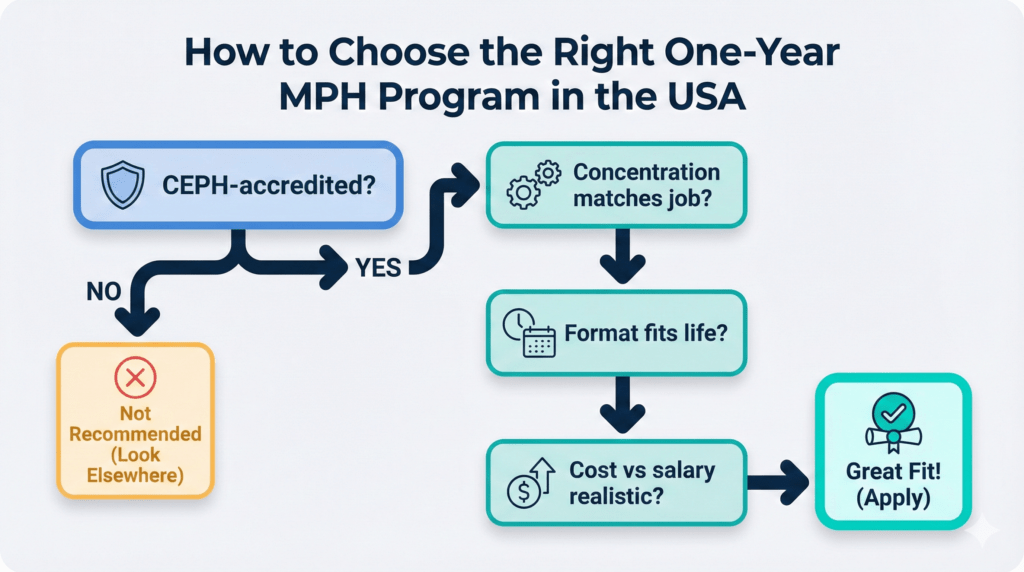
Use this like a checklist.
Step 1 – Only Consider CEPH-Accredited MPH Programs
Non-negotiable: if it’s not CEPH-accredited, delete it from your shortlist.
- The Council on Education for Public Health (CEPH) is the main accreditor for MPH programs in the US. It’s also recognized in the wider US accreditation system (CHEA). (CHEA)
- CEPH maintains an official directory where you can search accredited schools and programs, including online options and concentrations. (Ceph)
Why you care:
- Many US employers (government agencies, big systems, fellowships) quietly prefer or require CEPH-accredited degrees.
- Some fellowships, certifications, and doctoral programs explicitly ask for a CEPH-accredited MPH background. (OMD)
Action:
- Open the CEPH directory.
- Type the school name.
- If the MPH or school of public health is not listed → it doesn’t make your list, no matter how pretty the website looks.
If you want a shortcut, there are curated guides that list CEPH-accredited online MPH programs with filters for cost, format, and pace, but always verify final details in the official directory. (OMD)
Step 2 – Match the Concentration to the Job You Actually Want
Most people mess this up. They pick “Global Health” because it sounds cool, then apply for US hospital admin jobs and wonder why it’s not clicking.
In one-year MPH programs, you don’t have time to wander between random electives. You need a concentration that lines up with specific roles:
- Health Policy / Health Policy & Management
→ Good if you want roles in US health policy, think-tanks, payers, or government agencies. - Health Care Management / Health Services, Management & Policy
→ Better for hospital/health system leadership, operations, quality improvement, population health management. - Epidemiology / Applied Biostatistics
→ For data-heavy roles, surveillance, research, analytics jobs in health departments, pharma, NGOs. - Global Health / Urban Health / Community Health
→ For NGOs, international agencies, community-based organizations, and city-focused public health work. (GW-UMT)
Action:
- Write down 3–5 job titles you’d realistically aim for after graduation (e.g., “hospital quality improvement manager”, “epidemiologist”, “health policy analyst”).
- Check each program’s concentrations and sample job outcomes and see if they line up. Schools like GW explicitly list concentrations and career paths tied to each track. (GW-UMT)
- If the program can’t show clear alignment between concentration → skills → common job titles, that’s a red flag.
Step 3 – Choose the Format You Can Actually Survive (Online vs Hybrid vs Campus)
All of these can be good — if you’re honest about your circumstances.
1. Fully Online, One-Year MPH (USA)
- Example: MPH@GW – accredited online MPH with program options from 1 year to 5 years; the one-year option uses the same curriculum but requires full-time, high-intensity enrollment and explicitly forbids continued employment. (GW-UMT)
- Good if:
- You cannot relocate,
- You can block out a full year for study, and
- You’re self-disciplined and comfortable with online learning.
2. Hybrid / Blended Accelerated MPH
- Some schools mix online and on-campus terms or let you choose between them per concentration. These show up in CEPH and ASPPH program finders as “online”, “campus”, or “hybrid”. (Program Finder)
- Good if:
- You want some flexibility but still value in-person networking for at least part of the year.
3. Fully On-Campus, One-Year MPH
- Classic model: you move to the city, live near campus, and your life becomes that program for a year.
- Often the best for:
- Networking with faculty, alumni, and local employers;
- In-person practicum in nearby hospitals, health departments, or NGOs. (edX)
Harsh filter:
- If you need to work full-time, don’t pick a 12-month format that openly says “no work allowed.”
- Instead, choose a 2–3 year part-time online MPH from a CEPH-accredited school, where the curriculum is the same but the pace is realistic. (GW-UMT)
Step 4 – Compare Curriculum Depth and Flexibility
Accreditation only guarantees a minimum floor. Quality still varies.
When comparing one-year MPH programs, look at:
- Core requirements vs electives
- Does the program offer enough electives in your interest area, or is it almost all fixed courses?
- Good sign: clear breakdown of core credits vs concentration vs electives (e.g., GW shows 17 core credits + program-specific credits in its 45-credit MPH). (GW-UMT)
- Practicum / Applied Experience
- Is there a structured practicum embedded with real partners (health departments, NGOs, health systems)?
- Are placements supported, or are you just told “go find something”?
- Capstone / Integrative Project
- Strong programs describe concrete examples of capstone projects tied to real-world health problems, not vague “final paper” language. (corp-mktg.s3.us-west-2.amazonaws.com)
- Faculty and connections
- Check if faculty actively work in policy, hospitals, or big agencies, not just teach. Guides for CEPH-accredited online MPH programs specifically call out faculty expertise and curriculum as key evaluation factors. (OMD)
Action:
Open the program’s curriculum page and ask:
“If I completed exactly this plan of study, would I be employable for the jobs I listed earlier?”
If the answer is “not really”, keep looking.
Step 5 – Run the Numbers: Cost, Funding, and Realistic ROI
Don’t just stare at the sticker price; look at total cost vs realistic salary outcomes.
Use this structure:
- Total program cost
- Tuition per credit × number of credits (often ~42–45+ for accredited MPH) + fees. (Milken Institute School of Public Health)
- Compare at least 3–5 CEPH-accredited options (public, private, in-state, out-of-state).
- Living costs for 12–15 months
- If it’s on-campus in a high-cost city (NYC, DC, Boston), your rent + food can rival tuition.
- Scholarships and aid
- Many schools offer institutional scholarships, graduate assistantships, or employer tuition support, but some are limited for one-year tracks. Check financial aid pages and program brochures. (OMD)
- Expected salary band post-MPH
- Look at typical US MPH graduate roles in your focus (epidemiology, health policy, management) and their median salaries. Many online guides benchmark MPH careers by sector and role. (OMD)
Then ask the real question:
“Given my background and target roles, is this program realistically going to move me into a salary range that justifies the total cost within 5–7 years?”
If you can’t answer yes with a straight face, that program is probably ego, not strategy.
Step 6 – Location, Network, and Brand (In That Order)
Order matters:
- Location & ecosystem
- DC, NYC, Atlanta, Boston, etc., put you near federal agencies, NGOs, and major health systems. That matters if you’re on-campus and actually networking. (GW-UMT)
- Network & practicum partners
- Look for schools that showcase alumni outcomes, employer connections, and strong practicum partners (health departments, WHO/CDC collaborations, big hospitals). (edX)
- Brand name
- Yes, brand helps. A CEPH-accredited MPH from a well-known school (GW, Columbia, etc.) gives you a signal boost — but this is useless if concentration, skills, and experience are misaligned with your job goals.
Step 7 – Reality Check: Does the Format Fit Your Actual Life?
Final filter before you apply:
- Can you realistically:
- Stop working or cut work to minimal hours?
- Handle full-time study for 12–15 months with 50–80 hours/week of reading, assignments, and practicum?
- Fund tuition + living costs without burning your mental health?
If the answer is “no” to any of these, you’re not a one-year MPH candidate right now. You’re a standard or part-time MPH candidate — and that’s fine.
Bottom line for this section:
Choosing the “right” one-year MPH program in the USA means:
- CEPH-accredited only.
- Concentration directly linked to specific job titles.
- Format (online / hybrid / campus) that you can actually survive, not just fantasize about.
- Curriculum that clearly builds the skills those jobs need.
- A cost–salary equation that isn’t delusional.
- A location and network that match where you want to work.
If a program fails any of these checks, it doesn’t deserve your money or your year.
Notable One-Year and Accelerated MPH Programs in the USA (2025)
This is not a ranking. It’s a shortlist of serious, accredited options you can use as a starting point. Your job is to cross-check eligibility, cost, and format against your own profile.
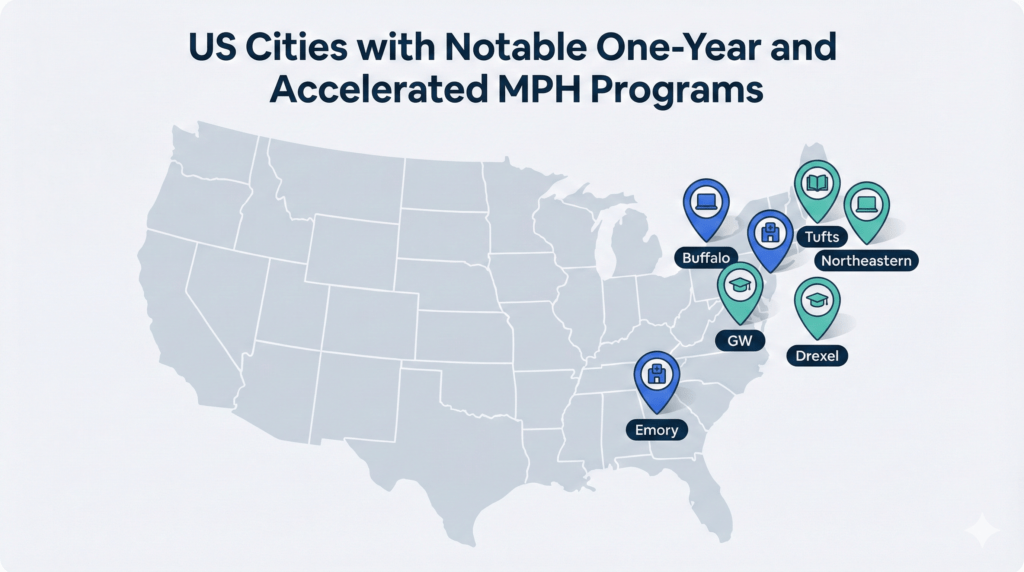
I’ll split them into:
- Fully / primarily online fast-track MPH options
- Hybrid or on-campus 12-month MPH programs
- Standard MPH degrees that can be finished in ~12–18 months with an accelerated plan
Fully or Primarily Online One-Year MPH Programs
These are the ones people usually mean when they ask about a “one-year online MPH in the USA”.
1. George Washington University – MPH@GW (One-Year Online Track)
- Format: Fully online, live + asynchronous teaching.
- Timeline: Intensive 12-month completion track; ~11.5 credits per quarter. (GW-UMT)
- Curriculum: Same 45-credit curriculum as GW’s standard online/on-campus MPH (no “lite” version). (GW-UMT)
- Work policy: GW is explicit – students in the one-year track are not permitted to work while enrolled because of the load. (GW-UMT)
- Good fit for:
- People who cannot relocate but can clear a year of their life.
- Clinicians or mid-career professionals who already bring solid health/data background and just need the MPH layer.
If your plan involves a full-time job, this track is not for you. The school itself is saying no.
2. Drexel University – Online MPH (12-Month Plan of Study)
- Format: Fully online option in areas like Global Health and Urban Health. (Drexel University)
- Timeline: 12-month plan is the shortest; Drexel also offers 18-, 21- and 33-month plans. (Drexel University Online)
- Workload: Drexel states bluntly: expect 60–80 hours of coursework per week and it’s recommended you not work on the 12-month plan. (Drexel University)
- Good fit for:
- Highly disciplined students who want a CEPH-accredited online MPH fast and can survive a brutal year.
If you’re already stretched thin by work/family, this will eat you alive.
3. Northeastern University – One-Year Online MPH
- Format: Fully online, asynchronous.
- Timeline: Designed so motivated students can finish in one year with a 42-credit plan, including core courses, electives, ~200-hour practicum and capstone.
- Focus: Leadership roles in regional, national or global health settings.
This is another option if you want online only, but again: it’s still full-time intensity, not something you casually stack on top of a 40-hour job.
Hybrid and On-Campus 12-Month MPH Programs
These are better if you want US networking, in-person practicum, and access to local employers.
4. Drexel Dornsife – 1-Year MPH (Hybrid)
- Format: Hybrid for some majors — first quarter entirely online, next three quarters on campus in Philadelphia. (Drexel University)
- Majors: Community Health & Prevention, Environmental & Occupational Health, Health Management & Policy in the 12-month hybrid setup. (Drexel University)
- Workload: Same message as the online plan – 60–80 hours/week and “don’t work while doing this”. (Drexel University)
You get a bit of flexibility up front, then full immersion on campus.
5. Tufts University – Accelerated 1-Year MPH (On-Campus or Online)
- Format: Available on-campus, online, or blended. (medicine.tufts.edu)
- Timeline: Accelerated option can be completed in 12 months – start in May and finish by the following June. (apply.medicine.tufts.edu)
- Structure: Rigorous course load with guaranteed seats in required courses to keep you on track. (apply.medicine.tufts.edu)
- Concentrations: Six concentrations (e.g., Epidemiology & Biostatistics, Health Services Management & Policy, Global Health, etc.). (medicine.tufts.edu)
Tufts is a good example of a flexible but serious accelerated program: you can choose format, but the one-year track is still intense.
6. Columbia University Mailman – Accelerated MPH (One-Year)
- Format: In-person, New York City.
- Timeline: Officially described as an “intensive, one-year program” for highly motivated professionals. (Mailman School of Public Health)
- Curriculum: Similar to the two-year Columbia MPH core, but delivered at a faster, more demanding pace. (Mailman School of Public Health)
- Target applicant: “Advanced professionals” – not undergrads with zero work history. (Mailman School of Public Health)
This is brand + network + pain: very strong name, but absolutely not forgiving if you’re underprepared.
7. Emory University Rollins – 12-Month MPH Programs
Emory has multiple accelerated options inside its MPH portfolio:
- 12-Month MPH in Health Care Management (In-Person)
- 3 semesters, 12-month full-time on campus.
- Built for people with extensive practical experience who want leadership careers in health care delivery.
- 12-Month MPH in Global Health (In-Person)
- Another three-semester, 12-month program under the Global Health department.
- Accelerated MPH for External Graduate/Professional Students (2 Semesters)
- For students already enrolled in another US grad/professional program (MD, JD, etc.) – they spend an academic year at Rollins to add an MPH.
If you want Atlanta + CDC proximity + big public health ecosystem, Emory’s accelerated tracks are serious options.
8. University at Buffalo (SUNY) – One-Year Accelerated MPH
Buffalo offers multiple one-year accelerated MPH tracks, often tied to particular departments:
- Example: One-Year Accelerated MPH in Biostatistics
- 12-month course of study culminating in an MPH degree.
- Eligibility: applicants must have a terminal degree (MD, PhD, JD, etc.) or significant post-baccalaureate public health experience; others go into the standard MPH.
Buffalo is a classic case of “accelerated = for already-qualified people”, not for undergrads with no experience.
Standard MPH Programs with Accelerated Completion Paths (12–18 Months)
These are not formally branded as only “one-year MPH” programs, but in practice you can finish in ~12–18 months if you take aggressive loads.
9. Boston University School of Public Health – MPH
- Format: On-campus, with some hybrid flexibility (up to four core courses online).
- Timeline: BU states you can complete the MPH “as quickly as 1 year, or as long as 5 years.” Most full-time students finish in 16–24 months.
- Accelerated track: External guides describe BU’s 48-credit accelerated MPH that can be done in three full semesters (≈16 months) plus a tuition-free summer practicum; applicants are expected to have at least two years of work experience. (masterspublichealth.com)
So technically you can push BU toward the 16-month side, but that’s very different from a rigid 12-month plan like GW or Drexel.
10. Other Accelerated / Fast-Track MPH Portfolios
Several universities offer “fastest routes” inside broader MPH structures rather than one branded program:
- Drexel Dornsife (again) – explicitly lists 12-, 18-, 21-, 33-month MPH plans so students can match pace to capacity. (Drexel University)
- Emory MPH (overall) – multiple accelerated programs (12-month Global Health, 12-month Health Care Management, 2-semester Accelerated MPH for external graduate/professional students).
- Northeastern, New York Medical College, others – listed in 2025 guides to fastest MPH degrees, often offering 12-month online options for students with strong preparation. (publichealthdegrees.org)
Aggregators like PublicHealthDegrees.org, EduMed, and others keep updated lists of accredited accelerated MPH programs (online and campus). Use them as a starting map, but always double-check details against the actual university website.
How to Use This List Without Being Stupid About It
- Don’t chase brand only. A shiny name is useless if the concentration, format, and workload don’t match your reality.
- Always confirm the exact duration, credit load per term, and work restrictions on the official program page – these change more often than blog posts and “Top 10” lists.
- Check eligibility filters: a lot of the true “one-year” tracks are only for advanced or experienced professionals (MDs, current grad students, people with serious public health experience).
Cost, Funding, and Salary Outlook for One-Year MPH Graduates
Let’s be blunt: a one-year MPH is not cheap “because it’s shorter.” For most US schools, you’re paying similar total tuition to a two-year program, just crammed into one year — plus all your living costs with zero time to work.
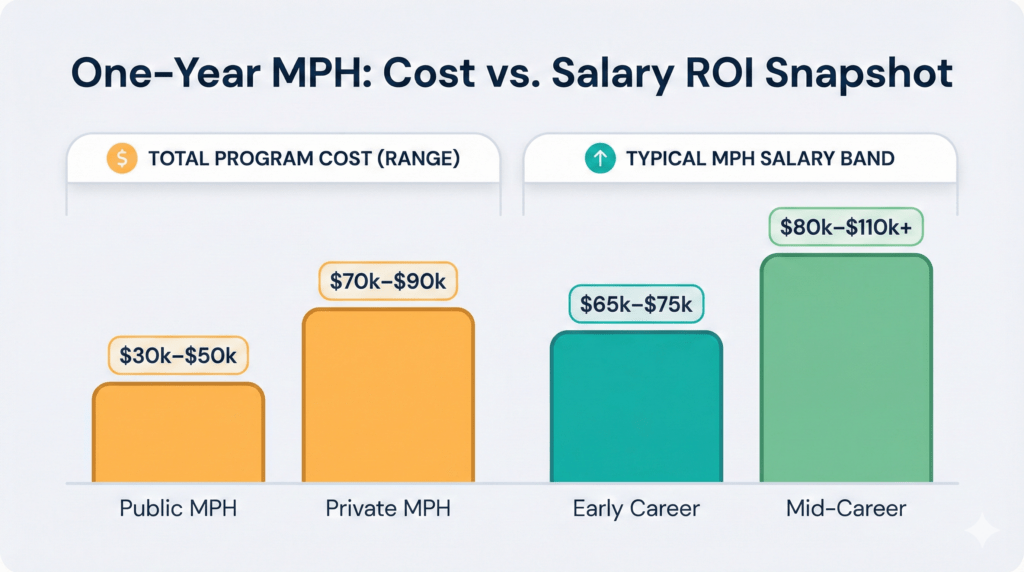
Use this section to sanity-check whether the numbers make sense for you.
Typical Tuition Range for One-Year MPH Programs (USA)
For serious, CEPH-accredited programs, here’s the realistic tuition band (not counting living costs):
- Elite private schools (one-year / 11–12 month MPH)
- Johns Hopkins Bloomberg: full-time 11-month MPH tuition is $85,740 for 5 terms in 2025–26.
- MPH@GW (George Washington): 45 credits × $1,945 per credit ≈ $87,525 estimated tuition for 2025–26.
- Tufts MPH: listed at $2,000 per credit (on-campus or online) for 2025–26; a typical 42–45 credit MPH lands you in the low-to-mid $80k tuition range before fees.
- High-tier private / private-non-elite and many online programs
- Drexel Dornsife lists MPH tuition at $1,416 per credit; a year of MPH study is estimated around $79,000 in tuition plus ~ $19k living expenses and other fees for a full year.
- Public schools of public health (cheaper, especially in-state)
- Colorado School of Public Health: MPH tuition $966 per credit (resident) and $1,566 (non-resident) for 2025–26, significantly lower than many private options.
- Other public programs (e.g., University of Florida, etc.) often sit in a similar “mid-hundreds to low-thousand per credit” range, especially for in-state students.
Rough reality check (tuition only, not precise quotes):
- Public, in-state one-year path: commonly ends up $30k–$50k in tuition.
- Private / big-name one-year MPH: often $70k–$90k in tuition.
Then add:
- University fees
- Health insurance
- Books / software
- Living costs for 12–15 months (rent, food, transport, etc.)
At somewhere like DC, Boston, NYC, or Philly, your real all-in one-year bill (tuition + living) can easily cross $100k at the high end if you’re not careful.
If you were picturing “maybe $20–30k total,” you’re not in the same universe as actual US pricing.
Funding Options: What’s Realistic and What’s Fantasy
You are not going to “hack” this entire cost with some magic scholarship unless you’re unusually competitive or lucky. Here’s the sober breakdown.
1. Institutional scholarships (merit + need)
- Schools like Hopkins explicitly say most admitted MPH students receive some combination of scholarships (merit-based, departmental, specific fellowships).
- GW, Tufts, Drexel, Colorado, etc. all have some scholarship and assistantship options, but:
- Awards are often partial,
- Many are more accessible in standard 2-year formats, and
- Some one-year tracks have limited or no RA/TA positions, because there’s no time to ramp you up.
Translation: Yes, hunt scholarships — but don’t build your plan around “I’ll probably get 80–100% covered.” That’s wishful thinking unless you’re an exceptional candidate with a perfect story and a school that specifically wants you.
2. Assistantships and part-time campus jobs
For 12-month tracks that openly say “expect 60–80 hours/week and do not work while enrolled,” assistantships are usually:
- Not offered to 12-month students, or
- So limited you cannot rely on them.
Two-year students are much more likely to get RA/TA roles, because they have time to ramp up and stay longer than a single intense year.
If your funding plan is “I’ll cover costs with an assistantship in a one-year MPH,” you’re planning on a loophole that mostly doesn’t exist.
3. Employer sponsorship / tuition reimbursement
This is one of the few sane ways to justify a pricey program:
- Some US hospitals, health systems, government agencies, and NGOs pay part of your tuition if you agree to stay for X years or move into a targeted role.
- For accelerated programs, you may have to take leave and then return, rather than work while studying.
If you’re already in a decent job, talk to HR before applying. A medium-tier program at half the cost via employer money beats a brand-name degree at full price you pay alone.
4. Loans and private financing
You already know this, but I’ll say it: you can finance almost anything in the US with federal and private loans, but:
- At $70k–$100k total cost, you’re taking on what is basically a mortgage in student debt.
- With interest, you’re probably paying this off over 10–20 years unless your post-MPH salary jumps fast.
If you’re planning to stay in low-paying roles (small NGOs, entry-level health educator jobs, local non-profits), that debt will hurt.
Salary Outlook for MPH Graduates (and How a One-Year Track Changes the Math)
Now the part everyone lies to themselves about.
Average and typical salary bands
- A recent analysis using PayScale data estimates the average US salary for someone with an MPH at around $73,000 as of 2024.
- A 2024 Kent State breakdown notes that by mid-career (5–10 years), many MPH-trained professionals in roles like epidemiologist, public health program manager, or health services manager move into the $80,000–$110,000+ range.
- Columbia’s public health outcomes data reports an overall median salary of about $75,000 for its public health graduates, with a wide range depending on role and sector.
- A 2025 salary overview at Research.com puts MPH-related roles roughly between $48,000 and $154,000 per year, again heavily dependent on job type and specialization.
In plain English:
- Low end (early, low-paid roles): ~$45–60k
- Mid-band (common mid-career roles): ~$70–100k
- Top roles (management/director/exec): six figures is normal, not automatic. Northeastern, for example, lists public health director median pay around $159k in its 2024 guide.
Your salary will depend way more on:
- Sector (government vs hospital vs pharma vs consulting vs tech)
- Role (epidemiologist vs admin vs data analyst vs director)
- Location (NYC/DC/Boston vs small city vs rural)
- Your pre-MPH experience and skills
than on which one-year program you picked.
Does a One-Year MPH Improve ROI vs Two-Year?
The honest answer: sometimes, but not magically.
Where the one-year format does help:
- You lose one year less income compared with a 2-year full-time program. If you were making $60k pre-MPH, that’s $60k of opportunity cost you avoid.
- You start earning your post-MPH salary earlier, so your higher pay compounds sooner over your career.
If you’re mid-career and can jump from, say, $70k → $95k+ within a couple of years, the math can work out very nicely over 5–10 years.
Where the one-year format does not help:
- Tuition at elite one-year MPH programs (Hopkins, GW, Tufts, etc.) is not cheaper than many two-year degrees; you’re compressing time, not slashing price.
- If the compressed schedule means:
- No time for internships,
- No meaningful research experience,
- Weak network building,
Key ROI question you need to answer honestly:
“Given my current salary and likely post-MPH roles, will this specific one-year program let me repay ~$X of debt within 5–10 years without wrecking my life?”
If “yes” requires fantasy salaries or instant promotions with no evidence, then the ROI is imaginary.
Straightforward Cost–Benefit Filters
Before you get seduced by brochures, run these filters:
- Total cost vs realistic starting salary
- If your realistic first post-MPH salary (not dream salary) is, say, $65–75k, going $100k+ into debt is aggressive.
- Public vs Private
- If you can get a CEPH-accredited in-state public MPH for half the price of a private one-year degree and still reach the same job titles, that’s often the smarter play.
- Scholarships + employer money
- If you can stack partial scholarships + employer sponsorship, an expensive brand name can be reasonable.
- If you can’t, don’t pretend you’re “investing in yourself” when you’re just overpaying for a logo.
Bottom line for this section:
- Expect $30k–$90k+ tuition for a one-year MPH in the US, plus living costs that can push your true one-year bill near or above six figures at the top schools.
- Average MPH salaries cluster around $70k+, with mid-career professionals commonly hitting $80k–$110k and leadership roles going well into six figures — but only if you actually get into those roles.
- A one-year MPH makes financial sense only if:
- You can afford the year with a sane mix of savings, scholarships, employer money, and manageable loans, and
- You have a credible path into roles where that MPH actually moves your salary and responsibility up, not sideways.
If the numbers don’t add up, don’t try to “believe your way” into them. Change the program, change the country, change the pace — but don’t ignore the math.
Alright, let’s finish the article. I’ll keep the remaining sections short, sharp, and useful so you can drop them straight in.
Career Paths After a One-Year MPH
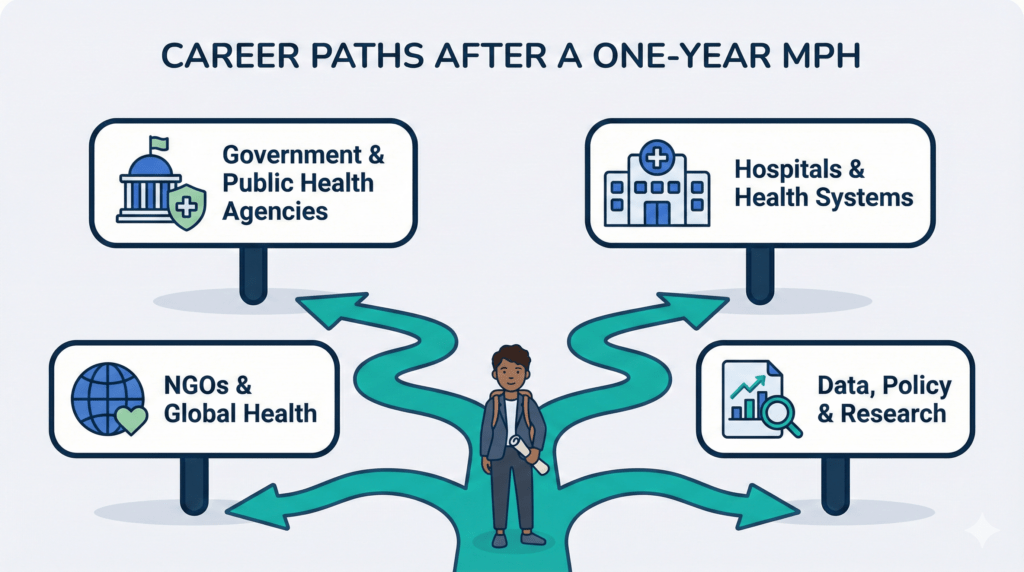
A one-year MPH doesn’t open different doors than a two-year MPH – it just gets you there faster if you already have a base.
Common roles in the USA:
- Government & Public Health Agencies
Epidemiologist, public health analyst, program coordinator/manager in local/state health departments, CDC-funded programs, federal agencies. - Hospitals, Health Systems & Managed Care
Population health manager, quality improvement specialist, infection preventionist, health care administrator, value-based care analyst. - NGOs, Global Health & Nonprofits
Program officer, M&E specialist, implementation coordinator, grant-funded project manager for global or community health orgs. - Research, Policy & Data Roles
Health services researcher, policy analyst, biostatistician/analyst (with stronger quant skills), implementation scientist, consultant.
Your actual job title will depend far more on your pre-MPH experience + concentration than on “one-year vs two-year”.
One-Year vs Two-Year MPH: Which Format Fits You?
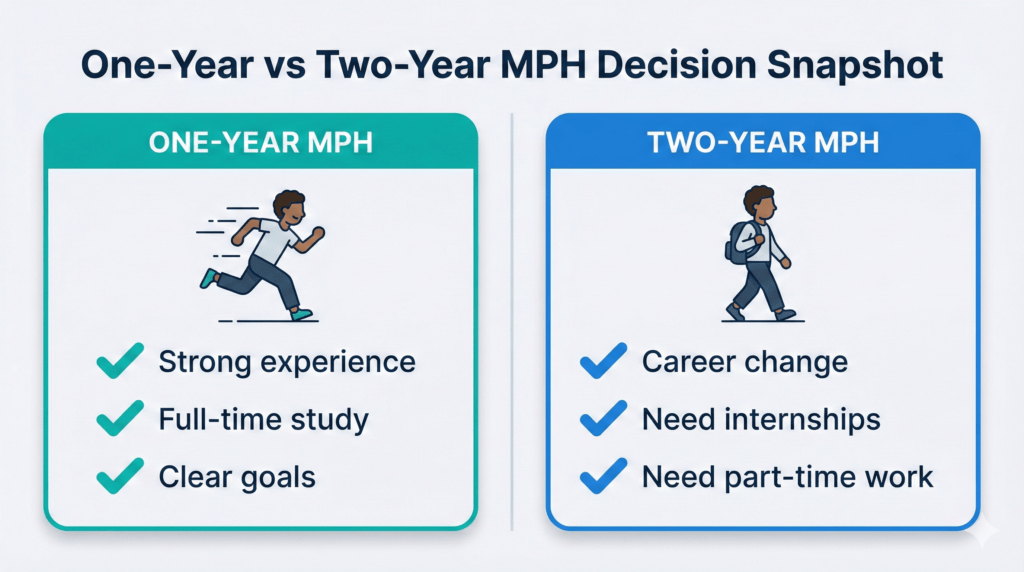
Use this as a brutally simple filter.
You’re a better fit for a One-Year MPH if:
- You already have health or quantitative experience (clinical, research, policy, analytics).
- You can treat school as a full-time+ job for 12–15 months with no real work on the side.
- You know exactly which roles you’re targeting after graduation.
You’re a better fit for a Two-Year MPH if:
- You’re switching fields and need time to build basic stats, epi, and health-policy understanding.
- You want internships, research, student leadership, or the option to explore different tracks.
- You need a structure where part-time work is realistically possible.
Simple rule:
If you’re still “figuring things out”, you’re a two-year person. If you’re already in the game and just need an upgrade, one-year can work.
Application Timeline and Checklist for a 2025 Start
Adjust months if you’re targeting spring vs summer vs fall, but the logic stays the same.
12–18 months before start (now–early 2024 for a 2025 intake):
- Make a shortlist of CEPH-accredited programs (online, hybrid, campus).
- Decide one-year vs two-year honestly based on your background and life situation.
9–12 months before start:
- Take TOEFL/IELTS/Duolingo if you’re international.
- Draft your statement of purpose with clear goals.
- Ask recommenders (supervisors/faculty) early.
6–9 months before start:
- Submit applications ahead of priority deadlines (better for funding).
- Apply for scholarships, employer sponsorship, or government funding if available.
0–6 months before start:
- Finalize your program choice, send in deposits.
- Arrange housing, visa (if needed), and leave from work.
- Clear your calendar; a real one-year MPH will own your life.
FAQs: One-Year MPH Programs in the USA (2025)
Q1. Are one-year MPH programs as respected as two-year programs?
Yes – if the program is CEPH-accredited and from a recognized university. Employers see “MPH + skills + experience,” not “how many semesters you took.”
Q2. Can I work full-time while doing a one-year MPH?
Realistically no. Schools like GW and Drexel literally say one-year students should not work due to 60–80 hours/week of study. If you must work, pick a longer or part-time track, not the 12-month option.
Q3. Do I need an MD or advanced degree for a one-year MPH?
Not always, but many true accelerated tracks (e.g., some at Emory, Buffalo) prefer or require a prior advanced degree or substantial health experience. If you’re fresh from undergrad, most one-year options are not aimed at you.
Q4. Are there fully online one-year MPH programs in the USA?
Yes – examples include MPH@GW, Drexel’s 12-month online MPH tracks, and Northeastern’s accelerated online MPH. They’re still full-time and intense; “online” doesn’t mean “easy.”
Q5. Is a one-year MPH good for immigration or working in the US afterward?
Immigration is a separate headache. A one-year MPH can qualify you for roles that support work visas (e.g., H-1B), but there is no guarantee. Treat immigration as a separate problem you plan for with actual legal advice, not as a built-in benefit of the degree.
Final Thoughts: Is a One-Year MPH Right for You in 2025?
Strip away the marketing and you’re left with this:
- A one-year MPH is the same degree, squeezed into a year.
- It’s great if you’re already in health, can afford a year off, and want to level up fast.
- It’s terrible if you’re underprepared, broke, or hoping to “figure things out” once you arrive.
Before you apply, answer three questions without lying to yourself:
- Can I survive a full-time, high-pressure academic year with almost no room for work?
- Does this specific program clearly connect to the jobs I actually want?
- Do the cost and likely salary afterwards make sense on a 5–10 year timeline?
If you can’t give a solid “yes” to all three, your problem isn’t “which one-year MPH?” – it’s whether you should be in a one-year format at all.
Internal Links:
CEPH-Accredited MPH Programs in New York (2025)
Accelerated 1-Year MPH Programs (2025 Guide): Accredited 12-Month MPH Options
MPH vs MHA vs MBA (2025): Which Health Degree Is Best for You?
Related MPH Guides
Use these linked guides to compare degree fit, accreditation, and costs before you apply.
