Overview – Funding Your Public Health Degree in 2025
Paying for an MPH doesn’t have to be overwhelming. Funding typically comes from a mix of scholarships (gift aid), assistantships (work-for-stipend/tuition), fellowships (paid training roles), employer tuition support, and service-based loan-repayment after you graduate. The biggest wins are competitive national scholarships and school-based full-tuition awards, but smaller association and state scholarships stack nicely and can cover books, fees, and living costs.
Table of Contents
Start early. Many marquee awards open in late summer and close in October–December for funds used the following academic year. Build a simple tracker with requirements, micro-deadlines (transcripts, recommendations, FAFSA/need docs), and status notes. ASPPH’s financing guides reinforce the “start early + cast a wide net” approach and point to state/federal aid, demographic-specific awards, and search strategies. aspph.org+1
As you scan opportunities, note eligibility quirks: citizenship or residency limits, GPA floors, “field fit” (e.g., health education vs. epi), and service commitments (some awards fund you now in exchange for serving in high-need settings later). If you’re in (or considering) an online MPH, most external scholarships don’t distinguish modality—what matters is accreditation and your fit with the funder’s mission. Use this page to shortlist options, then verify details on the official program pages before you submit.
Pro tip: Treat scholarship apps like mini-grants—tailor your statement to the funder’s mission, quantify your impact, and ask recommenders to speak to public-health outcomes and leadership they’ve personally seen.
National Public Health Scholarships
Below are major, widely recognized funding options for MPH/public-health students. Always confirm current award amounts, eligibility, and deadlines on the official pages—programs change details yearly.
Bloomberg Fellows Program (JHU) – Full tuition + stipend
- Sponsor: Johns Hopkins Bloomberg School of Public Health
- Eligibility: Full-time MPH (or DrPH) students partnered with a U.S. organization in a designated focus area; continued service commitment with that organization after graduation
- Deadline: Typically late fall/early winter for the following summer start
- Notes: Mission-driven, cohort model; extremely competitive
Sommer Scholars (JHU) – Full tuition + living support
- Sponsor: Johns Hopkins Bloomberg SPH
- Eligibility: Exceptional leadership and impact; considered alongside MPH admission
- Deadline: With MPH application (no separate scholarship form in most cycles)
- Notes: Prestige scholarship emphasizing leadership potential
TYLENOL® Future Care Scholarship – $10,000 / $5,000
- Sponsor: TYLENOL® / Scholarship America
- Eligibility: Students in health-related degrees (public health included)
- Deadline: Opens spring; results late summer
- Notes: One of the longest-running private health scholarships
ACHE Albert W. Dent Graduate Student Scholarship – $5,000
- Sponsor: American College of Healthcare Executives
- Eligibility: Graduate underrepresented minority students in health administration/public health (often final year)
- Deadline: Typically winter–spring window
- Notes: Leadership/professional association angle; pair with ACHE student membership
ACHE Foster G. McGaw Graduate Student Scholarship – $5,000
- Sponsor: ACHE Foundation
- Eligibility: Graduate students in health administration/public health
- Deadline: Typically winter–spring
- Notes: Strong fit for MPH students with management/administration focus
SOPHE Vivian Drenckhhahn Student Scholarship – $2,500 (≈3 awards)
- Sponsor: Society for Public Health Education
- Eligibility: Full-time undergrad/grad; SOPHE members in health education/health promotion
- Deadline: Commonly October
- Notes: Education/behavioral science focus
AAUW International Fellowships – ~$20,000 (Master’s)
- Sponsor: American Association of University Women
- Eligibility: Women who are not U.S. citizens/perm. residents; full-time graduate study in the U.S.
- Deadline: Fall
- Notes: Broad discipline coverage; strong for international MPH candidates
Hispanic Scholarship Fund (Graduate) – $500–$5,000
- Sponsor: HSF
- Eligibility: Students of Hispanic heritage; graduate enrollment; U.S. citizen/PR/eligible non-citizen per program rules
- Deadline: Opens winter; closes spring
- Notes: Apply even if you have other aid—awards can stack
Native Forward Scholars Fund – Varies (multi-program)
- Sponsor: Native Forward (formerly AIGC)
- Eligibility: American Indian/Alaska Native students (tribal eligibility required)
- Deadline: Multiple cycles
- Notes: Numerous graduate awards; check discipline-specific options
UNCF Graduate Scholarships – Varies
- Sponsor: UNCF + partner donors
- Eligibility: Black/African American students; program-specific criteria
- Deadline: Rolling across the year
- Notes: Set alerts; opportunities open/close frequently
Fulbright Foreign Student Program – Full funding (varies by country)
- Sponsor: U.S. Department of State
- Eligibility: International master’s/PhD candidates; local commission timetables
- Deadline: Country-specific
- Notes: Flagship program; align your statement to binational goals
Rotary Global Grant Scholarships – Typically ~$30,000+
- Sponsor: Rotary Foundation
- Eligibility: Graduate study aligned to Rotary “areas of focus” (e.g., disease prevention, water/sanitation)
- Deadline: Through local Rotary districts
- Notes: Requires a host club; early networking helps
Joint Japan/World Bank Graduate Scholarship Program – Full tuition + stipend
- Sponsor: World Bank
- Eligibility: Citizens of eligible developing countries admitted to partner programs (health/public policy often included)
- Deadline: Annual application windows
- Notes: Return-to-home-country expectation post-graduation
WHO/TDR Postgraduate Training (Implementation Research) – Full academic support
- Sponsor: TDR (hosted at WHO)
- Eligibility: LMIC nationals at designated partner universities; implementation research focus
- Deadline: By partner institution
- Notes: Great fit for disease control/global health tracks
Peace Corps Coverdell Fellows (RPCVs) – Tuition reductions/stipends (varies)
- Sponsor: Peace Corps + partner universities
- Eligibility: Returned Peace Corps Volunteers
- Deadline: By partner school
- Notes: Combines funding with service-in-community internships
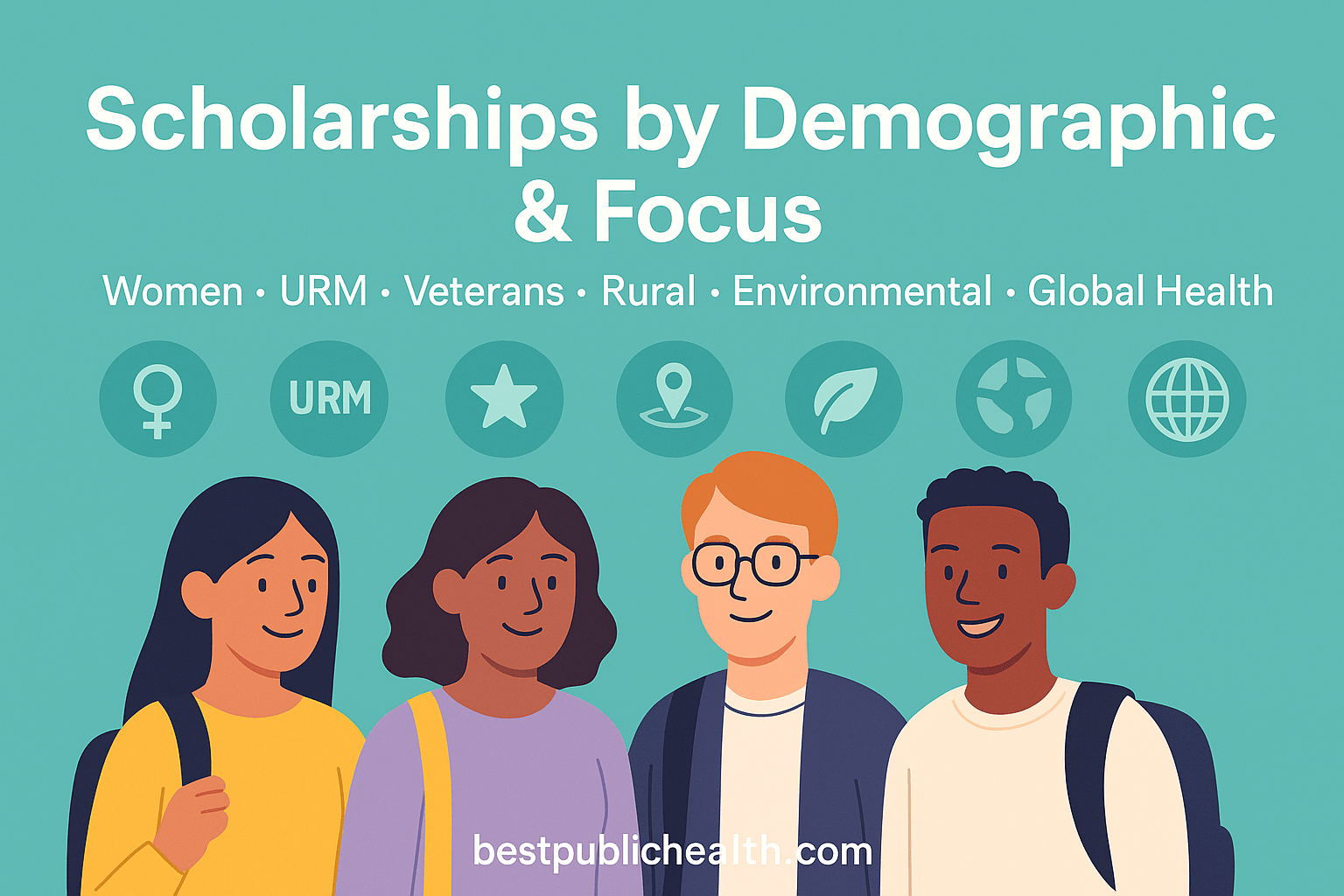
Scholarships by Demographic/Focus
Targeted awards can significantly raise your odds. Use these as starting points, then layer on school-based aid and state programs.
Minority & Underrepresented Students
- Hispanic Scholarship Fund (Graduate): stackable awards for graduate study
- UNCF Graduate Opportunities: multiple donor-funded programs across the year
- Native Forward (AIGC): extensive graduate scholarships for AI/AN students
- APIA-focused programs (e.g., APIA Scholars): some cycles include grad/health awards
Tip: Many professional associations (e.g., ACHE, APHA sections, local coalitions) run small but stackable scholarships aimed at representation—watch their student pages.
Women in Public Health
- AAUW International Fellowships: for non-U.S. citizens pursuing grad study in the U.S.
- PEO International (various): several funds support graduate women (some U.S., some international)
Tip: Even when a scholarship isn’t labeled “public health,” you can win by framing your impact and leadership in population health.
Veterans & Military-Affiliated
- Pat Tillman Foundation (Tillman Scholars): leadership-oriented funding for veterans/military spouses (MPH eligible)
- University VA-aligned awards: many MPH programs add tuition gaps for GI Bill users
Tip: Ask your school’s VA office about matching funds and priority assistantships.
Rural / Underserved Commitment
- NHSC Scholarship (service-obligation): tuition + stipend for certain health professions with HPSA service (public-health-aligned tracks at some schools)
- State health-department scholarships & LRPs: several states fund residents who train/serve in-state
Tip: If you’re open to service, combine a smaller upfront award with loan-repayment after graduation for maximum net benefit.
Environmental / Global Health Focus
- NEHA/AAS student awards: environmental and environmental-health emphasis
- Rotary Global Grants: fit disease prevention, water/sanitation, maternal/child health projects
- TDR (WHO) training funds: implementation research in LMICs
Tip: Align your personal statement to the sponsor’s mission (e.g., climate resilience, WASH, vector control) and quantify past impact.
First-Gen / Low-Income & General Need
- University hardship/need-based scholarships: often under-advertised inside departments
- Graduate assistantships (RA/TA): convert to partial or full tuition coverage + stipend
Tip: Even if you miss a national deadline, you can still win departmental awards at admission or at the end of the first term—ask early.
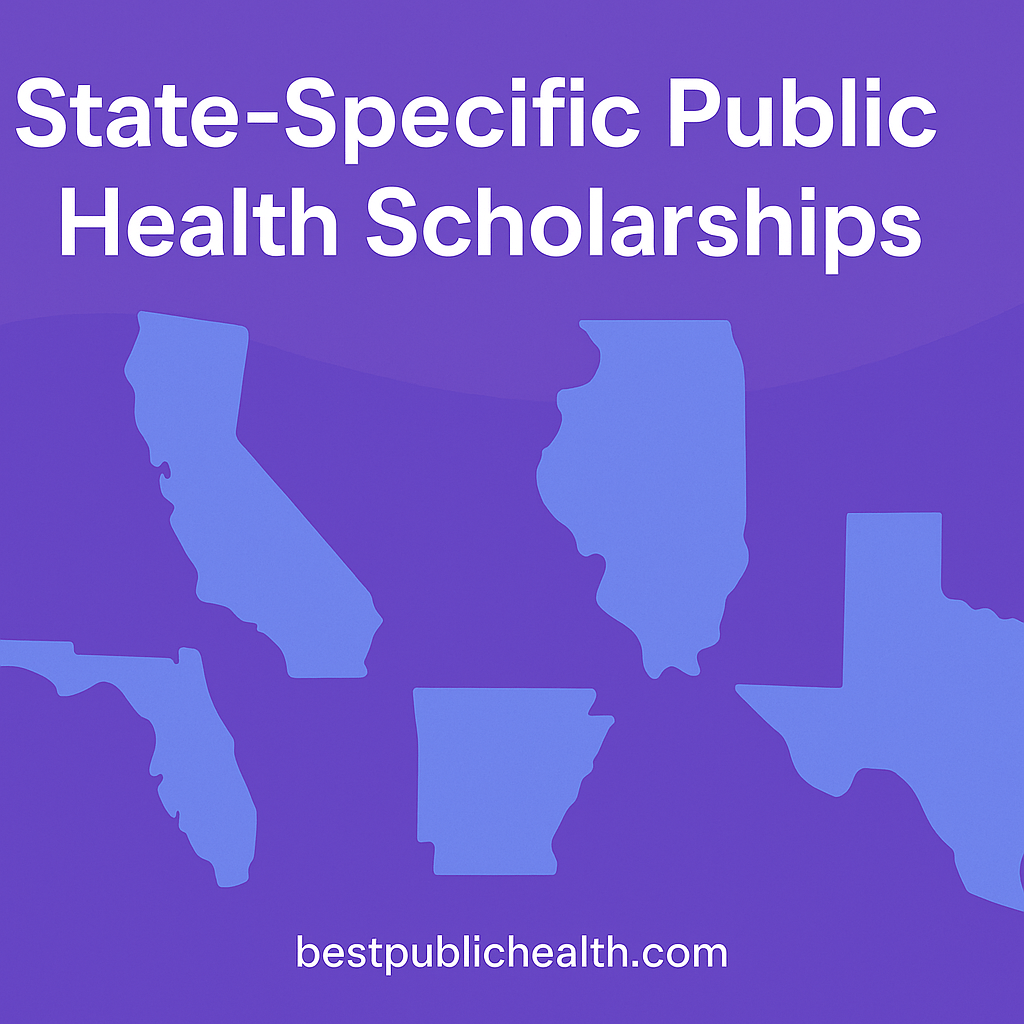
State-Specific Public Health Scholarships
Many states fund residents or students who study/serve in-state. Awards change year-to-year, so use these examples as a starting point and check each official page. (We also maintain 50-state pages—use the jump below each card to see everything for that state.)
California
- HCAI (formerly OSHPD) / Health Professions Education Foundation: rotating scholarships and robust loan-repayment for those serving shortage areas.
- County & association awards: local public health associations and county health departments post small, stackable scholarships.
Texas
- Texas Public Health Association (TPHA) Student Scholarships: undergrad/grad public health.
- Regional health foundation grants: e.g., Gulf Coast, North Texas community foundations often list health graduate awards.
New York
- NY State/City health fellowships & stipends: paid placements that offset costs while you study or right after you graduate.
- SUNY/CUNY departmental funds: many MPH programs offer merit/need awards unique to each campus.
Florida
- State/association support: Florida Public Health Association student awards (small but stackable).
- County public health foundations: check Miami-Dade, Orange, and others for grad awards focused on community health.
Illinois
- Illinois Public Health Association (IPHA) Student Scholarships: for MPH/PH students.
- Chicago-area foundations: look at health equity/care access funds supporting grad training.
North Carolina
- North Carolina Public Health Association (NCPHA) Student Scholarships: undergrad/grad; amounts vary.
- Rural health service awards: incentives for students committing to practice in rural counties.
Washington
- WA public health association/coalitions: annual student awards for MPH/health promotion.
- Hospital system foundations: Providence, MultiCare, etc., sometimes fund local graduate training.
Massachusetts
- Local health department & coalition awards: Boston/Cambridge foundations often include population-health graduate awards.
- University-affiliated community health funds: merit + need packages for Massachusetts residents.
Georgia
- State public health association awards: student support tied to conference participation or posters.
- Community foundations (Metro Atlanta, Savannah): public-health/health equity scholarships.
Pennsylvania
- PA public health association & regional coalitions: student mini-grants/scholarships.
- Hospital/health-system foundations: Allegheny, Penn Medicine affiliates sometimes post grad awards.
Pro tip: For service-linked funding (e.g., rural incentives), check your state’s primary care office and HRSA-aligned programs. Even if a scholarship is small, you can pair it with loan-repayment after graduation for a bigger net benefit.
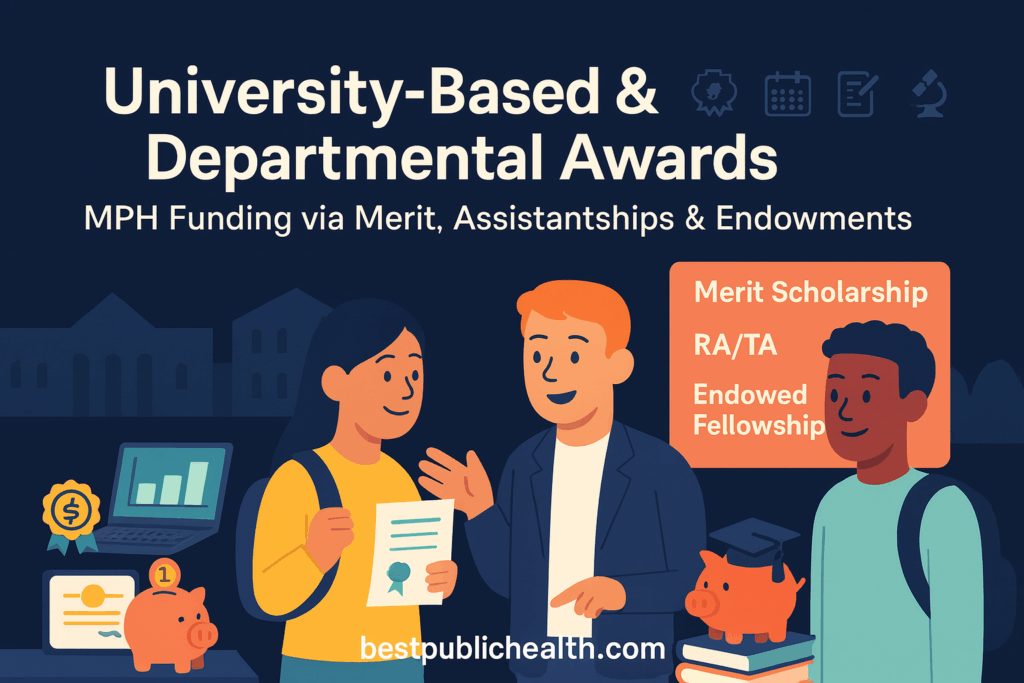
University-Based & Departmental Awards
Some of the largest MPH awards are internal—available only after admission or through your department.
Where to look
- School/Department pages: “Tuition & Funding,” “Scholarships,” and “Assistantships” sections.
- Graduate School site: campus-wide fellowships and emergency/need grants.
- Public Health department newsletters & student portals: deadlines often live here first.
- Faculty labs & centers: PI-funded RAships tied to grants (epi, MCH, global health, environmental health).
Common types
- Merit scholarships: partial to full tuition reductions for top applicants.
- Graduate Assistantships (RA/TA/GA): tuition remission (partial/full) + stipend; typically 10–20 hrs/week.
- Named fellowships/endowments: donor-funded awards with a theme (e.g., community health, health equity).
- Conference/research mini-grants: $250–$2,000 for travel, data collection, or capstone expenses.
How to unlock these
- Ask early. Before you accept an offer, email program directors about assistantship pipelines (how many 1st-years hold RA/TA roles, average stipend, waiver %).
- Signal fit. In your statement and interview, align with faculty research or department priorities (e.g., MCH, HIV, opioids, climate).
- Be flexible on hours. Some schools ramp assistantships after the first semester once you’ve proven capacity.
- Stack smartly. Many internal awards combine with external scholarships—confirm stacking rules with financial aid.
- Reapply each year. Some awards renew automatically; many require an annual progress update.
Quick checklist for your outreach email
- 2–3 lines on your focus (e.g., injury prevention, health disparities).
- Mention methods/skills (R, Python, SAS, GIS, implementation science, program eval).
- Ask about: open RA/TA positions, typical start terms, stipend + tuition coverage, and any departmental fellowships you should target.
Service-Based Funding & Loan Repayment
Scholarships help while you’re in school. Service programs catch the rest on the back end. If you’re willing to work where the need is highest, you can erase a surprising amount of debt in two to five years.
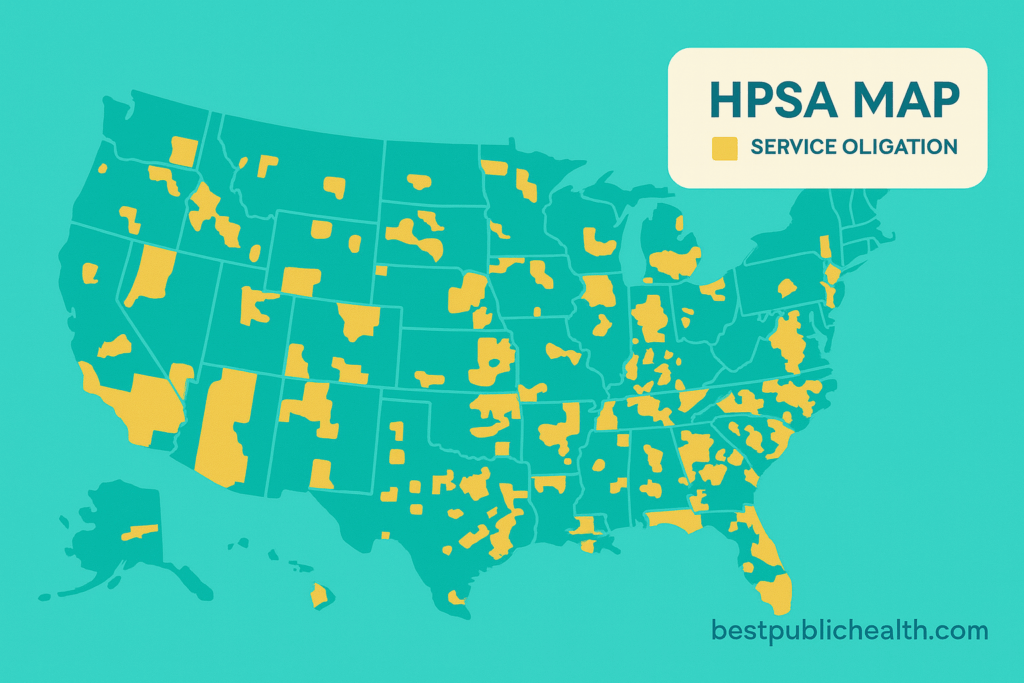
H3: National Health Service Corps (NHSC): scholarship vs. loan repayment
- Scholarship (while enrolled). Covers tuition/fees and pays a monthly stipend. You agree to serve in a Health Professional Shortage Area (HPSA) after graduating. The list of eligible disciplines changes—check the current year before you assume you’re in or out.
- Loan Repayment (after hire). Take a qualifying job at an approved HPSA site and NHSC pays down your loans. Awards scale with the site’s HPSA score and whether you’re full-time or part-time.
Who this typically suits
- Folks headed toward primary care, behavioral health, community health, or local/state health department work—especially in rural or under-resourced settings.
Prep, not fluff
- Make a shortlist of 5–8 real HPSA employers (clinic names, not just cities).
- In your essays, point to outcomes: “Expanded PrEP access by 28% across two clinics in Ward 7,” not “I’m passionate about access.”
- Keep paperwork tidy—licenses, hours, job descriptions—because verification is strict.
Back-of-the-envelope math
- Balance at graduation: $48,000.
- Two-year award: $25k–$50k total.
- Effective reduction: $12.5k–$25k per year off principal—often beats a one-time $5k scholarship.
HRSA public-health workforce programs you should actually watch
- Public Health Workforce Loan Repayment (PHWR). Aims at people working in governmental or tribal public health. Windows and amounts move year to year—put HRSA’s announcements and your state listserv on alerts.
- MCH traineeships. While you’re enrolled, some departments use HRSA funds to provide stipends or partial tuition. Ask the Maternal & Child Health lead early; spots go fast.
State loan-repayment (SLRPs) and other incentives
- Many states run NHSC-style repayment for work in rural/frontier or high-need communities. Some cover epi, environmental health, and local HD roles.
- Start at your state’s Primary Care Office page. Check whether state and federal benefits stack—the answer isn’t always the same.
Working plan that actually pencils out: modest scholarship + RA/TA during school, then 2–3 years of loan-repayment in a qualifying role. Over three years, the net savings often land in “full-tuition” territory.
Fellowships & Traineeships (Paid)
Think “paid apprenticeship,” not classroom time. These roles give you a salary, mentoring, and projects that read well on a résumé. They don’t always touch tuition, but they can cover living costs and open doors to loan-repayment-eligible jobs.
CDC Epidemic Intelligence Service (EIS) — post-grad, 2 years
- What you do: Field investigations, surveillance, rapid response, writing that matters.
- Who it fits: MPH grads who like epi + analysis and aren’t afraid of messy, real-world data.
- Timing: Applications usually open late summer/early fall for the next year. References take time—start early.
CDC Public Health Associate Program (PHAP) — early-career, 2 years
- What you do: Full-time work at state/local/tribal health agencies with CDC training attached.
- Why people pick it: Strong conversion to permanent roles; you learn how a health department actually runs.
HRSA-funded traineeships (MCH, Behavioral Health, Rural)
- What you get: Stipend, partial tuition, seminars, mentored practicum.
- How to find: Ask program leads (MCH, BH, Rural, Primary Care). Expect clear deliverables—seminars, specific practicum sites, sometimes a service pledge.
State & local health department fellowships
- Examples: State epi fellowships, county health residencies, cross-agency leadership cohorts.
- Why they’re useful: Paid, structured, and you leave with contacts who can hire you.
University/center research fellowships
- Where to look: Injury prevention centers, HIV/ID labs, implementation science groups, environmental/global health institutes.
- How to ask: Send 3–5 faculty a one-page brief: methods you use, datasets you’ve touched, and one problem in their lab you’d like to work on next term.
Mini-case
Final-semester MPH student lands a 0.5 RA in implementation science (tuition remission + stipend). After graduation, they start PHAP in a mid-sized city, convert to a permanent role, then qualify for state LRP in year two. Net result: living costs covered during school, steady salary after, and a big bite out of loans by month 24.
For International Students
Paying for a U.S. MPH as a non-citizen is doable, but the mix is different. You’ll lean less on federal aid and more on country programs, global funders, university awards, and assistantships.
What usually pays the bills
- Country/Global awards. Think Fulbright, JJ/WBGSP, Chevening/DAAD/Commonwealth, and WHO/TDR. They’re competitive, but they’re also transparent: clear deadlines, published benefits, and well-documented criteria.
- University money. Many schools reserve merit and dean’s scholarships for international admits (anywhere from 25% to full tuition). The quieter win: RA/TA jobs—10–20 hours/week for stipend + partial or full tuition remission.
- Center/lab placements. Global health, environmental health, HIV/ID, or implementation science centers often pay research fellows from grant budgets.
Plan it like a project
- Shortlist five programs that actually fund internationals (don’t guess—ask for last year’s numbers).
- Email, don’t assume. A two-line note to the program coordinator works:
“Hi ___, how many international MPH students held RA/TA roles last year, and roughly what % tuition did those cover?” - Line up proof of funds early. You’ll need award letters or bank statements for the I-20/DS-2019.
- Budget for the non-obvious. University health insurance (often mandatory), fees, and a modest emergency fund.
- Mind work rules. F-1 usually caps on-campus work at 20 hrs/week during term; build your budget around that, not beyond it.
A simple, effective combo
One external scholarship (even partial) + a first-semester RA + a small department award can cover most tuition and a good chunk of living costs—without relying on loans. Start those lab outreach emails 3 months before you arrive.
How to Apply: Timeline, Tips & Templates
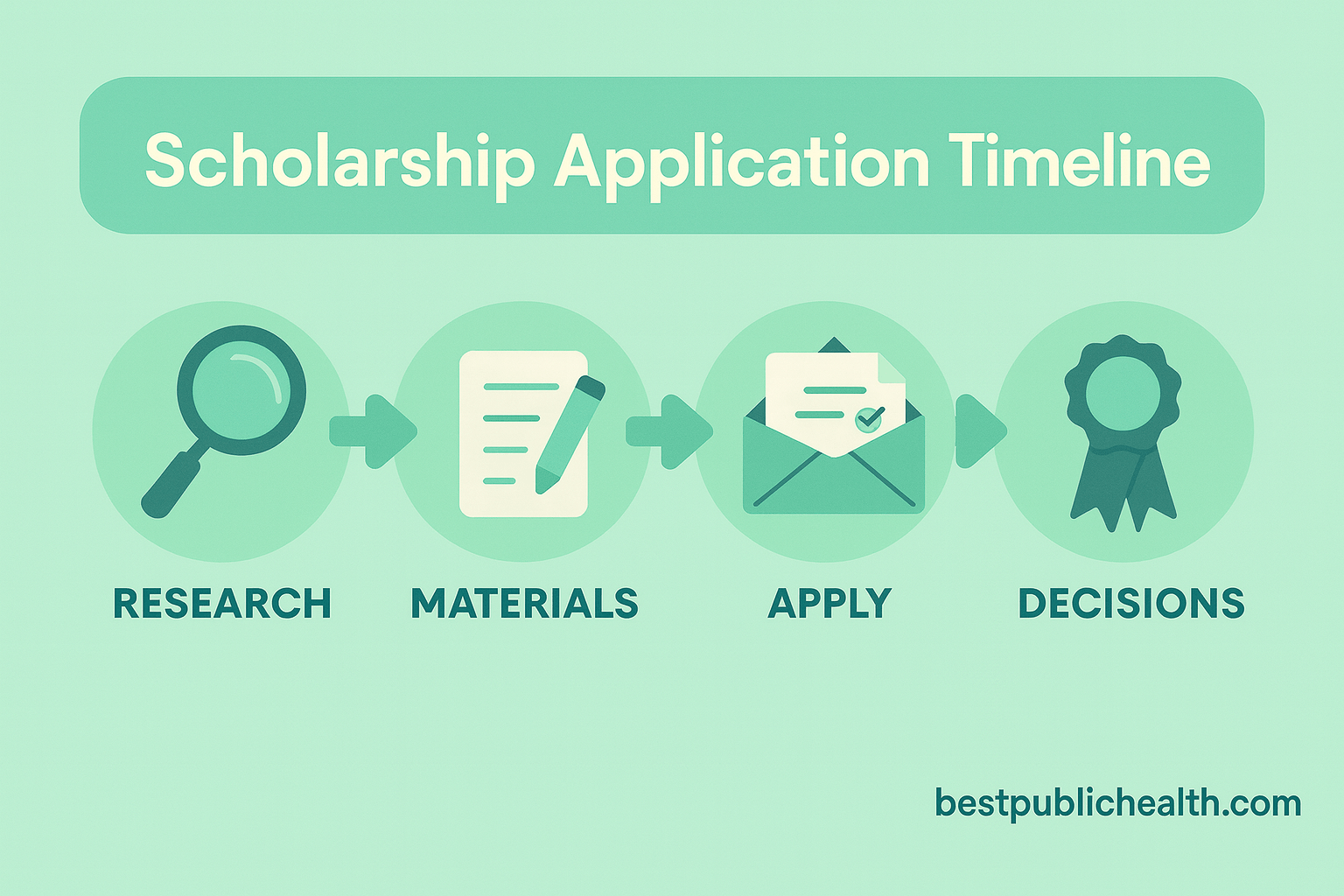
Applications that win are tidy, specific, and obviously aligned with the funder’s mission. Here’s a no-drama way to run the process.
A working 12–18 month timeline
- Months 0–2 — Map the field. Build a list of 20–30 awards. Note citizenship rules, GPA floors, and any service obligations.
- Months 2–4 — Build the kit. One master statement + two tailored versions, résumé/CV, transcript orders, three recommenders who’ve seen your work.
- Months 4–7 — Ship in waves. Most big deadlines hit Oct–Dec for the next academic year. Block 90 minutes weekly for applications.
- Months 7–10 — Keep momentum. Rolling deadlines, late-cycle awards, and department funds open up.
- Months 10–12 — Backstops. Apply for RA/TA roles, travel/research mini-grants, and any school-specific scholarships you missed earlier.
Personal statement: a simple structure that reads well
- What you’ve seen up close. Two sentences from a real setting (clinic, field site, dataset).
- The gap. A concrete problem and one metric (screening uptake, time to treatment, coverage).
- What you did. Tools, partnerships, and a result—even if partial.
- Why this funder + program. Name a center, course, or mentor and how you’ll use them.
- After graduation. One measurable goal tied to a population/place and a two-year horizon.
Swap “I’m passionate about X” for numbers. “Shifted vaccine no-show rate from 18% → 9% after adding SMS with two-way replies” lands better than adjectives.
Letters that help (and how to get them)
- Pick writers who watched you work (PI, supervisor, field preceptor).
- Hand them a one-page brief: 5 bullets of outcomes + your goals + the deadline.
- Ask for one vivid detail: “Could you describe my role in the naloxone pilot and how we used run charts to adjust outreach?”
- Nudge 7–10 days before the due date with links again.
Documents & eligibility: avoid scrambles
- Common asks: transcripts, CV, proof of citizenship/residency, FAFSA/need docs (U.S.), and sometimes portfolio/code for data-heavy tracks.
- International: passport, proof of funds, English test scores, and—if required—credential evaluation. Put everything in named folders now.
A lightweight system you’ll actually use
- Tracker columns: Program | Amount | Fit notes | Docs | Recommenders | Deadline | Status | Decision | Follow-up.
- Folders:
/Scholarships/01_Statements,/02_Transcripts,/03_Recommendations,/04_Proof. - Naming:
Lastname_Award_Statement_v2.docxso you can find the right file at 11:58 pm.
Easy mistakes to dodge
- A generic essay that never mentions the sponsor’s mission.
- Missing one document (often proof of enrollment).
- Overlooking stacking rules or service obligations—then saying no to money you already “won.”
awesome — here are the next two sections, concise, skimmable, and ready to paste.
FAQs – Public Health Scholarships
When should I start applying for 2025 funding?
Start 12–18 months before you enroll. Many big awards open in late summer and close Oct–Dec for the next academic year.
Are there scholarships specifically for MPH students?
Yes. Examples include school-based full-tuition awards (e.g., leadership cohorts) and association scholarships aimed at public health, health education, or environmental health.
What GPA do I need?
Varies by program. Plenty of awards have a 3.0 floor, but some weigh essays, service, and leadership more heavily. Always check the official criteria.
Can online MPH students get scholarships?
Usually yes—funders typically care about accreditation and field of study, not modality. Confirm with the sponsor and your school.
Can I stack multiple scholarships?
Often. Some funders limit stacking or reduce the award if you receive other aid. Disclose all funding and ask about their coordination policy.
I missed a deadline—what now?
Pursue departmental awards, assistantships (RA/TA), and rolling/late-cycle scholarships. After graduation, target loan-repayment programs to finish the job.
What’s the difference between scholarships, fellowships, and loan-repayment?
- Scholarships: gift aid up front (no repayment unless you break a service commitment).
- Fellowships/traineeships: paid roles with mentoring; may include stipends/tuition support.
- Loan-repayment: money after graduation for service in qualified roles/sites.
How do I make my application stand out?
Use numbers and outcomes. Name the population, the method, and a result (even partial). Mirror the sponsor’s mission and show how their dollars change your next two years.
Where else should I search?
Your school’s financial-aid page, department newsletters, professional associations, and reputable aggregators. Also check state health departments and local community foundations.
Related MPH Guides
Use these linked guides to compare degree fit, accreditation, and costs before you apply.
