If you’ve been weighing an MPH but can’t step away from work or family, best online MPH programs in 2026 finally make the timing realistic. Today’s CEPH-accredited options deliver the same core public health competencies you’d see on campus, just in a format that fits real life. Think weekly live classes in the evening, recorded lectures for busy weeks, and clear term plans so you’re not guessing what’s due. For many students—nurses on night shifts, clinic managers, community organizers—an online Master of Public Health is the only path that doesn’t require uprooting a job, a household, or both. The result is simple: you keep momentum in your career while earning a credential employers recogniz
Table of Contents
Best Online MPH Programs in 2026: Fast Shortlist
Updated June 2026. The strongest online MPH choice is not just the most famous school name. Start with CEPH accreditation, then compare total cost, live class requirements, practicum support, concentration fit, and whether the program is realistic with your work schedule.
| Student goal | What to prioritize | Next guide |
|---|---|---|
| Working full time | Asynchronous lectures, evening sessions, clear part-time plan | Best MPH Programs |
| No GRE preference | GRE not required, GRE optional, or transparent waiver policy | No-GRE MPH Programs |
| Accreditation check | CEPH status, school or program accreditation, and delivery format | CEPH-Accredited MPH Programs |
| Lower total cost | Tuition, fees, employer aid, scholarships, and time to completion | Public Health Scholarships |
Why Pursue an MPH Online in 2026?
Online MPH programs have matured. Since 2020, universities rebuilt courses for digital delivery instead of just streaming a classroom. You’ll see small-group breakouts, case discussions that feel like staff meetings, and project rooms where teams spread across time zones still manage to ship solid work. The experience is less “watch a video,” more “solve a problem with your cohort.”
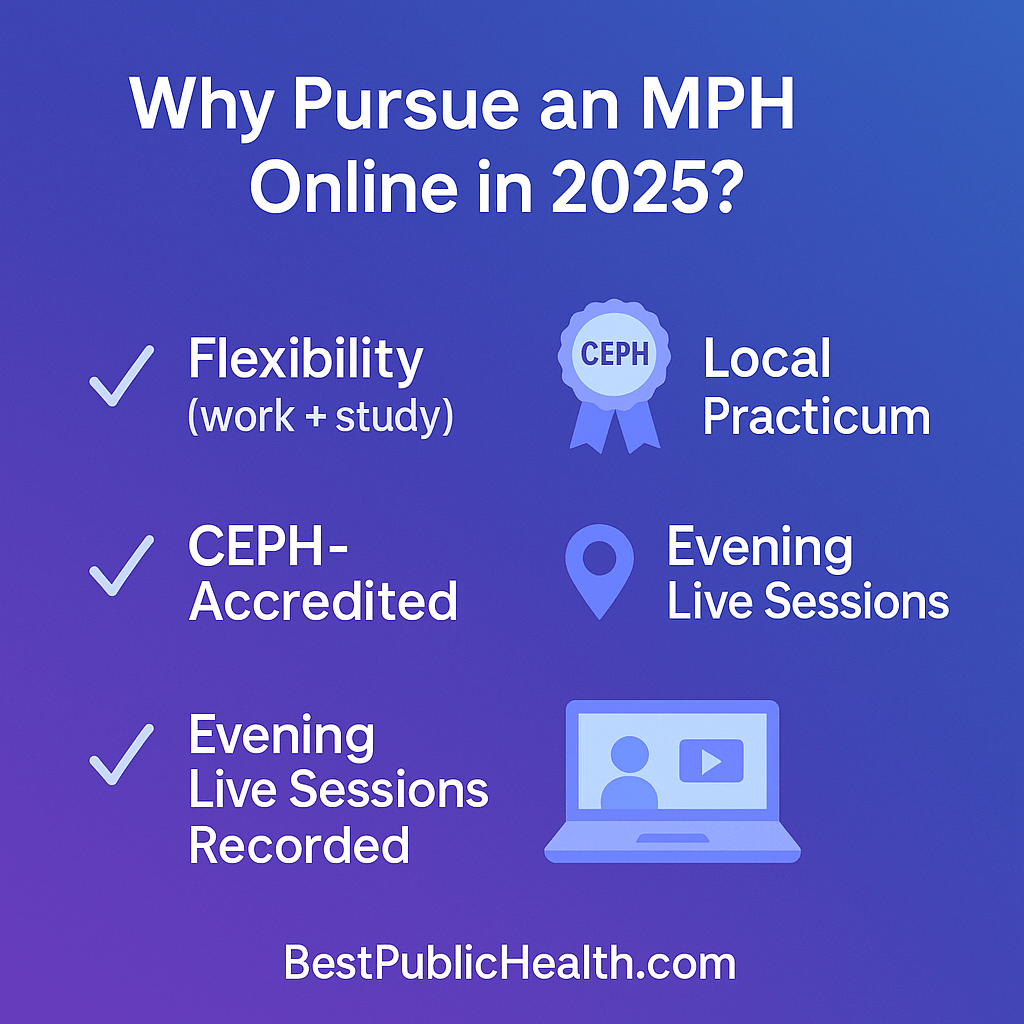
Flexibility is the headline. You can log in from home, a clinic office, or a quiet corner of the library and take 6–9 credits per term without burning your vacation days. Live sessions are commonly scheduled after work; when life happens, replays are there. Part-time plans let you move steadily toward graduation without pausing your paycheck.
Quality travels with you. CEPH accreditation applies to online and on-campus programs alike, which means the degree holds the same weight when you apply for roles in epidemiology, policy, community health, or program management. If you’re comparing schools, make “accredited” your first filter.
Practice stays local. Most online MPH students complete practica where they already live—at a county health department, an FQHC, a hospital system, or a nonprofit partner—so the hours you invest also build the network you’ll lean on after graduation. Many programs kept the remote and hybrid options that proved effective during the pandemic, giving you more ways to meet requirements without travel.
Bottom line: an online, CEPH-accredited MPH lets you keep your life in place while you gain the tools to lead—no commute, no relocation, and no compromise on rigor.
Ranking Methodology for Online MPH Programs
You deserve to know how we built this list. We started by trimming the field to programs we’d feel good recommending to a working nurse, an analyst at a health department, or a community-based organizer who can’t relocate. Then we read the fine print—course maps, handbooks, tuition pages—and compared apples to apples: credits, delivery, support, and real outcomes.
Accreditation & reputation
CEPH or bust. If a school or program isn’t accredited by CEPH, it’s out. Among those that pass, we look for signals that the learning experience is genuinely strong: engaged faculty, active research and practice ties, and consistent employer recognition. A shiny ranking isn’t enough on its own; we read past the headline to see what actually supports students.
Price & value
We calculate a realistic total cost: required credits × published per-credit rate, plus any mandatory fees a school lists. If there’s an in-state/out-of-state split, we note both. Programs earn extra credit when they’re transparent about pricing and when they help you pay for it—clear scholarship pages, public-sector discounts, payment plans, or support using employer tuition benefits. Time matters too: a plan that gets most students to the finish line in ~20–24 months (with a sane part-time map) is better value than a maze of delays.
Curriculum & outcomes
We prefer depth with focus—tracks like epidemiology, health policy, global health, leadership, or nutrition—without scattering quality across too many niches. Practice is non-negotiable: supported, local practicums (with placement help) and capstones that solve real problems. We also score how learning happens: small cohorts, live seminars, team projects, and strong data skills (R/Python, reproducible analysis) beat passive slide shows. Where schools publish them, we factor in graduation rates, time to employment, and the reach of the alumni network.
How we score
- Quality & reputation (35%) – accreditation, faculty strength, employer respect, student experience.
- Cost & value (30%) – true price transparency, funding options, and a clear path to finish on time.
- Curriculum & outcomes (35%) – relevant concentrations, supported practice, applied learning, and results.
Tie-breakers: round-the-clock tech help, writing/stat support, evening live classes with reliable recordings, clear admissions guidance (GRE policy, prerequisites), and straightforward deadlines.
Important: details change. We time-stamp our updates each year, but always double-check tuition, fees, and requirements on the program’s site before you apply.
Top Online MPH Programs (2026)

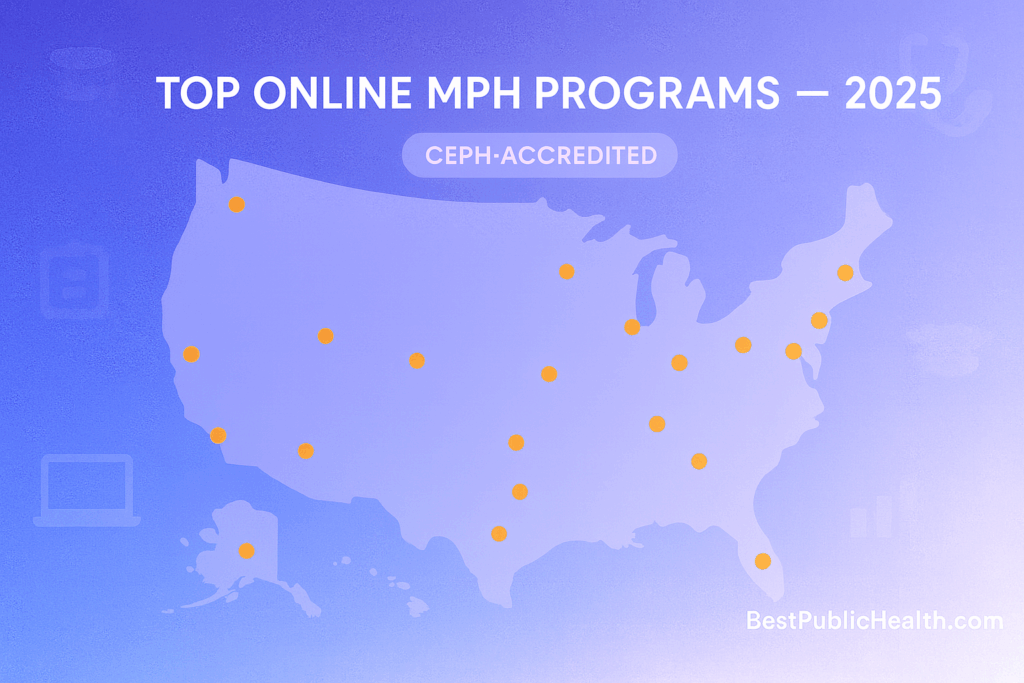
Here’s the short list I’d hand a colleague who can’t relocate but wants a serious, CEPH-accredited online MPH. I’ve kept the blurbs tight and practical—what it feels like to study there, who tends to thrive, and why each program earns a spot. (Schools update prices every year, so double-check current tuition and fees on the program site before you apply.)
1) UNC Gillings – Online MPH (Chapel Hill, NC)
A work-friendly rhythm—live evening sessions, strong faculty access, and teams that actually collaborate instead of posting into a void. Great fit if you want leadership or epi training with nationwide health-department ties.
2) University of Michigan – Population & Health Sciences (Ann Arbor, MI)
Cohort model with a clear arc from methods → applied projects → capstone. The analytics emphasis (and alumni network) pays off if you see yourself in data-driven roles across agencies or large health systems.
3) UC Berkeley – Online Interdisciplinary MPH (Berkeley, CA)
Built for experienced professionals who want pace and rigor without moving. You shape the plan with targeted electives; occasional short on-site touchpoints appear, but the degree is designed to be completed at a distance.
4) George Washington University – MPH@GW (Washington, DC)
Policy people feel at home here. Weekly live classes keep you plugged in, and practitioner instructors bring “this is how it works in government” energy to the room.
5) Boston University – Online MPH (Boston, MA)
Case-based learning drives the program—you’ll dig into real datasets, argue through trade-offs with your team, and leave with concrete portfolio pieces. Solid choice for students eyeing program design or evaluation work.
6) Emory University – Distance-Based/Executive MPH (Atlanta, GA)
Geared toward mid-career professionals. Most learning is online; brief, planned campus sessions (track-dependent) help you build relationships with Rollins faculty and peers. Strong Southeast practice network.
7) University of Florida – UF Online MPH (Gainesville, FL)
Straightforward course maps, reliable advising, and good support for Florida-based practica. A practical pick for public-sector staff who need structure more than sizzle.
8) University of South Florida – USF Online MPH (Tampa, FL)
A wide menu of online tracks—public health practice, epi, policy & management, and more—plus a history of remote placements with county and state partners. Flexibility without chaos.
9) UMass Amherst – Online MPH in Public Health Practice (Amherst, MA)
One of the longest-running online MPHs. Feels very “manager’s toolkit”: budgeting, leadership, quality improvement, and the nuts and bolts you use the day after graduation.
10) UAB – University of Alabama at Birmingham – Online MPH (Birmingham, AL)
Methods-forward training with applied projects, popular among hospital and community-based professionals across the Deep South. Expect clear expectations and steady momentum to the finish line.
Honorable mentions:
- Florida A&M (FAMU) Online MPH – frequently among the most budget-friendly accredited options.
- University of Arizona Online MPH – flexible pacing; strengths in health promotion and applied epi.
- CUNY SPH Online MPH – urban public health lens with value pricing for NY residents.
Choosing the Right Online MPH Program
Consider Your Career Goals
Start with the job you want on your email signature two years from now. Work backward.
- Epidemiology / Data roles → Look for required courses in epi methods, causal inference, R/Python, and a data-heavy capstone.
- Health policy / Management → Prioritize policy analysis, budgeting, implementation science, and a DC/State-capital–connected practicum.
- Global health / Program delivery → Field-friendly methods, monitoring & evaluation, partnerships with NGOs, and flexible practicum sites abroad or with global projects at home.
- Health promotion / Community health → Courses in behavioral science, community-based participatory research, and evaluation; practica with FQHCs, health departments, schools.
- Environmental/Occupational health → Exposure assessment, risk communication, and ties to state environmental agencies.
- Nutrition / Maternal–Child health → Supervised practice options, WIC/health system partners, and pathways to relevant credentials where offered.
Quick exercise: write three bullets—skills I have, skills I need, problems I want to solve. Pick the program whose required courses and practicum partners cover the last two lists.
Faculty and Networking Opportunities Online
Online doesn’t mean anonymous.
- Scan faculty bios for real practice work (health departments, CDC projects, hospital quality teams).
- Ask admissions for current-student or alumni contacts in your region; a 10-minute call tells you more than a brochure.
- Check whether classes use live sessions (with cameras on, breakout rooms) and small cohorts—that’s where relationships form.
- Look for career services that help online students too: resume clinics, mock interviews, employer panels, and alumni Slack/LinkedIn groups.
- For practicum, confirm there’s placement support and approved sites near you (or remote projects that count).
Green flags: faculty answer emails quickly, advisors meet before you enroll, and you can sit in on a sample class.
Red flags: “contact us for details” on basic items like tuition, credit count, or practicum rules.
Technology and Support Services
Your platform should help you learn—not get in the way.
- Learning platform test drive: Is there a mobile app? Calendar sync? Automatic recordings with captions?
- Tooling for methods: access to R/Python/SQL environments, data sets, and tutoring hours in stats/writing.
- 24/7 tech help and clear response times for academic advising.
- Library & research access: full-text journals, interlibrary loan, citation tools, IRB guidance for projects.
- Accessibility & flexibility: captioning, time-zone friendly live sessions, reasonable proctoring, extensions policy.
- Student wellbeing: success coaches, counseling, and accommodation processes that actually work for online learners.
Two-minute checklist:
Credits × cost per credit = real price (add fees) • No residency required? (or dates fit your life) • Practicum near you with advisor help • Live class times you can make • Methods tools you’ll use on the job • At least two alumni willing to talk.
Program Snapshots: what it actually feels like
UNC Gillings — Online MPH
Most weeks run on a steady beat: one evening live class, one team touch-base, and work you can plan around a full-time job. Faculty lean practical—many collaborate with health departments—so you’ll crank out things you’d use at work: briefs, quick dashboards, implementation notes. Advising is responsive, and practicum planning starts early so you’re not hunting for a site at the last minute.
University of Michigan — Population & Health Sciences
You move as a cohort from methods to applied analysis to a capstone that ties it together. Come ready to defend choices with data; instructors expect it. Career staff are hands-on with resume clinics and alum intros, which helps if you’re crossing over from clinical work to population health.
UC Berkeley — Online Interdisciplinary MPH (OOMPH)
Built for people who already shoulder responsibility at work. The pace is brisk, expectations clear, and electives let you shape the degree around the problems you care about. Occasional short on-site touchpoints pop up, but the program is designed to finish at a distance.
George Washington University — MPH@GW
Weekly live classes keep the group tight. Many instructors have done government work, so you get the “here’s how this really moves through an agency” view. If policy analysis or program evaluation is your lane, the projects land close to the bone.
Boston University — Online MPH
Case work, not busy work. You’ll debate trade-offs, analyze real data, and leave each term with portfolio pieces—logic models, evaluation plans, short policy memos. Writing support is easy to book and the feedback is direct.
Emory — Distance-Based / Executive MPH
Skews mid-career: supervisors, clinicians, program leads. Learning is mostly online, with brief planned campus sessions (track-dependent) that help relationships click. Practicum and capstone projects often tie into your employer’s priorities, which makes buy-in easier.
University of Florida — UF Online MPH
Clear course maps and predictable due dates keep stress down. Florida students benefit from agency ties, but out-of-state students report smooth placements when they start early. A straight path to the credential—no drama.
University of South Florida — USF Online MPH
Lots of choice in online tracks. Faculty know county/state workflows, so projects feel familiar if you’re already in public service. Recorded sessions and flexible office hours help when shifts or family duties get loud.
UMass Amherst — Online MPH in Public Health Practice
Very “manager’s toolkit.” Alongside methods you’ll cover leadership, budgeting, QI, and implementation. Assignments look like the docs you hand to executives or funders. Advising nudges you toward a practicum that advances your current role.
UAB — University of Alabama at Birmingham — Online MPH
Methods forward but approachable. Expect applied labs, team deliverables, and instructors with hospital/community partners on speed dial. Strong local network in the Deep South; virtual support is solid for everyone else.
Cost & Time Planner (real-world math you can do today)
Find the true price
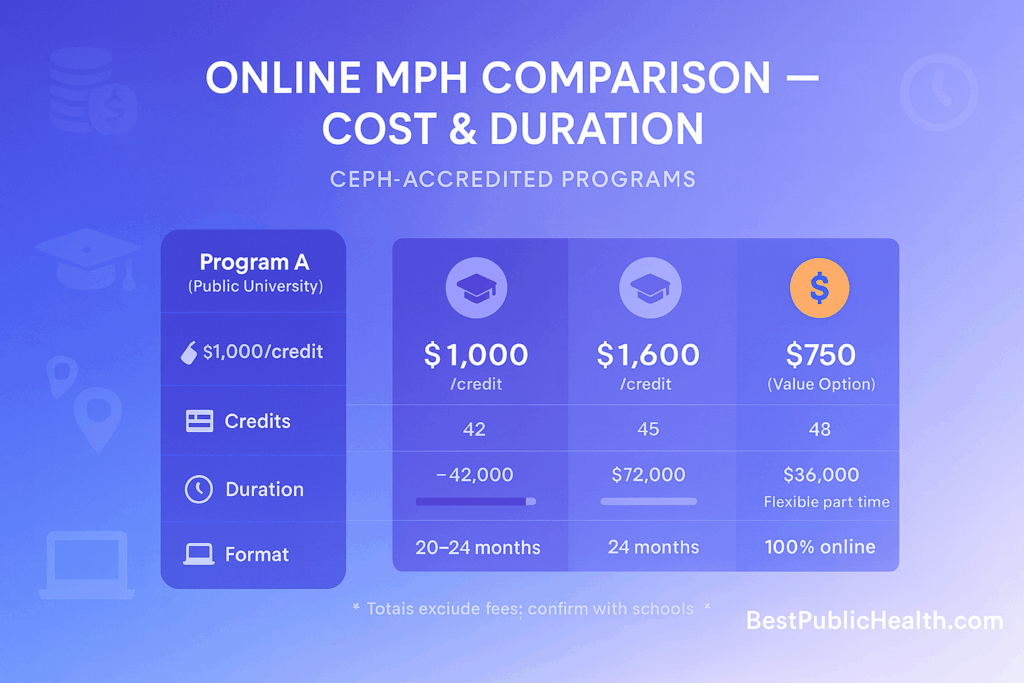
- Required credits × posted cost per credit
- mandatory fees (per term or one-time)
- travel for any required residencies
Adjust for your situation
- Subtract school scholarships or public-sector discounts
- Subtract employer tuition help (ask HR; many hospitals fund a portion)
- Pick a pace:
- Full-time: ~20–24 months
- Part-time: ~30–36 months (usually one course at a time)
Quick examples (hypothetical)
- 42 credits × $1,050 = $44,100 + $1,000 fees = $45,100; minus $4,000 scholarship → $41,100.
- 48 credits × $925 = $44,400; employer pays $2,500/year × 2 = $39,400 out-of-pocket.
Make a one-page grid for your top three programs and fill these numbers. Decisions get clearer fast.
Scholarships & ways to pay
- School awards: merit/need; early applications win.
- Public-sector discounts: some schools cut rates for government/NGO staff.
- Employer benefits: common in health systems—know the cap and any service commitment.
- Federal aid (where eligible): file early; graduate timelines are tight.
- External awards: associations, local foundations, community groups.
- Payment plans: monthly billing that won’t wreck cash flow.
Pro tip: write one strong “master” essay about a local health problem you want to tackle; customize it per application.
No-GRE & waiver notes (2026)
Plenty of accredited online MPH programs are test-optional, and many offer GRE waivers for prior grad study, strong GPAs, or relevant experience. If your transcript is light on quant skills, a score can help only when the program says it will. Always check the current policy on the admissions page.
A week in the life (part-time, working full-time)
- Mon/Tue: skim readings, watch 30–45 minutes of lecture, post a short response.
- Wed night: 60–90 minute live session—discussion, quick polls, case work.
- Thu: team sync (30–60 minutes) to divide project tasks.
- Sat morning: methods lab or writing block (2–3 hours).
- Sun: finish the deliverable; scan last week’s feedback.
Rule of thumb: 10–15 hours per week per 3-credit course. Put those hours on your calendar like shifts.
Practicum: landing a site you’ll actually like
- Start scouting in your first term: county health department, FQHC, hospital community benefit, school district, or a nonprofit coalition.
- Pitch a project that solves a real pain point (clean a dataset, build a simple dashboard, evaluate a campaign, write a brief).
- Meet your site preceptor monthly and leave with a written to-do list.
- Keep a short impact log (date → task → outcome). That becomes resume bullets later.
Conclusion – Getting Started
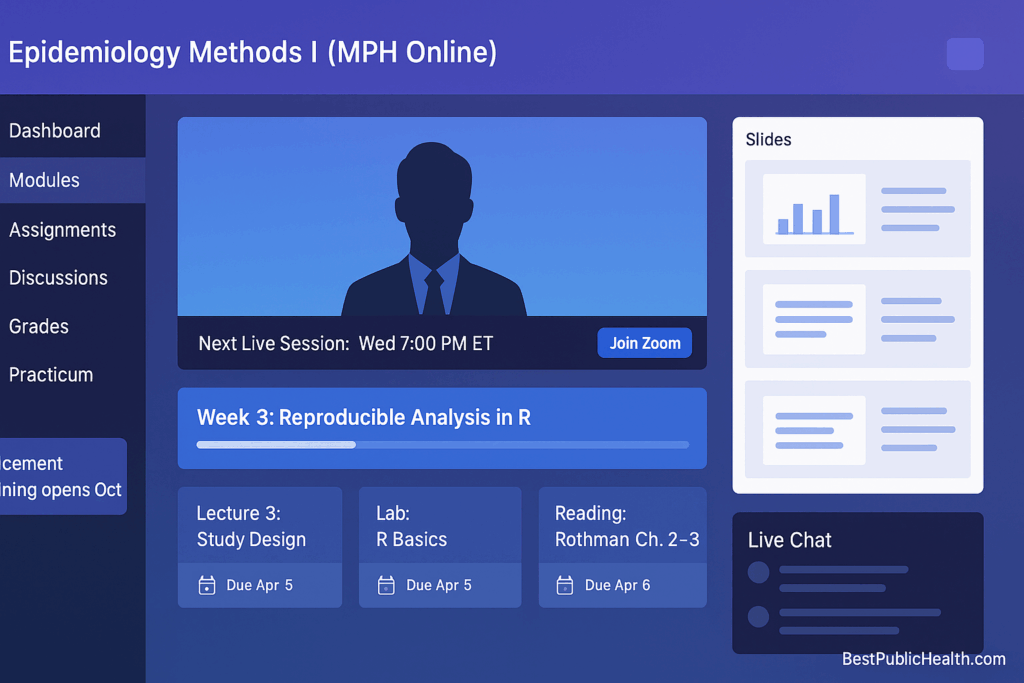
You don’t have to sort your whole future tonight. Pick a couple of solid options, talk to real people, and make a plan you can actually stick to. The right CEPH-accredited online MPH should meet three tests: it fits your week, it teaches the skills you’ll use on Monday morning, and it helps you finish on time.
30 days, one page at a time
- Days 1–7: Build a shortlist of 3–5 programs. Jot down credits, per-credit cost, any fees, live class times, and whether there’s a campus visit.
- Days 8–14: Meet humans. Ask admissions for a sample class and a current-student chat. Ten honest minutes beats ten glossy pages.
- Days 15–21: Price it for you. Multiply credits × cost per credit, add fees, then subtract scholarships, employer tuition help, or payment plans. Decide full-time vs part-time based on your weekly hours.
- Days 22–30: Line up the paperwork—transcripts, resume, two recommenders, and a draft statement that explains the problems you want to work on.
Quick note you can send to a program
Hi [Name],
I work as a [role] in [city] and I’m exploring your online MPH for [term/year], likely the [track]. Could I sit in on a class and speak with a current student about workload, practicum options near [your area], and typical time to finish while working?
Thanks,
[Your Name]
Sanity check before you click “apply”
- Accreditation confirmed on CEPH
- Practicum can be done near you (and you know when placement starts)
- Live session times fit your time zone
- Total cost is clear in writing (credits, fees, and any aid)
Your next step here
- Open our Program Finder to compare accredited online MPH options by track, pace, and price.
- Grab the MPH Admissions Checklist and subscribe for deadline reminders and small, useful tips—no fluff.
You’re closer than it feels. Make one good decision this week, then the next one. That’s how this gets done.
Online MPH Program FAQs
A quick, plain-English guide to the questions almost everyone asks when they start comparing online MPH options.
Do online MPH programs still require the GRE?
Most do not. Many schools went test-optional and stayed that way. A strong transcript, relevant work, and a focused statement usually carry more weight than a score. If your GPA is light or your background is far from public health, a GRE can help—but only if the program says it will.
Can I finish faster than a traditional program?
Sometimes. The standard pace is about 20–24 months full-time. A few structured, year-round tracks can land you closer to 12–18 months, but they’re intense. If you’re working full-time, a part-time plan of 30–36 months tends to be more realistic.
How do practicums work if I’m online?
You complete them where you live. Schools pair you with a practicum advisor, you identify a site (health department, hospital, FQHC, nonprofit), and you agree on a project that meets program competencies. Expect planning to start early—often in your first term—so you’re not scrambling when hours begin.
Will employers respect an online MPH?
Yes—what matters is the training and CEPH accreditation behind it. Hiring managers care that you can analyze data, design programs, evaluate outcomes, and work with communities. The delivery format isn’t the deciding factor; your portfolio and references are.
What will it really cost?
Programs price by the credit. Totals vary widely by school and residency status, but most land somewhere in the mid-five figures before aid. Compare required credits × cost per credit, add mandatory fees, then factor in any scholarships or employer tuition benefits to see your real number.
Are there scholarships or aid for online students?
Yes. Look for school-based awards, tuition discounts for public-sector employees, payment plans, and federal aid where eligible. Don’t forget external options (professional associations, community foundations) and employer tuition assistance.
Do I ever have to visit campus?
Some programs are 100% online. Others schedule a short orientation or an intensive weekend each year. If travel is hard for you, make “no residency required” a filter when you build your shortlist.
Can I keep my job while I study?
That’s the aim. Most students take one or two courses at a time. A good rule of thumb is 10–15 hours per week per 3-credit course. Evening live sessions and recorded lectures make it possible, but you’ll still need a solid calendar and a boss who knows you’re in grad school.
Internal Links
Related MPH Guides
Use these linked guides to compare degree fit, accreditation, and costs before you apply.
