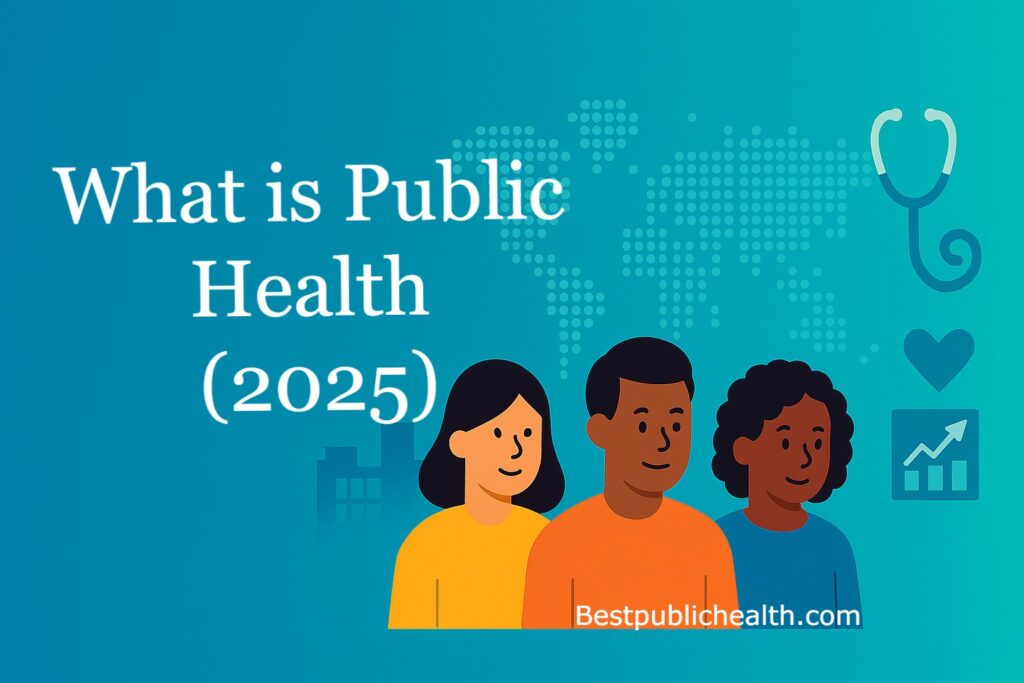
What is public health in 2025? In plain terms, it’s the everyday work of keeping communities healthy amid climate extremes, new infections, mental-health strain, and widening inequities. Public health is the people, systems, and policies that prevent disease, protect populations, and help us live longer, better lives. And if you want to lead that work, the Master of Public Health (MPH) is still the most direct, practice-ready degree.
What makes this moment different is how you can enter the field—and how fast it’s evolving. From data-driven epidemiology and AI-powered surveillance to community partnerships and policy change, today’s MPH programs look nothing like they did a decade ago. You can choose a classic on-campus experience with labs, cohorts, and city-based internships—or a flexible online MPH program that fits a full-time job and family life without slowing your career.
This guide breaks down everything you need to know: what public health really means, how the MPH degree is structured, the best program options (online and on campus), and where the jobs are—today and in the years ahead. If you’re curious about making measurable impact at scale, start here.
Public Health Explained:
Picture this: a heatwave hits a mid-sized city. ER rooms fill up, air quality drops, and older adults struggle. By the time ambulances arrive, it’s already late. Public health tries to prevent that moment—by warning neighborhoods earlier, opening cooling centers, adjusting bus schedules, checking water supply, and getting inhalers to clinics before the rush. That, in plain words, is public health.
If you need a one-liner: public health is how communities prevent disease, protect people, and promote healthier living—using data, policy, and partnerships instead of waiting until someone is already sick.
How is it different from clinical medicine? A clinician treats the person in front of them. Public health asks, “Why are so many people showing up with the same problem—and what can we change so they don’t have to?”
In 2025 the work is broader than it used to be. Yes, there’s outbreak control and vaccination. But there’s also air and water safety, safer streets, food labeling, mental-health promotion, and honest communication in a noisy online world. Teams include epidemiologists and biostatisticians, but also policy folks, community organizers, climate specialists, and data scientists building real-time dashboards.
You’ll see public health every day if you look for it:
- The texting system that nudges parents about childhood vaccines.
- The crash-data map that leads to a new crosswalk near a school.
- The city rule that keeps rental homes mold-free.
- The overdose response plan that trains barbers and bus drivers to use naloxone.
- The heat alert that opens libraries late and sends fans to seniors.
And when people talk about the MPH—the Master of Public Health—they’re talking about the training that prepares you to do this kind of work at scale, whether in a health department, hospital network, NGO, or startup.
Bottom line: public health is the quiet infrastructure of longer, better lives. When it’s working, you may not notice it. But you feel it—in cleaner air, safer neighborhoods, and fewer emergencies.
The MPH, in Real Life (2025)
Think of the Master of Public Health (MPH) as a toolkit for fixing health problems before they become emergencies. It’s a professional degree—practical, hands-on, and designed for people who want to move from “I see the issue” to “Here’s how we solve it.”
Who usually does an MPH?
You might be a nurse or junior doctor who wants population-level impact. Or a statistics/IT/policy grad who enjoys data, systems, and community work. Career switchers show up here too—people who want mission + measurable results.
What you actually learn (minus the jargon)
- Epidemiology & biostats: how to design studies and read data without getting fooled.
- Policy & management: budgets, programs, leadership, and the levers that change systems.
- Behavior & equity: why people do what they do—and how to help them do better, fairly.
- Environment & climate: air, water, heat, disasters, and how to keep communities safe.
- Global & community health: building programs that work in the real world, not just on paper.
You’ll almost always complete a field placement/practicum and a capstone, so you graduate with real projects on your CV—not just coursework.
Quick facts for 2025
- Formats: on-campus, online, or hybrid (same core outcomes, different rhythms).
- Pace: ~12–24 months; some 1-year options exist.
- GRE: often waived, especially for online MPH programs.
- Accreditation: look for CEPH—it signals quality and employer recognition.
Popular tracks you’ll see
Epidemiology, Biostatistics/Data Science, Health Policy, Global Health, Maternal & Child Health, Environmental/Climate Health, Infectious Disease, Nutrition, One Health, Health Informatics.
Online vs on-campus—how to choose
- On-campus: tight cohort, labs, local internships, face-to-face mentoring (think Harvard, Johns Hopkins, UNC, Emory, Brown, USC, UGA).
- Online: built for working adults—same core curriculum, flexible pacing, no commute.
Ask yourself: Do I need the campus network right now, or do I need to keep working while I upskill?
Admissions snapshot (what schools look for)
Bachelor’s degree, transcripts/GPA, statement of purpose, résumé/CV, and 2–3 recommendations. A stats or bio foundation helps, but many programs welcome varied backgrounds—especially if your story shows purpose.
Where graduates land
Epidemiologist, program manager, policy analyst, biostatistician, health educator, public health consultant—in health departments, hospitals, NGOs, multilateral orgs, and health-tech startups.
How to list it: Your Name, MPH. Simple, professional, and instantly recognizable.
MPH Programs in 2025: Online or On-Campus?
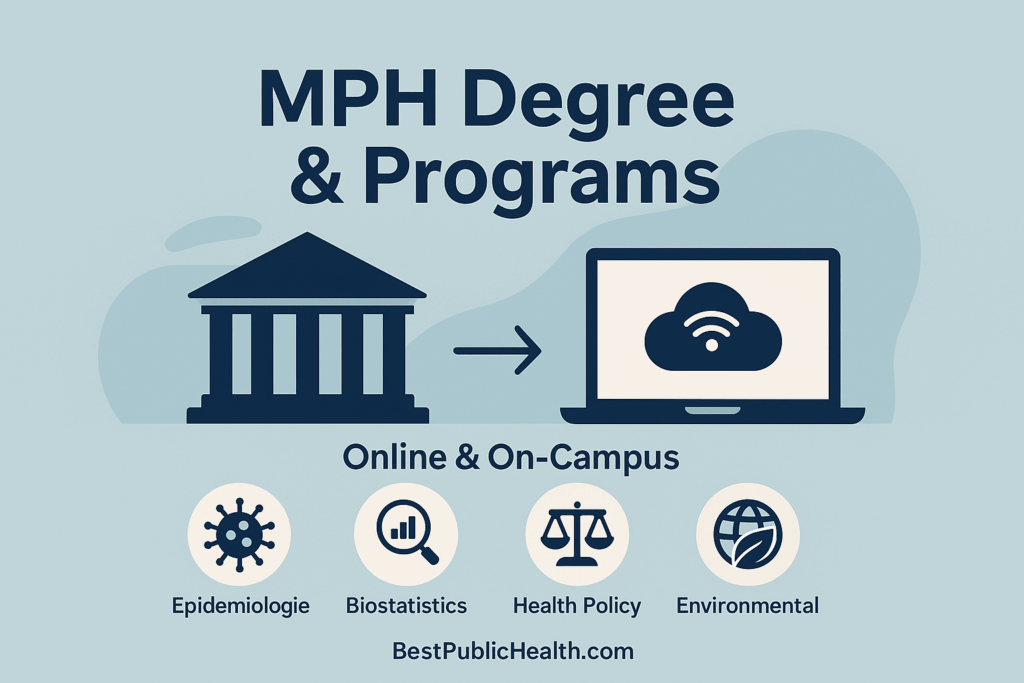
You can earn an MPH two main ways in 2025: on a campus with a cohort, or online while you keep working. The diploma says the same thing; the day-to-day experience is very different.
Program formats
- On-campus MPH: Real classrooms and labs, face-to-face time with faculty, and easy entry into research groups. Most students line up local placements with city health departments, hospital systems, or NGOs and build a tight cohort along the way.
- Online MPH: Live or recorded classes you can take around shifts and family life. The curriculum mirrors the on-campus track, practicum happens where you live, and many schools no longer require the GRE for these options.
Timelines & Pacing
- Standard pace: 18–24 months
- Accelerated: 1-year MPH or one-year online MPH at select schools
- Part-time: 2–4 years with lighter course loads
What Every MPH Program Includes
- Core courses: epidemiology, biostatistics, policy & management, social/behavioral health, environmental/climate health
- A concentration: Epidemiology, Health Policy, Global Health, MCH, Environmental Health, Nutrition, Informatics, One Health, etc.
- Hands-on training: a practicum/field placement plus a capstone or thesis
Admissions Snapshot (2025)
- Bachelor’s degree, transcripts, résumé/CV, statement of purpose, 2–3 recommendations
- GRE often waived, especially for online tracks
- Clinicians and non-clinicians welcome; quantitative prep helps but isn’t always required
- Always check CEPH accreditation (this protects quality and employer recognition)
How to Choose the Right MPH
Ask yourself:
- Schedule: Do I need the flexibility of an online MPH or the immersion of campus?
- Career goal: Which concentration lines up with the jobs I want in 12–24 months?
- Network: Do I want a local network (on-campus) or a national/global one (online cohorts)?
- Support: Career services, practicum placement help, alumni mentoring, writing/stat labs
- Value: Tuition, scholarships/assistantships, paid practicums, employer tuition benefits
Quick Comparison Checklist
- ✅ CEPH-accredited
- ✅ Practicum built into the calendar (not squeezed in)
- ✅ Strong placement partners (health departments, NGOs, hospitals, health-tech)
- ✅ Clear data skills training (R/Python/SPSS, dashboards)
- ✅ Faculty active in the area you care about (policy, epi, climate, MCH, etc.)
- ✅ Options for 1-year or no-GRE if speed or testing is a barrier
Bottom line: In 2025, “best” doesn’t mean one school for everyone. It means the best fit—a program (online or on-campus) that matches your life, your timeline, and the public health problems you most want to solve.
Top MPH Programs (Real-World Notes, 2025)
These aren’t brochure blurbs—just quick takes you’d share with a friend. Always double-check current details and CEPH status on each site.
- Johns Hopkins MPH: Big catalog, quick pace, and tons of epi/global options. Feels built for self-starters who like data and want DC/NGO connections. Online paths exist and are busy but well supported.
- Harvard MPH: Strong on policy and leadership. You can cross-register around campus (business, policy, education), which is a real perk if you want systems-level roles. Network matters here; so do scholarships.
- UNC Gillings (UNC MPH): Very applied. Great MCH and nutrition, with community projects across North Carolina. Tight culture; good fit if you want hands-on work while you study.
- Emory Rollins (Emory MPH): CDC is next door, and it shows—excellent infectious disease and surveillance opportunities. Atlanta offers plenty of practicum sites.
- USC MPH: West-coast health systems, communications, and health-tech energy. Useful if you plan to stay in LA or want media/innovation angles. Online track is common for working pros.
- Brown University MPH: Smaller, close-mentored feel with rigorous methods and a clear health-equity thread. Good for students who want depth over size.
- University of Georgia (UGA MPH): Solid value and statewide placements. Community-based projects are the norm; Athens has a collaborative vibe.
Online MPH—what to ask before you apply
- Same professors and curriculum as the on-campus track?
- Live classes, recorded, or both—and at what times?
- Practicum support where you live, not just near campus?
- Real access to career services and alumni as an online student?
- Will you learn R/Python/SPSS and basic dashboarding—not just theory?
Bottom line: Pick the program that matches your concentration, schedule, budget, and where you want to work after graduation—not just the biggest logo.
What Can You Do With an MPH? (Real Jobs, Real Teams)
Picture three first weeks on the job:
- Day 4, City Health Dept: You’re pairing 911 heat calls with satellite temperature maps to flag the next neighborhood at risk. Your badge says Epidemiology Analyst.
- Day 9, State Capitol: A committee needs a two-page brief by 3 p.m. on how a naloxone program would save money and lives. You’re the Policy Analyst who speaks numbers and plain English.
- Day 12, NGO Field Office: A clinic’s vaccine fridge failed overnight. You sketch a simple checklist, train the staff, and prevent the next loss. Title: Program Officer (M&E).
That’s public health work—less theory, more puzzles.
Where MPH grads actually land
Health departments (city/state), ministries of health, hospital systems, universities, NGOs and multilaterals, community orgs, consulting, insurers, and a fast-growing slice of health-tech. If a place touches people, policy, or data, it hires MPH talent.
A few common lanes (with plain-English snapshots)
- Epidemiology & Surveillance: Build clean datasets, spot trends early, brief leaders before a small spike becomes tomorrow’s headline.
- Policy & Management: Budgets, contracts, and program design—the levers that make systems work for real people.
- Community/Global Programs: Plan an intervention, train partners, track results, fix what’s not working.
- Environmental & Climate Health: Air, water, heat, workplaces—keep them safe; prepare for disasters.
- Biostats/Data/ Informatics: Turn messy spreadsheets into decisions; R/Python/SPSS plus a simple dashboard.
- Health Communication & Behavior: Clear, honest messaging; campaigns that actually change what people do.
- MCH & School Health: From prenatal care to teen mental health—lots of coordination, lots of impact.
Skills that move your résumé to the top of the pile
- Data fluency: R or Python (one is fine), basic SQL, and a dashboard tool (Tableau/Power BI).
- Evaluation basics: logic model → indicators → survey/interview → short, readable report.
- Writing for decision-makers: one-pagers, slide decks, and emails that get to the point.
- Policy literacy: know how a regulation/bill moves and what it costs.
- People work: stakeholder mapping, facilitation, and community trust.
- Nice extras: grant writing, GIS, or a second language.
A simple break-in plan (90 days)
- Pick one lane + one tool (e.g., epi + R; policy + budgeting; MCH + evaluation).
- Use your practicum to ship something tangible—a dashboard, protocol, or policy memo—and keep a copy/screenshot.
- Post a one-page portfolio and tailor your CV bullets to the verbs in each job ad.
- Apply where you meet ~70% of requirements; ask two supervisors to be references for outcomes, not just attendance.
If you’re a clinician adding an MPH
You’ll be competitive for infection prevention, quality & safety, population health, clinical research, and policy fellowships—roles that blend bedside sense with systems change.
Bottom line: “MPH jobs” aren’t a single track. They’re a toolbox. Pick a problem you care about, learn the tool that moves it, and show proof you can deliver.
Admissions & Picking the Right MPH (2025 Guide)
You don’t need a secret handshake to get into a Master of Public Health—you need a clear story, the right shortlist, and a tidy application. Here’s a straight-talk playbook.
The 5-signal sniff test for any program
- CEPH accreditation — non-negotiable. No CEPH, no thanks.
- Format fit — do you need an online MPH degree or the energy of a campus cohort?
- Concentration match — epi, policy, MCH, environmental/climate, informatics—pick the lane you’ll actually use.
- Practicum power — will they help you land a placement where you live (for mph online programs) or with solid local partners (on campus)?
- Career help — real advisors, alumni intros, résumé labs, and employer pipelines.
What admissions teams look for (beyond GPA)
- Purpose: a tight “why public health, why now” arc.
- Proof of doing: a project, internship, clinic role, research poster, community work—anything with outcomes.
- Basic quant comfort: one stats course or data experience helps; it’s fine to be learning.
- Communication: can you write clearly and work with people who aren’t you?
Common requirements (2025)
- Transcripts + bachelor’s degree
- CV or résumé (1–2 pages)
- Statement of purpose (800–1,000 words)
- 2–3 recommendations (one supervisor if possible)
- English proficiency for international applicants
- GRE: often waived, especially for online MPH no GRE tracks
- Optional: portfolio links or writing sample
One-year, online, and hybrid options
- One-year MPH programs exist at a few schools—great if you can study full-time and want speed.
- Online MPH degree tracks mirror campus curricula with live or recorded classes; practicum happens in your city.
- Hybrid = weekend intensives or short on-campus blocks plus online coursework.
A simple SOP outline that reads like a human
- The moment: one scene that shows the problem you care about (not your entire life).
- What you’ve done: 2–3 concrete bullets—“built a heat-risk map,” “ran a vaccine reminder pilot,” “analyzed injury data.”
- Why this MPH + this concentration: name the courses/labs that matter to your goal.
- After graduation: 1–2 roles you’re aiming for and the population you want to serve.
Funding without the headache
- Ask about scholarships, assistantships, employer tuition, and paid practicums.
- Apply early—aid is first-come at many schools.
- For online students, confirm you get the same scholarship pool and career services.
Application timeline (quick version)
- 6–8 months out: shortlist 5–7 programs; email advisors with two smart questions.
- 4–5 months: draft SOP, update CV, request letters.
- 2–3 months: submit; line up FAFSA/aid forms; prep for interviews.
- After admits: compare aid, practicum networks, and course maps—not just brand names.
Easy mistakes to avoid
- Generic SOPs with no concrete outcomes.
- Ignoring CEPH.
- Picking a logo over a concentration you’ll actually use.
- No plan for stats/data—take a refresher now if you’re rusty.
Bottom line: The “best” masters in public health is the one that fits your life, teaches the tools you’ll use on day one, and opens doors in the city or sector you want. Choose for fit and outcomes, not hype.
The Future of Public Health (Beyond 2025)
If the last few years were about reacting fast, the next few are about building systems that don’t break. Here’s what’s coming—and why it matters for anyone eyeing an MPH future.
1) Data that actually helps, not just “more data.”
Wastewater monitoring, syndromic feeds, EHRs, and satellite heat maps will be stitched into simple dashboards a local team can act on by Monday morning. Expect more privacy-by-design rules and plain-English reporting so communities understand what’s being tracked and why.
2) AI that’s useful, audited, and accountable.
LLM copilots will draft risk messages, summarize outbreaks, and speed grant writing; ML will flag early signals. The bar will be human-in-the-loop, versioned prompts, and bias checks. MPH grads who can explain a model to a mayor will lead.
3) Climate + health as core business, not a side project.
Heat waves, wildfire smoke, floods, vector shifts—this is the new calendar. Cities will budget for cooling plans, clean-air shelters, resilient clinics, and climate-aware housing codes. Environmental/climate health will be one of the fastest-growing MPH careers.
4) One Health goes mainstream.
Human, animal, and environmental surveillance will share more pipes. AMR (antimicrobial resistance) and food systems will drive cross-agency work.
5) Trust, communication, and behavior science scale up.
The fight isn’t only viruses; it’s mis/disinformation. Behavioral design, community partnerships, and credible messengers (schools, faith leaders, barbers, bus drivers) will be baked into every plan.
6) Education that mirrors the job.
MPH programs 2025+ are moving toward stackable certificates, applied studios, short data bootcamps (R/Python/GIS), and paid practicums. Expect more hybrid formats, micro-credentials, and assessment by deliverables, not just exams.
7) Health tech meets public service.
More roles at the edge of government, providers, and startups—product managers in health departments, public-interest technologists, and interoperability specialists who speak both policy and APIs.
Bottom line: The MPH future belongs to people who can blend data + community + policy, and show their work in plain language.
Conclusion: Where to Start
Public health in 2025 is practical work with real stakes. If you want in, pick a problem you care about, learn one tool that moves it (epi + R, policy + budgeting, MCH + evaluation, climate + GIS), and ship one deliverable people can use.
- Choose an MPH program (online or on-campus) that is CEPH-accredited, fits your schedule, and offers strong practicum support.
- Build a small portfolio during your coursework: a dashboard, an evaluation brief, a policy memo, a risk-communication guide.
- Aim for roles where you meet ~70% of requirements and tailor your CV to the job’s verbs.
Ready to compare options? Use your Programs Search on BestPublicHealth to filter online vs on-campus, concentration, and timeline—then start shortlisting.
Explore More Public Health Resources
On BestPublicHealth
FAQs: Quick Answers
Master of Public Health—a professional degree focused on preventing disease, protecting populations, and improving systems.
Yes—if you target in-demand lanes (epi/data, policy/management, climate/environment, MCH, informatics) and graduate with usable deliverables.
MPH = population health, prevention, policy, programs. MHA = hospital/health-system administration, operations, finance. They overlap; pick based on your day-to-day interests.
Many programs—especially online MPH tracks—waive the GRE. Check each school’s page.
Absolutely. Policy, data, communications, environment, and program roles are filled by people from social science, stats, econ, IT, and more.
Yes—think infection prevention, quality & safety, population health, policy fellowships, and leadership roles that blend bedside sense with systems change.
Typically 18–24 months. Some schools offer one-year (accelerated) options; part-time online can be 2–4 years.
They care about CEPH accreditation, your skills, and your work samples. Make sure the online track matches campus in faculty, curriculum, and practicum support.
CEPH is the accreditor for public health programs in the U.S. It signals quality and is preferred by many employers and fellowships.
Depends on your market, but Epidemiology/Data, Policy/Management, Environmental/Climate, Informatics, and MCH are consistently strong.
No. Take a short stats or R/Python bootcamp before or alongside your MPH. Employers want comfort with data, not perfection.
Yes—online MPH programs are built for it. Just plan practicum hours early and coordinate with your employer.
Pick a lane + tool, secure a practicum that ships a real product, keep a one-page portfolio, and network with purpose (faculty + supervisors).
Many roles stayed hybrid/remote post-pandemic, especially data, evaluation, and policy. Fieldwork and some community roles remain in person.