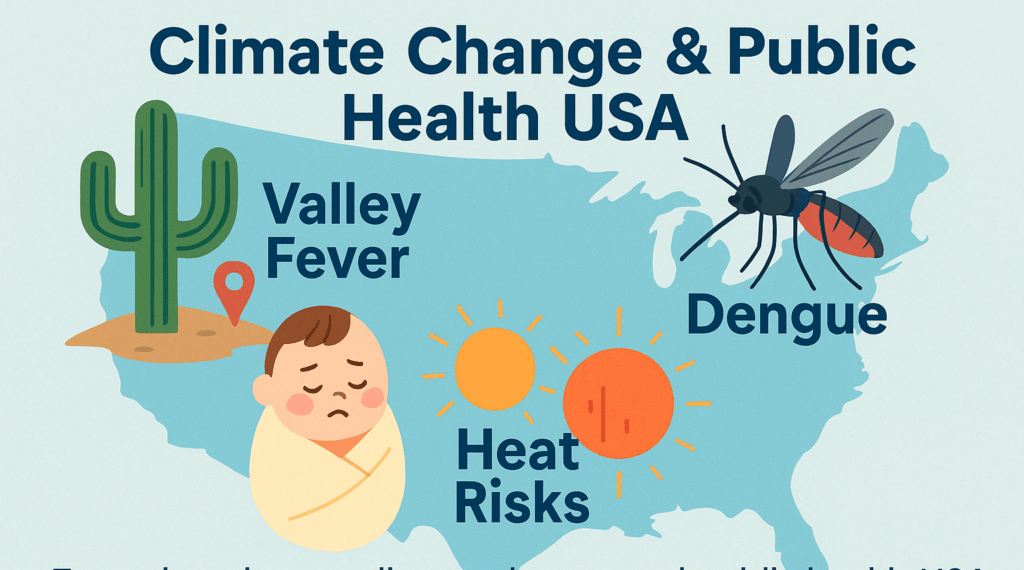
Not long ago, Valley Fever was something you’d only hear about in parts of California or Arizona. Dengue? That was for tropical regions overseas. And heat-related illness in babies? Almost never made headlines. But now, all three are turning into serious public health concerns here in the U.S.
As the climate warms,we’re seeing clear signs that climate change and public health in the USA are increasingly intertwined, disease patterns are changing. Infections are showing up in new places, and vulnerable groups—like infants—are facing risks that didn’t exist a decade ago. This isn’t a distant possibility. It’s already happening, and many local health departments are starting to feel the pressure.
In this article, we’ll take a closer look at three health problems made worse by climate change—how they’ve emerged, where they’re spreading, and what can be done to manage them before they grow even more serious.
🌵 1. Valley Fever Is No Longer Just a Desert Problem
If you live in California or Arizona, you might’ve heard of Valley Fever—a strange-sounding illness that starts off like the flu but can linger for weeks, even months. What many people don’t realize is that it’s caused by a fungus that lives in the soil. And thanks to climate change, this infection is spreading faster and farther than ever before.
In just the past year, California reported over 12,000 cases, and one coastal county—Monterey—saw a shocking 260% increase compared to its recent yearly average. That’s not a typo. A disease once mostly tied to hot inland deserts is now showing up closer to the coast.
🤔 What Exactly Is Valley Fever?
Valley Fever, or coccidioidomycosis, happens when someone breathes in spores of a fungus called Coccidioides. It usually lives in dry, dusty soil—especially in the American Southwest. When the wind kicks up, the spores can go airborne, and all it takes is one breath.
Most people who get infected feel like they have a bad cold or the flu. Symptoms include:
- Fever
- Fatigue
- Chest pain
- Dry cough
- Body aches
In some cases, especially in older adults or people with weakened immune systems, the infection can spread to other parts of the body—including the brain or spinal cord. This is rare, but it can be life-threatening.
🔥 Why Is Valley Fever Getting Worse?
It comes down to a weather pattern scientists now call the “grow and blow” cycle:
- Dry, hot conditions help the fungus grow deeper in the soil.
- Heavy rains trigger a burst of fungal growth near the surface.
- Droughts and wind dry the soil again, sending spores flying through the air.
This cycle used to happen mostly in the southern Central Valley and deserts like Arizona, but now it’s affecting areas further north and closer to the ocean. Thanks to longer, hotter summers and unpredictable rain patterns, the fungus has more time and space to thrive—and it’s finding new places to call home.
🏥 Why Should You Care?
One of the biggest challenges with Valley Fever is that it’s often misdiagnosed. Doctors might think it’s the flu, pneumonia, or even COVID-19. By the time a correct diagnosis is made, the patient could already be weeks into feeling miserable.
Here’s why this matters:
- More people are getting sick. Valley Fever used to be considered rare. Now, it’s becoming a serious regional issue with thousands of new cases every year.
- There’s no vaccine. The only treatment is antifungal medication, which can take months to work.
- It affects vulnerable groups. Pregnant women, the elderly, people with asthma, and those who work outdoors (like farmworkers) are especially at risk.
In California, the spike in cases has gotten so serious that state lawmakers have proposed a new screening bill. If passed, it would require doctors in high-risk counties to test patients with respiratory symptoms for Valley Fever by default. The goal? Catch it early—before it spreads or becomes chronic.
🌎 A Bigger Climate Warning
Valley Fever might sound like a local issue, but it’s actually a canary in the coal mine. What we’re seeing is a disease that once thrived in a very specific environment adapting to new conditions—and spreading because of them. It’s a direct example of how climate change is making old diseases new again, and putting unexpected pressure on our public health system.
🦟 Dengue Is Quietly Spreading — And Not Just Abroad
A few years ago, dengue fever barely showed up on the radar for most Americans. It was a problem in faraway places—something you’d hear about in the context of tropical vacations or overseas outbreaks.
But now, it’s popping up in places closer to home.
In Puerto Rico, a spike in cases led to a public health emergency in 2024. In Florida, people who haven’t left the state are getting infected. These aren’t isolated cases from returning travelers—they point to something more serious: mosquitoes in U.S. neighborhoods spreading dengue locally.
🧬 The Basics: What Is Dengue?
Dengue is a virus passed through mosquito bites, mostly by Aedes aegypti. These aren’t your average backyard mosquitoes—they bite during the day, lay eggs in tiny puddles of water, and love warm, humid weather.
When someone gets dengue, it often starts with a fever that hits fast and hard. After that, the symptoms vary, but often include:
- Pain behind the eyes
- Joint and muscle pain (people call it “breakbone fever” for a reason)
- Headaches
- Nausea
- Sometimes, a red blotchy rash a few days in
Most people recover at home, but in some cases—especially if it’s the person’s second infection—dengue can turn severe, causing internal bleeding or damage to major organs.
🧭 Why the U.S. Is Seeing More of It
The short answer? Mosquitoes are moving north.
Longer, hotter summers and increased rainfall are creating a perfect setup for mosquitoes to thrive in places that used to be too cold or dry. And once they move in, it doesn’t take much for dengue to follow.
Florida, Texas, parts of Arizona, even stretches of California—all have seen growth in mosquito activity. Meanwhile, travel and rapid urban expansion give the virus plenty of ways to spread.
🚨 The Problem With Ignoring It
Dengue doesn’t always make headlines, but that doesn’t mean it’s harmless. In many cases, it’s mistaken for the flu, and people don’t even know they’ve had it.
The real danger? It becomes locally entrenched. If mosquitoes in a city are infected and people don’t know what to watch for, small outbreaks can grow silently.
This makes early detection and mosquito control absolutely critical—especially in areas where the disease hasn’t been common before.
🛡️ What You Can Actually Do
At home, it’s all about breaking the mosquito life cycle:
- Empty containers with standing water—even tiny ones
- Use window screens and daytime repellent
- Check gutters, flower pots, and anything else that holds rain
In your neighborhood, the focus should be on:
- Advocating for local mosquito monitoring
- Public awareness campaigns (especially before summer hits)
- Support for cleanup programs and spraying (when needed)
💉 A Note on the Vaccine
There is a vaccine—but it’s not for everyone. The U.S. has approved Dengvaxia, but only for:
- Kids aged 9–16
- Living in dengue-prone areas (like Puerto Rico)
- Who’ve already had dengue once
That means most people don’t qualify, and the best protection is still prevention.
🔚 What It Really Means
Dengue isn’t coming—it’s already here. It’s just not loud about it yet.
What used to be a “foreign” virus is becoming a quiet visitor in U.S. cities. If local governments, clinics, and residents don’t take it seriously now, we’ll be seeing more outbreaks—and faster than we expect.
3. Babies and Extreme Heat — An Overlooked Danger
When heatwaves hit, most public health alerts talk about seniors or people with chronic illness. But there’s another group at serious risk — and hardly anyone talks about them: newborns.
As climate patterns shift and heatwaves last longer, doctors are seeing something they don’t always expect — babies being affected by high temperatures in ways that are subtle but dangerous. And with record heat hitting parts of the U.S. again this summer, it’s a growing concern.
🍼 Why Babies Struggle More With Heat
The thing about newborns is they don’t have the tools we do to regulate body temperature. They don’t sweat much, they lose water faster, and their small bodies heat up more quickly than ours. They also can’t tell you when they’re overheating — they just get quieter, or more irritable, or stop feeding as well.
Some of the biggest risks include:
- Dehydration, especially during breastfeeding
- Overheating during sleep, particularly in warm or unventilated rooms
- Early delivery, if the mother was exposed to heat stress late in pregnancy
- In the worst cases, heat exhaustion or heatstroke, which can be life-threatening
In areas where families don’t have air conditioning or easy access to cooling centers, the danger only gets worse.
📊 What We’re Seeing in 2025
This isn’t just theory. In the last two years, studies across dozens of U.S. cities have shown a link between multi-day heatwaves and preterm births, especially in the third trimester. Pediatricians in states like Arizona, Texas, and Florida have raised concerns this summer as infants come in with signs of overheating and dehydration.
And it’s not just the daytime highs — hot nights are especially hard on babies. When the body doesn’t get a chance to cool down at night, it can lead to poor sleep, rapid water loss, and sometimes, serious complications before caregivers even notice something is wrong.
🏘️ Who’s Most at Risk?
The truth is, any newborn can be affected by heat. But some are at much higher risk, especially if:
- They were born during a heatwave
- Their family lives in an urban “heat island” (dense, concrete-heavy neighborhoods with little shade)
- There’s no reliable air conditioning in the home
- They belong to communities already facing healthcare or housing challenges, especially Black, Hispanic, or low-income families
Climate change is widening these gaps. And when it comes to babies, even small disadvantages — like a warm, unventilated room — can become serious threats.
🛠️ What Parents and Cities Can Do
For Parents and Caregivers:
- Keep the baby’s sleep area cool — use a fan, light bedding, and block sunlight during the day
- Offer milk (breast or bottle) more often during heat spells
- Watch for signs like poor feeding, extra sleepiness, or flushed skin — they can mean the baby is overheating
- When possible, visit cooler spaces like libraries, malls, or clinics during the hottest part of the day
For Cities and Health Systems:
- Include infant care and maternal health in heat emergency planning
- Make cooling centers safe and welcoming for families with babies
- Work with OB-GYNs and pediatricians to share heat safety messages
- Invest in long-term solutions, like tree coverage, shaded housing programs, and accessible public health info in multiple languages
🔍 A Public Health Problem That’s Easy to Miss
The reason this doesn’t get more attention? Babies can’t tell you they’re struggling. They don’t show clear signs until things are already serious. That’s why it matters now — not just after the heatwave, but before it happens.
With more states reporting record highs in 2025, this isn’t just a medical issue — it’s a public health priority. Keeping infants safe during heat isn’t about fancy tech or expensive treatment. It’s about simple awareness, cool air, and community support.
✅ Conclusion: Health Is Already Feeling the Heat
You don’t need a forecast to know things are changing. Just look around.
Diseases like Valley Fever are showing up far outside their usual zones. Dengue is no longer limited to faraway places — people in Florida are catching it without leaving their neighborhood. And extreme heat isn’t just about sweat and sunburn anymore. It’s quietly becoming a risk to newborns, especially those born during the hottest months.
This isn’t something we’ll worry about someday. It’s already here. And it’s showing up in ways most people didn’t expect.
But here’s the thing: we’re not stuck.
Local health departments, city planners, and even neighbors can step up. Shade makes a difference. So does communication. So does just paying attention. Sometimes, the fix isn’t high-tech — it’s knowing when to check in, when to open a cooling center, when to let people know what symptoms to watch for.
The more we treat climate change as a health issue, the better we’ll be at protecting the people who don’t have the luxury of waiting.
Because at the end of the day, public health has always been about one thing: responding to what’s happening — and doing something about it.
